AI Is Not Going Anywhere
How educators can help students thrive in an AI-driven world while preserving the human skills that matter most.

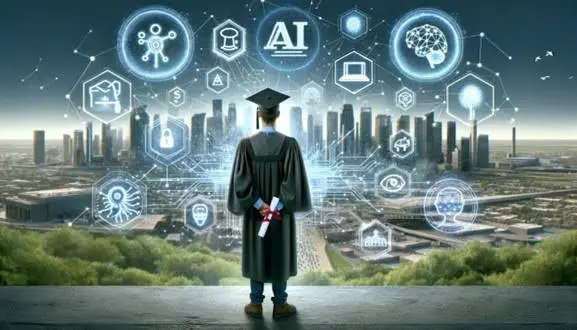
AI, Education, and the Future of Human Potential
By: Cyndy Valenti
My name is Cyndy Valenti, and I am a high school English teacher at a top magnet school in Philadelphia, as well as a curriculum designer, mentor, and coach. I work primarily with upperclassmen, including seniors who are preparing to enter college, careers, and a world where AI is already reshaping expectations.
My Experience with AI Has Been Complicated
My experience with AI has been complicated because I see its impact from multiple angles every day. In education, AI is not just a tool that is "changing jobs" in some abstract way. It is changing how students think, write, learn, avoid learning, build confidence, and, in some cases, lose confidence.
At its best, AI can act as a thought partner. It can help students brainstorm, clarify ideas, revise their writing, ask stronger questions, and feel less intimidated when they do not know where to begin. For some students, it provides access to language, structure, and support they might not otherwise have, allowing them to participate in academic conversations they may have previously avoided.
At the same time, I also see the other side. AI can become a shortcut that allows students to bypass the thinking, drafting, revising, and productive struggle that real learning requires. As an Advanced English IV teacher, I find that deeply personal because so much of my work involves helping students develop their own voices.
When AI writes for them, the issue is not simply "cheating." It is that students can begin to believe their own words are not good enough, fast enough, polished enough, or valuable enough. That worries me.
As a Woman in Education
As a woman in education, I also feel the pressure to adapt quickly. Teachers are already expected to evolve constantly, solve new problems, support students emotionally, meet academic standards, integrate technology, and prepare students for the future. AI has added another layer.
We are expected to understand it, regulate it, detect it, teach around it, teach with it, and somehow keep the human heart of learning intact. That is a lot to carry, especially in a profession where so much labor is already invisible.
I have felt the creative impact personally as well. As someone who designs interdisciplinary curricula and writing-based projects, I think often about originality, voice, and intellectual ownership. AI can generate lesson ideas, essay prompts, rubrics, and writing samples instantly, but it can also diminish appreciation for the lived experience and professional judgment that strong educators bring to curriculum design.
A good lesson is not just a product. It is built on knowing students, reading the room, understanding context, responding to emotion, and creating something that genuinely connects. AI can assist with that, but it cannot replace it.
AI Is Not Going Anywhere
The reality, however, is that AI is not going anywhere. Because of that, I do not believe the answer is to ignore it, ban it without discussion, or pretend that students will not use it once they leave our classrooms.
Education has to evolve.
Just as computer literacy became essential, AI literacy now needs to become part of how we prepare students for success.
My seniors need to graduate knowing how to use AI ethically, critically, and confidently. They need to know how to:
- Ask strong questions
- Evaluate AI-generated responses
- Fact-check information
- Recognize bias and misinformation
- Protect their own voice
- Understand when human judgment matters more than speed
Early-Career Hiring and Leadership Development
This also connects directly to early-career hiring and leadership development. If AI automates many of the entry-level tasks that once helped young professionals learn the basics, organizations will need to be much more intentional about how they develop future managers and leaders.
Entry-level work has traditionally been where people learned to solve problems, communicate professionally, make mistakes, receive feedback, manage deadlines, and understand how an organization functions. If AI removes or reshapes some of that work, companies will need to create new pathways for growth through mentorship, apprenticeships, project-based learning, and opportunities for emerging employees to develop judgment—not just efficiency.
The Future Belongs to Students and Workers Who Can Think Critically
From an educator's perspective, I believe the future belongs to students and workers who can use AI responsibly, creatively, and critically. Those are the skills that will separate people who merely use AI from those who can lead in an AI-supported workplace.
For HR leaders, I believe the important questions are:
- Are hiring expectations changing?
- Are companies beginning to view AI literacy as a core competency?
- How will employers ensure that young professionals still gain the experience needed to become future leaders if the traditional entry-level learning curve continues to evolve?
Not Simply Fear or Excitement
My experience with AI is not simply fear or excitement. It is both.
I see opportunity, but I also see loss.
I see students gaining access, but I also see students risking dependence.
I see teachers gaining tools, but I also see another expectation being placed on already overloaded shoulders.
As a teacher of seniors, my goal is not to prepare students for the world as it used to be. My job is to help prepare them for the world they are actually entering.
That means teaching writing, communication, critical thinking, digital responsibility, and AI literacy as interconnected skills.
Students need a foundation for using technology ethically and effectively while continuing to develop the human capabilities AI cannot replace: judgment, empathy, creativity, collaboration, confidence, and leadership.