The Invisible Ceiling: Why Brilliant Women in Tech Keep Stopping Just Short of the Leadership Table
Why brilliant women in tech stop climbing and start leading instead.

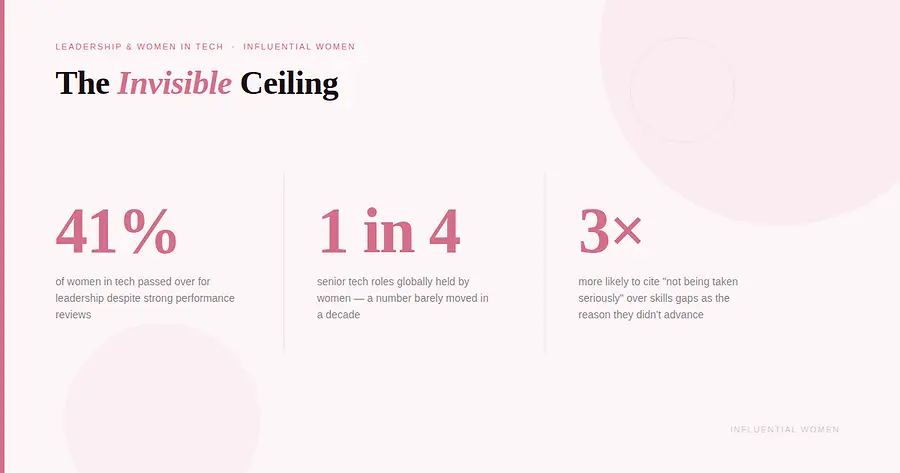
The Invisible Ceiling Women in Tech Still Face
Let me start with a scene you might recognize.
You’ve just walked out of a meeting where you did everything right. You read the room. You navigated the tension between two teams. You translated engineering complexity into a business case and walked everyone through it calmly, precisely, and with conviction. You left feeling something close to proud.
And then, two days later, you find out the follow-up strategy session — the one where direction actually gets set — happened in a room you weren’t in. Nobody excluded you deliberately. Nobody sat down and decided you weren’t ready. The system just… moved without you. Again.
This is the invisible ceiling.
Not a glass ceiling you can see and point to, but a quiet one made of assumptions, conditioning, and conversations that were never held. And the reason so many brilliant women in tech keep hitting it is not because they aren’t good enough. It’s because being good at your job and being seen as a leader are two completely different games, and most of us were only ever taught to play one of them.
The Performance Trap — And Why Working Harder Won’t Save You
Here’s the story many of us were handed early on: work hard, be excellent, and earn your place.
It’s a story that works up to a point. It gets you in the door. It gets you to senior-level roles. It might even get you to director, if you’re exceptional and fortunate.
But somewhere around the middle of most women’s careers in tech, the ladder runs out. Not because the rungs disappear, but because the next rung is not reached by climbing harder. It requires something entirely different: visibility, narrative ownership, and the willingness to lead out loud before anyone has officially handed you the title.
I spent years believing I simply hadn’t proven myself enough yet. I would take on more scope, deliver more impact, and solve harder problems. And every time I looked up, I could see brilliant women around me doing exactly the same thing: heads down, working twice as hard, and being seen half as much.
We were all playing a game of infinite proof that had no winning condition.
The shift came when I stopped asking, “What do I need to do to deserve this?” and started asking, “What would I do if I already did?”
“Working harder is not the same as leading louder. The women who rise are not only the ones who do more, but the ones who claim what they do.”
The Gap Nobody Names: Technical Excellence vs. Strategic Authority
There is a particular kind of woman who thrives in product and engineering environments.
She’s fluent in both worlds. She can hold a deep technical conversation in the morning and a board-level strategy discussion in the afternoon. She’s the connective tissue of her organization — the person everyone turns to when something is broken, ambiguous, or needs translating across teams.
She is also, statistically, among the least likely to be sitting at the leadership table.
Why?
Because being the bridge is not the same as owning the direction.
Women at the product-engineering intersection are often so good at serving other people’s strategies that they never get asked — and never learn to insist — on setting one of their own. The very skills that make them invaluable as connectors can also make them invisible as leaders.
Leadership in tech is still largely coded as a certain kind of loudness: the person who speaks first, presents the vision, and claims the framework before anyone else has articulated it.
Women are taught through a thousand subtle signals that this kind of loudness is not for them. That confidence without invitation reads as arrogance. That certainty without consensus reads as difficult.
So we wait.
We refine.
We make sure we’re right before we speak.
And in that careful, competent silence, someone else takes the room.
What This Looks Like in Practice
- You write the strategy deck. Someone else presents it.
- You solve the technical problem. Someone else gets asked to lead the workstream.
- You broker the relationship. Someone else gets credited with the partnership.
You’ve been here.
We’ve all been here.
The Loneliness Nobody Admits
Speaking from personal experience, it is profoundly lonely to be exceptional at your job and still feel invisible in your career.
We perform competence so well, for so long, that we lose the language for uncertainty.
Men in tech often build horizontal networks almost instinctively — informal, honest, reciprocal ones where half-formed ideas are welcome and nobody has to pretend to be further along than they are.
Women, meanwhile, often wait until they have something polished to share. We wait until we’re ready.
That wait, compounded over a decade, can become the difference between being connected to opportunity and being discovered by it — or not.
I recently started The PME Club because I was tired of waiting for that honest, peer-level table to exist. What I found wasn’t just strategy or information. It was something more fundamental: permission to think out loud, to be mid-process, and to say, “I don’t know,” to people who respond with, “Neither do I — here’s what I’m trying.”
If you haven’t found that community yet, I want to say this clearly:
You are allowed to build it.
You do not need credentials to convene a conversation.
You just need to start one.
The Likability Tax
Every woman in a professional environment pays it.
The likability tax is the invisible surcharge placed on being direct, certain, or ambitious — the extra softening, disclaiming, and qualifying we add to our communication so our competence does not feel threatening.
I have softened feedback that needed to land hard.
I have framed disagreements as questions when I knew I was right.
I have over-thanked people for receiving my own ideas.
I have smiled through feedback sessions that would have made my male colleagues furious because I knew my anger would be labeled “difficult,” while theirs would be labeled “passionate.”
And here is what I know now:
Likability is not the enemy.
Using the fear of losing it to police your own authority — that is the enemy.
You are allowed to have a strong opinion without adding a disclaimer.
You are allowed to say, “I built that,” without immediately redirecting the credit.
You are allowed to walk into a room and be the most confident person there — not because you are arrogant, but because you have done the work and you know it.
Influence does not ask for permission.
It walks in like it belongs because it does.
“Likability is a tool. The moment you let it become a leash, you’ve already lost the game you were trying to win.”
You Are Not an Executor. You Are an Architect. Act Like It.
One of the most expensive habits brilliant women in tech develop is this: delivering the architecture while accepting the executor title.
We build the thing that makes the strategy possible and then step back while someone else stands at the front of the room and gets called the visionary.
Leadership identity is not a reward that arrives after sufficient proof.
It is a construction — something you build deliberately, publicly, and in parallel before the room fully agrees with you.
It means writing the article before you feel like an expert.
It means pitching the talk before you feel like a speaker.
It means saying, “I’m building something,” before you feel like a founder.
It means claiming the strategy in the meeting, not just enabling it during preparation.
Every time I write publicly about what I’m building, I am choosing to stop waiting for permission that was never going to come on its own.
This article is part of that practice.
So is every honest conversation I have with other women who are still figuring things out.
The building happens before the certainty.
That is not recklessness.
That is how leadership actually works.
The Conversations That Change Everything
Not:
“How do I get a seat at the table?”
But:
“What am I building that becomes the table?”
Not:
“How do I prove I belong?”
But:
“What would I do if I already knew I did?”
Not:
“Who will sponsor me?”
But:
“Who am I bringing with me as I rise?”
The women who move fastest in their careers are not luckier or more talented than you.
They found each other early.
They talked while they were still figuring things out.
They built in public and claimed their work out loud.
They stopped performing readiness and started practicing leadership — which are almost opposite things.
You do not need one more credential.
You do not need a perfect plan, a polished personal brand, or a sponsor who suddenly notices you.
You need to start the real conversation — the honest one, the unpolished one, the one you’ve been having quietly with yourself at midnight for the past two years.
Start it out loud.
The right people are already waiting to hear it.
I’ve been the only woman in the room.
I’ve been the most qualified person in the room and the least heard.
I’ve navigated the product-engineering divide as both a woman and a leader, and I’ve made every mistake I described in this piece — some of them for years before I understood what I was doing.
What changed was not my skill set.
It was the decision to stop waiting for the world to notice the skills I already had and to start building the visibility, community, and voice that would allow those skills to matter at the scale I knew they could.
That decision is available to you right now.
Not when you’re more senior.
Not when the timing is better.
Right now, exactly as you are.
With belief in everything you are already capable of,
Swarnima


