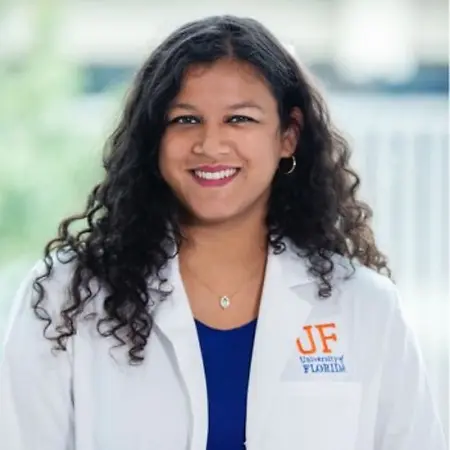
Her Story
About Aakanksha
Aakanksha Jha is a biomedical engineer and postdoctoral research fellow at Seattle Children's Research Institute and the University of Washington, where she is part of the highly competitive INVENT program — an initiative designed for scientists with an entrepreneurial vision for translating research from the laboratory into real-world clinical solutions. Born and raised in India, she made the courageous decision to move across the world on her own to pursue her passion for biomedical engineering in the United States, driven by a lifelong fascination with the intersection of biology and quantitative science. She earned her Bachelor of Engineering in Biomedical Engineering from L.D. College of Engineering in India, followed by a Master of Engineering and a doctorate — both in Bioengineering and Biomedical Engineering — from the University of Florida, where she completed her PhD in a remarkable three years rather than the typical five to six. It was during her graduate studies that she developed a deep expertise in immunology and biomaterials design, exploring how cellular behavior is shaped by the physical and biochemical environments surrounding it.
<br><br>
Her research centers on the engineering of soft biomaterials, specifically hydrogels, to modulate immune system responses — with the ultimate goal of empowering the body's own immune cells to combat cancer. At Seattle Children's, she applies this specialized knowledge to pediatric oncology, an area she identified as critically underfunded and in urgent need of innovative scientific attention. Her doctoral work on chronic wound healing and immune cell regulation not only earned her a published patent — PCT/US2022/073593, for a biofunctional hydrogel designed to control pro-inflammatory response — but also laid the scientific foundation for her current translational work in childhood cancer. A recipient of the CL7 Charlie Landers Young Investigator Grant on her very first application, and a Forbes 30 Under 30 shortlistee, Dr. Jha has established herself as a rising force in immunoengineering and cancer biomaterials research. She is an active member of the American Association for Cancer Research, the Society for Biomaterials, the Biomedical Engineering Society, and both the Seattle and Washington, DC chapters of Women in Bio.
<br><br>
Beyond her scientific contributions, Dr. Jha is a passionate advocate for diversity, equity, and mentorship in STEM. She regularly participates in outreach events for high school and undergraduate students, mentors young researchers in laboratory settings, and contributes monthly to Greenpeace as part of her broader commitment to global causes. Fluent in English, Hindi, Gujarati, and Maithili, she brings a richly multicultural perspective to both her science and her advocacy — believing firmly that the brightest ideas emerge from the most diverse minds. A former lead singer in an Indo-fusion band, salsa and bachata dancer, and avid paddleboarder, she embodies the philosophy that a creative and balanced life fuels, rather than detracts from, exceptional scientific work. Dr. Jha's journey — from navigating financial uncertainty as an international student to earning a patent, a competitive research fellowship, and national recognition — stands as a testament to the power of resilience, adaptability, and unwavering self-belief.
Her Interview
Ten minutes with Aakanksha
01What do you attribute your success to?
I owe much of my success to the mentors who have guided and supported me throughout my career. My PhD advisor, Dr. Erika Moore, was instrumental in my training and played a defining role in shaping who I am as a scientist — our working relationship and compatible personalities made a tremendous difference. My current advisors at Seattle Children's Research Institute and the University of Washington, Drs. Elizabeth Lawlor and Cole DeForest, are individuals I deeply admire and continue to learn from every day. Beyond these three primary mentors, I've been fortunate to have others along the way who have contributed to my journey, but these individuals have made the most profound impact on my professional development and growth.
02What’s the best career advice you’ve ever received?
The most transformative career advice I received came from my Cell and Tissue Engineering professor at the University of Florida — he was the first person to tell me I should consider pursuing a PhD. Coming from India, where a master's degree is a prerequisite for doctoral study, I had never imagined going straight into a PhD program. At the time, I was also navigating real financial pressures, including student loans from my master's, which made the idea feel out of reach. But his encouragement prompted me to explore the possibility more seriously, and when COVID created an unexpected window of opportunity, I took it. That single piece of advice fundamentally changed the trajectory of my career.
03What advice would you give to young women entering your industry?
My advice is to cultivate unwavering, blind confidence in yourself. As a woman in science — and especially as a woman of color — you will encounter environments where your voice is minimized or overlooked, particularly in spaces dominated by more established voices. There is an important distinction between assertiveness and aggression, and learning to walk that line with grace is something we navigate every single day. Science thrives on diversity of thought, background, and perspective, and your presence and your ideas matter. Be fearless, be heard, and never allow yourself to be subdued. I recently participated in an outreach event where young brown-skinned women approached me to say how inspired they felt by my story — that moment moved me deeply. If even one person walks away from an interaction with me feeling that a career in research is possible for them, that is a success story I am proud to be part of.
04What are the biggest challenges or opportunities in your field right now?
The most pressing challenge — and simultaneously the most meaningful opportunity — in my field is childhood cancer research, which remains severely underfunded relative to its impact. There is a critical gap in research attention and resources dedicated to pediatric cancers, many of which are extraordinarily aggressive. That gap is precisely what drew me to Seattle and to my current role. The opportunity lies in applying what we know from biomaterials science and immunology to directly address this unmet need — translating discoveries from the laboratory to the clinic through initiatives like the INVENT program at Seattle Children's Research Institute, which actively supports scientists in pursuing the entrepreneurship side of their work and even building companies from their research. That bridge between science and real-world patient impact is where I believe the most transformative work is happening.
05What values are most important to you in your work and personal life?
At the core of everything I do is a commitment to living holistically — recognizing that while I am deeply passionate about my research, a fulfilling life extends well beyond the laboratory. I believe in remaining adaptive and open, values I developed early on after changing nearly a dozen schools growing up, as my father served in the Indian military. That experience taught me how to build new connections, adjust to unfamiliar environments, and approach change with curiosity rather than fear. I value creativity — I've always had a creative heart, having participated in singing, debates, creative writing competitions, and performing in an Indo-fusion band where my fiancé played guitar alongside me. I also value being a continuous learner — absorbing every experience, keeping an open mind, and never allowing my perspective to become rigid. Above all, I value making a meaningful impact on others. When young women — particularly women of color — tell me that my story inspired them to pursue a path in science, that is the kind of success that matters most to me.
Join Influential Women and start making an impact. Register now.