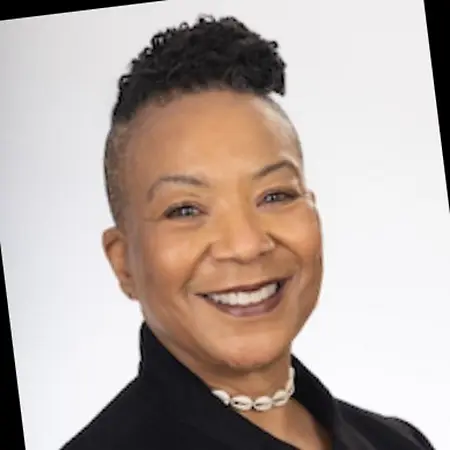
Her Story
About Adrianne
My career path has really been about being in one of the helping professions from early on. As a young person, my first wish was to be a pediatrician, but I let the math scare me, so I went toward the social sciences. My undergraduate degree is in psychology, and I realized I would need a master's degree to move me forward in the helping profession. I went into social work because it's broad and wide and deep, and I've used that degree to do many different things. I've done clinical work for several years, served as a behavioral health manager supervising other individuals, worked with court-appointed special advocates and veterans, particularly those who are homeless. I've been in academia since 2014, and prior to that, I served as a clinical behavioral mental health therapist beginning in 2007. I served as an assistant professor at UWGB and also at Case Western Reserve. I really leaned into my research from my PhD and started to spearhead conversations around biases, not just implicit biases, but explicit biases. I was the inaugural director of DEI for the Ohio Supreme Court, and I continue to serve in some facet of DEI work. My area of expertise is social engagement, especially through difficulty, and instructional design. I design curriculums to help organizations think about their biases and help organizations think about improved engagement across their hierarchy.
Her Interview
Ten minutes with Adrianne
01What’s the best career advice you’ve ever received?
The best career advice I ever received came from Dr. Faye Gary, one of my mentors. She asked me to volunteer for something, and I said I didn't have time to do it. She took my hand, patted it, and said, 'Dr. Fletcher, you have time. The students need you.' She was an amazing mentor and an individual who just challenged you to do more for the sake of the students coming behind us. That moment really stuck with me because she reminded me that we have time for what matters, especially when it comes to serving and supporting the next generation.
02What advice would you give to young women entering your industry?
The biggest thing I would suggest is to take a few steps back and look at what your skills are, so that you can hone your career trajectory in accordance with your skill set. Oftentimes we have our head down and we're just doing our work, and we don't often recognize our skill set. Don't necessarily let somebody else tell you what your skills are. Increase awareness of who you are, what your skills are, and then use that information to hone your career trajectory.
03What are the biggest challenges or opportunities in your field right now?
Obviously, we are challenged with the whole wish of erasure with the DEI focus. That's had an impact on 300,000 plus Black women, and as I am a woman of color, that is a challenge. Since the Dear Colleague letter has been more or less pushed off the table, we're seeing an increase in these roles at universities and other places. But there's a lot of skepticism, because it's hard to know whether or not individuals who are now hiring for these roles are really going to hold fast to the work that needed to be done. I guess the good thing is, I believe those of us who do this kind of work know how to do it in a way that is below the radar and still get good work done.
04What values are most important to you in your work and personal life?
My faith is terribly important to me, and that always has to be step one when I am thinking about what's next on the horizon for my career. My spiritual life, my spiritual well-being, is very important to me because I do want to encourage individuals to take care of themselves spiritually. That is the soul, and it's the core of ourselves, and if that is not well, nothing else will be well. Self-care is also important to me, and not just self-care in words, but total self-care, from your spiritual self to your physical self, all of the pieces.
Join Influential Women and start making an impact. Register now.