Her Story
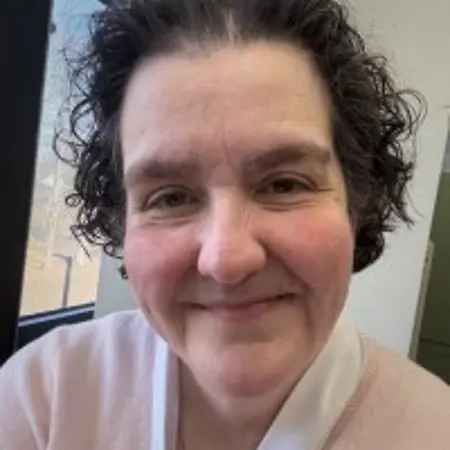
About Adrienne
Adrienne Darrah is an assistant teaching professor at Penn State University, where she has been a full-time faculty member since fall 2022. Her teaching primarily focuses on public speaking, helping students manage anxiety while developing practical communication skills. Adrienne’s journey to academia was unconventional: a first-generation college graduate, she initially studied architecture before switching to art history, then spent over 15 years in arts and higher education fundraising. Her passion for teaching was sparked in 2016 when she began as an adjunct, finding fulfillment in directly impacting students’ lives.
Building on this experience, Adrienne pursued advanced degrees, earning an MBA, a Master of Public Administration, and ultimately a PhD in Mass Communication from Penn State in 2023. Her research explores critical cultural studies, particularly examining women’s roles in film, television, and commercials. Adrienne blends her academic expertise with a practical, approachable teaching philosophy, encouraging students to navigate public speaking with authenticity and confidence while making academic work accessible and meaningful.
Beyond the classroom, Adrienne contributes to her community and profession through leadership and service. She is active in the AEJMC and the National Communication Association, and she serves in civic roles such as Inspector of Elections for her district and on local human relations commissions. Adrienne’s career reflects persistence, adaptability, and a dedication to helping others grow—qualities that have allowed her to transform from a first-generation student to a respected educator and researcher.
Her Interview
Ten minutes with Adrienne
01What do you attribute your success to?
I always want more. That drive has gotten me to where I am and continues pushing me forward, though I'll admit it's a double-edged sword. Sometimes I don't view this as entirely positive. My fear is that on my deathbed, I'm going to look back and think I missed out on so much because I was so driven to do so much that I missed out on the important things. A perfect example is when I was working on my doctorate and my son was between four and eight years old. My husband would take him to all the birthday parties and playdates, and at one party, one of my son's friend's little brother asked him, 'Do you have a mom?' When my husband and son came home and told me this story, thinking it was funny, I literally burst out in tears because I realized I was missing out on so much. My husband said eventually it would be over, but I was missing those crucial years in my son's life. So yes, my drive and my need to have more has gotten me to where I am, but at the same time, I do have fears that it's keeping me from recognizing the things that I have. It's that constant push for the next degree, the next achievement, the next milestone. Once I finished my MBA, I immediately thought about doing another degree because it felt like I blinked and missed it. That hunger for more education and more accomplishment is both my greatest strength and something I worry about.
02What’s the best career advice you’ve ever received?
The best career advice I ever received came from my professor when I was working on my doctorate. I was in my early to mid-40s, sitting in this heavy theory class with all these kids in their early 20s who were speaking at such a high academic level, using all this academic language. I felt so out of place and uncomfortable that I considered dropping the course. I decided to visit the professor during her office hours and, after I explained to her how intimidated I felt, she told me not to drop the class. She explained that graduate students had this tendency to adopt an academic-centered language because they think that is expected of them. She told me that they are no smarter than I am and I need to be who I am. I take that with me anytime I'm at a conference or trying to join a new committee, because you do have these academics who speak in a certain way that's very inaccessible. When Republicans complain about higher education being elitist, that's really what they are complaining about, because it's not accessible, and we don't make it accessible. I tend to write at a tenth-grade level because my language tends to be pedestrian, and I have had a journal come back and tell me my writing is not written at a high enough level even though the content is what is supposed to matter. So I submitted the paper to another journal and published it exactly as I had written it. So that advice, don't try to be something you're not, continue to be who you are and don't worry about everybody else, that was the best career advice I received.
03What advice would you give to young women entering your industry?
Don't let imposter syndrome get to you. Everybody, even the most seasoned professional, continues to feel it, so you are not alone. I still stand in front of the classroom sometimes and think, "why are they letting me do this?" Even after earning multiple degrees and years of experience, that feeling never goes away. You have to understand that those feelings of inadequacy are normal and universal. The key is not letting them stop you from moving forward or being who you are.
04What are the biggest challenges or opportunities in your field right now?
The biggest challenge right now is being a woman in a world that isn't entirely friendly to women. Since 2016, it's been particularly hard, though that wasn't our introduction to what misogyny and inequality looked like. I don't want to get on my high horse about it, and I tell my husband I'm not a feminist, but at the same time, I do not think it's fair that I get paid less than my male peers. Growing up, my father told me I could do and be whatever I wanted to be. I was never taught that I was less-than because I was a girl. In college, they tell you that regardless of who you are, regardless of your gender, color, nationality, religion, or sexuality, you can go out, negotiate, get that job, and move up. But then you move into the real world and realize that for those of us who don't have a certain anatomy, skin color, sexuality, or nationality it's a little bit harder, a little more difficult. Figuring out how to maneuver a world that is not entirely friendly to women has been the biggest learning experience. It eclipses all of my education. I really grew up thinking I could be whatever I wanted to be, but unfortunately, that's not reality. Even in fundraising, there's what one fundraiser I spoke with called the 'development look.' Women who are hired into public-facing fundraising positions tend to be petite, blonde, thin, dress to the nines, and put full faces of makeup on, as this fundraiser noted, it is a lot like a Miss America pageant. It doesn't matter what the men look like, they come in every shape and size, but the women have to fit this ideal if they're going to be out in front of people asking for money. COVID also set women back as they took on more responsibilities in the home, and many women were not able to keep their jobs or return to the workforce. And now they've overturn Roe v. Wade and there is talk about the women being marginalized further through the SAVE Act. So being a woman has been my biggest learning experience and continues to be the biggest challenge.
05What values are most important to you in your work and personal life?
Honesty is number one for me. Growing up and seeing members of my extended family incessantly lie made such an impact on me that I promised myself I would change. So I do not lie. When my son was young, I told him I would never lie to him, and that if he ever had a question, he could come to me and ask. I promised that if I thought something was too big for him to understand, I would tell him, but I would answer whatever he asked me. When he turned ten, we sat him down and to have the sex talk and tell him the truth about Santa Claus. After we told him about Santa, he looked me in the eye and asked about the Easter Bunny and the Tooth Fairy. I told him the truth about those too. He took a moment and then said to me, 'You told me you would never lie to me.' That just killed me. I told him that would be the only thing, and I promised I would never lie to him otherwise. Honesty is really, really important to me, and I need that foundation of truth in both my personal and professional life.
Join Influential Women and start making an impact. Register now.