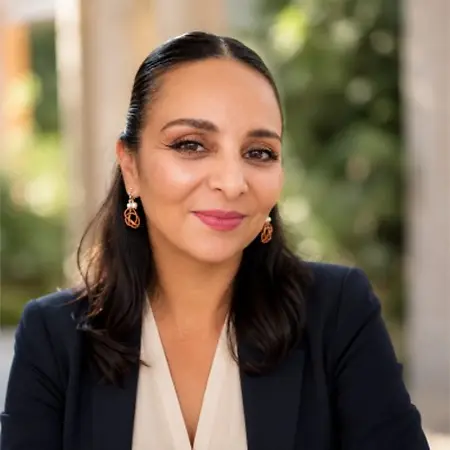
Her Story
About Aida
For Aida Renee Amador Aleman, the border is not an abstract policy issue—it is home.
Born in the United States, raised in Mexico, and rooted in the San Diego–Tijuana region, Aida has built her career connecting communities that are often treated as separate. Her work is grounded in the belief that border communities should not be defined only by crisis, but recognized for their creativity, resilience, knowledge, and leadership.
For nearly a decade, Aida has led nonprofit and community-based programs focused on migration, food security, mental health, education, and cross-border engagement. She stepped into program leadership during the humanitarian response to the 2018 Central American migrant caravan, helping build partnerships and initiatives that responded to immediate needs while protecting the dignity and agency of migrant communities.
She co-founded Migrant Kitchens of Tijuana, connecting migrant-led food initiatives with economic opportunity, community engagement, and cultural exchange. She also helped create a mental health program for migrants in partnership with Universidad Iberoamericana Tijuana and Psicólogos Sin Fronteras, expanding access to both group and individual support. She later served as Interim Executive Director of a migrant shelter in Tijuana.
Today, as Operations & Impact Director at Friends of International Friendship Park, Aida strengthens the systems, partnerships, and impact strategies behind the organization’s work to preserve Friendship Park as a place of connection, dignity, and binational cooperation.
Her leadership reflects an uncommon ability to move between communities, institutions, and cultures while remaining accountable to the people most affected by the issues she addresses. Rather than speaking for border communities, Aida works to ensure that their voices, ideas, and leadership are included in the decisions that shape their lives.
Her Interview
Ten minutes with Aida
01What do you attribute your success to?
I attribute my success to the communities that have trusted me, the mentors and colleagues who have challenged me, and my ability to move between cultures without losing sight of who I am. Living and working across the San Diego–Tijuana border has taught me to listen carefully, adapt quickly, and recognize strengths that institutions often overlook. I have also learned that meaningful leadership is not about having every answer. It is about building trust, bringing the right people together, and creating the conditions for communities to lead.
02What’s the best career advice you’ve ever received?
The best advice I have received is not to wait until I feel completely ready. Some of the most important moments in my career required me to step forward during uncertainty, learn quickly, and trust the experience I had already gained. Leadership often begins before we feel fully prepared for it.
03What advice would you give to young women entering your industry?
Do not underestimate the value of your lived experience. Your background, language, family history, and connection to your community are not separate from your professional expertise—they can be among your greatest strengths. Learn how systems work, but do not allow those systems to convince you that leadership has only one appearance, accent, or path. Find mentors, build genuine relationships, ask for opportunities, and remember to bring other women with you as you advance.
04What are the biggest challenges or opportunities in your field right now?
One of our greatest challenges is that border and migrant communities are frequently discussed through political narratives that overlook their humanity, complexity, and contributions. Organizations are also being asked to address increasingly urgent needs with limited and uncertain resources.
At the same time, there is an extraordinary opportunity to build programs with communities instead of for them. Binational partnerships, community-led philanthropy, responsible technology, and stronger systems for measuring impact can help nonprofit organizations become more effective and accountable. The people closest to a challenge often understand the most practical solutions; our responsibility is to ensure they have the resources, access, and decision-making power to put those solutions into practice.
05What values are most important to you in your work and personal life?
Dignity, integrity, empathy, courage, and accountability guide both my work and my personal life. I believe people deserve to be treated as individuals with knowledge and agency, not as problems to be solved. I value collaboration, but I also believe collaboration must be honest and equitable. Above all, I want my work to create meaningful opportunities for connection and leave communities with greater strength, voice, and ownership.
Join Influential Women and start making an impact. Register now.