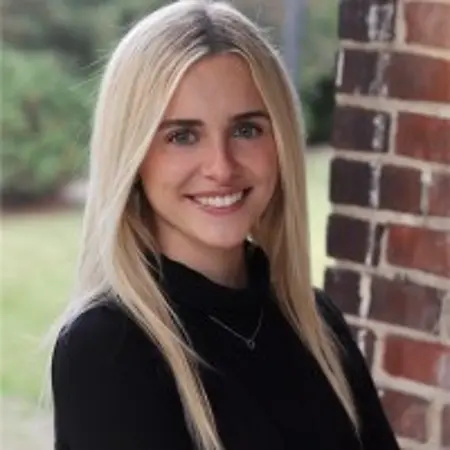
Her Story
About Alexa
Alexa Silverstein is the Founder and Principal Consultant of LEX Data Advisory, a data strategy and analytics consultancy that helps organizations turn complex, fragmented data into clear, reliable, and actionable insights. She works with clients end to end from initial outreach and consultation through hands-on data work, specializing in data cleaning, scrubbing, analysis, dashboard development, and ongoing retainer based reporting solutions. Through her work, she helps organizations convert monthly raw data into streamlined, easy to use dashboards that improve visibility, efficiency, and decision making across teams. Alexa began her career in corporate banking at Fifth Third Bank in June 2022 immediately after graduating, where she initially supported credit and portfolio management functions. While in this role, she increasingly took on data focused responsibilities for her team and others across the organization, which ultimately became the work she was most drawn to. During her time there, she worked in a challenging, male dominated environment. After leaving the bank in October 2025, shortly after welcoming her second child in August, she chose to pivot fully into data consulting and launched LEX Data Advisory at the beginning of 2026. Alexa holds a Master of Business Administration from the University of Cincinnati and a Bachelor of Science in Business Administration in Finance and Economics from the University of Dayton. Throughout her academic and professional journey, she has developed a strong foundation in analytics, leadership, and operational problem solving. Her work today is driven by a commitment to reducing unnecessary workload for employees, particularly analysts and early career professionals, by removing manual reporting burdens and improving data systems. She is also passionate about building and leading a supportive, women-centered environment in the data field, creating space for women to grow in confidence, collaborate, and thrive in leadership roles.
Her Interview
Ten minutes with Alexa
01What do you attribute your success to?
Honestly, probably helping others is what I love most about my work. I want to make processes efficient for businesses so they can succeed and grow, but what's more important to me is the mental health of lower-level employees. I was that corporate banking analyst who had an entire portfolio to manage and was also doing data work for my team and other teams, because once somebody realizes you know how to do something, it all falls on you in the corporate world. I think it's really important that employees, especially lower-level analysts, are able to focus on their role and develop in their role so they can grow themselves and make their own success story. All these other obstacles get in the way, and I know it can be very overwhelming. Companies can benefit from my services because it takes work off the plate of the workers they hire to do a specific job. Corporate sometimes takes eagerness and turns it into something that really just blows it up. At the end of the day, life is really too short, and we already have to work the vast majority of our time on this planet to live. If you're going to do it, then you might as well be doing the job that you interviewed for, and not wearing 12 other hats and being compensated for maybe half of one. If I can make a difference and an impact on one person, then that is enough for me.
02What’s the best career advice you’ve ever received?
Honestly, the best career advice I ever received was to stop focusing so much on proving my value and instead focus on actually creating it. Early on, I think I was very focused on saying the right things, having a polished pitch, and trying to come across as impressive. But someone pointed out to me that most people aren’t looking to be impressed, they’re looking to solve a problem or make something easier in their business. That really shifted my perspective. I started approaching conversations differently, spending more time listening and trying to understand what was actually going on beneath the surface. Instead of thinking about what I wanted to say next, I focused on identifying where there was friction, inefficiency, or missed opportunity, and then figuring out how I could genuinely help. What I’ve found is that when you do that well, you don’t really have to sell yourself in the traditional sense. People can see the value because it’s grounded in their reality, not just a generic pitch. It also builds stronger relationships, because it shows that you’re invested in outcomes, not just appearances. That advice has stuck with me because it applies at every stage. Whether you’re just starting out or working with more established companies, the ability to listen, diagnose, and deliver something meaningful is what actually drives long term success.
03What advice would you give to young women entering your industry?
I would like to see more women as data analysts and more women front-facing as consultants. In my experience, women work hard and they're overlooked. I think the world has endless opportunities for men in business, and I would like to make a space and an area for a woman to come in and feel like this is her passion, and this is her project, and she's excited to run with something, and she's excited to be a leader. I think the best community for women is other women, because nobody else understands us the way that we understand each other. I'm passionate about growing a team of women and hopefully inspiring others to join this field and not be afraid of it. That was a common thing in my corporate job - HR would say they kept interviewing women and they didn't want to join the team. That's important to me because our brains are strong, and large, and powerful, and very much capable, and I want to see other women come in and be a part of that space and be confident in that space. It's truly something you can't describe until it is experienced. It really is powerful, especially when you take the men out of it, you take the corporate stomping out of it, and you give people a space to do exactly what they want to do and become exactly who they want to become and exceed in the ways that they want to exceed.
04What are the biggest challenges or opportunities in your field right now?
Right now, one of the biggest challenges in my field is that most companies have more data than ever, but they’re not actually using it in a way that drives decisions. There’s a gap between having information and turning it into something actionable. A lot of teams are either overwhelmed by it, don’t fully trust it, or don’t have it structured in a way that’s easy to work with. At the same time, that’s also the biggest opportunity. The companies that can simplify their data, make it accessible, and tie it directly to performance are the ones that are able to move faster and make better decisions. It doesn’t always require complex systems either. Sometimes it’s just about creating clarity around a few key metrics and building processes that people will actually use consistently. Another challenge I’m seeing is the disconnect between strategy and execution. There are a lot of great ideas and plans, but they don’t always translate into day to day actions or measurable outcomes. That’s where things tend to break down. So where I see the opportunity is in helping bridge those gaps. Making data more practical, making strategy more actionable, and ultimately helping teams operate in a way that’s a lot more intentional and results driven. The demand for that is only increasing, especially as companies try to do more with the resources they already have.
05What values are most important to you in your work and personal life?
In both my work and personal life, the values that matter most to me are integrity, reliability, and being present. On the personal side, my kids and my family are the most important thing to me, so I really value being present with them and making sure that the time I spend with them is intentional and not distracted. That carries over into how I think about my time and commitments overall. In my work, integrity is a big one. I want to be someone people can trust to be honest about what I see, even if it’s not always the easiest thing to say. I also really value reliability. If I commit to something, I take it seriously and make sure it gets done well. I also care a lot about being genuinely helpful. I don’t like doing things just for the sake of checking a box. I want the work I’m doing to actually make a difference, whether that’s improving how a business operates or making someone’s job easier. Overall, I try to keep things pretty simple. Show up, do what I say I’m going to do, be honest, and make sure I’m prioritizing what actually matters both at work and at home.
Join Influential Women and start making an impact. Register now.