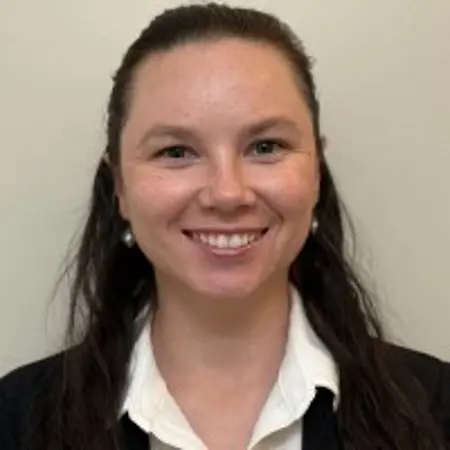
Her Story
About Alexandra
Alexandra Greiner is a wetland scientist based in Columbus, Ohio, currently working at CTL Engineering, Inc., where she specializes in wetland delineation, environmental permitting, and regulatory compliance. In her role, she works closely with clients to navigate complex environmental regulations, guiding projects through approval processes with agencies such as the U.S. Army Corps of Engineers and the Ohio Environmental Protection Agency. Her work plays a critical role in balancing development needs with environmental protection, ensuring that natural ecosystems are preserved and managed responsibly.
Her path into environmental science was both unconventional and deeply personal. Originally trained in physical therapy assisting, Alexandra experienced a significant health challenge that prompted a period of reflection and ultimately reshaped her career direction. During her recovery, she reconnected with her lifelong appreciation for nature, which inspired her to pursue a Bachelor of Science in Environmental Science from Wright State University. She went on to build her career in environmental consulting, gaining hands-on experience in soil sampling, wetland delineation, and field-based environmental assessments. She is currently furthering her expertise by pursuing a Master’s degree in Conservation Biology, with an expected graduation in 2026.
With several years of experience in the field, Alexandra is known for her collaborative approach, technical knowledge, and commitment to environmental stewardship. She brings a strong sense of purpose to her work, emphasizing teamwork, accessibility, and sustainable solutions that protect ecosystems for future generations. Her journey reflects resilience, adaptability, and a genuine passion for preserving the natural world through science and responsible development.
Her Interview
Ten minutes with Alexandra
01What do you attribute your success to?
I attribute my success to my love for the environment and my passion for what I do to help better the environment for future generations to come. My whole journey started during a really difficult time - when I fractured my skull and had a brain bleed and found out I had a brain tumor, I was on bed rest for 6 months before surgery and 6 months after. I couldn't walk, couldn't really do anything. I was literally just laying in bed watching TV, and I started watching a lot of nature documentaries, especially David Attenborough, who's like my hero. That's when I realized this was what I wanted to do. I've always loved being out in nature, climbing trees, running and playing in the creek we had in our backyard growing up. I care about what happens to the environments we interact with every day. I care about what we leave behind for the next generation. That's what keeps me engaged, even when the work gets complicated. The relationships I've built with both the Army Corps and the Ohio EPA have been crucial - I've really developed a relationship where I can call someone from either department and be like, hey, I have a really quick question about this project, can you help me for a second? That kind of credibility doesn't come quickly. It comes from consistency, from doing the work right, from showing up prepared and honest every time.
02What advice would you give to young women entering your industry?
Some advice I would give is to just not be afraid. The engineering and science field is very male-dominated. I was kind of worried if I would find a job once I graduated. But I think just really being passionate about what you do and not being afraid that, like, oh, this is male-dominant - you can achieve whatever you dream of. Don't be afraid just because it's outside the norm or to do what you want to do. I didn't really have any mentors along the way. I kind of had to be my own mentor and guider. It's not lost on me that engineering and environmental consulting are still male-dominated spaces. I've felt that. There's a certain pressure that comes with being one of fewer women in the room, especially early on. But what carried me through wasn't a perfect strategy. It was persistence and a genuine belief in the work.
03What are the biggest challenges or opportunities in your field right now?
The biggest challenge in my field is that it's very male-dominated. The engineering and science field is very male-dominated, and I was kind of worried if I would find a job once I graduated. It's not lost on me that engineering and environmental consulting are still male-dominated spaces. I've felt that. There's a certain pressure that comes with being one of fewer women in the room, especially early on. But I didn't have a formal mentor guiding me through it. I had to figure things out myself - how to speak up, how to establish credibility, how to stay grounded when things felt uncertain. What carried me through wasn't a perfect strategy. It was persistence and a genuine belief in the work.
04What values are most important to you in your work and personal life?
Some values that are most important to me are openness and being approachable. I'm always very easy to approach if another colleague or coworker has questions, or is like, hey, this isn't my area of expertise, can you help me with this? I'm more than happy to help and just be a support for others. I try to be a team player and approachable. When I get to work, I'm just trying to always be the best version of myself I can be. If there's anything I consistently bring into my work, it's approachability and a willingness to collaborate. This field is too complex - and too important - for ego. You have to be able to work with different stakeholders, different perspectives, and still move toward a solution that makes sense environmentally and practically.
Join Influential Women and start making an impact. Register now.