Her Story
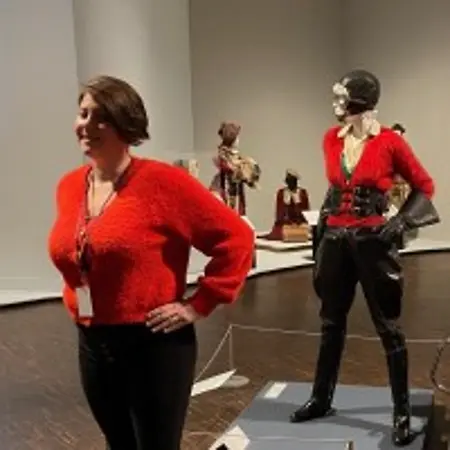
About Alexandra
Alexandra Nasharr is a museum professional and Curator & Collections specialist with the Osceola County Historical Society in Kissimmee, Florida. Her journey into museum curation began with a Bachelor of Fine Arts degree completed in 2012, followed by seven years working in commercial and nonprofit art galleries in Chicago, where she developed a strong foundation in exhibition work, visitor engagement, and visual presentation. After the COVID-19 pandemic, she returned to academia to pursue a Master’s degree in Museum Studies at Western Illinois University in Moline, Illinois, where she also served as a graduate assistant for two years—an experience that helped solidify her transition into the museum field.
In her current role, Alexandra has been with Osceola History for two years, where she manages a diverse collection spanning the mid-1800s through the 1930s. Her work includes Seminole artifacts, historical photographs, family documents, agricultural tools, and other material culture that reflects Central Florida’s layered history. She curates exhibitions, writes blogs and editorials on local families and their contributions, delivers talks for libraries and community organizations, and oversees interpretive work at Pioneer Village, which features preserved historic structures. She also collaborates closely with a small archival team, ensuring that behind-the-scenes research is integrated into public-facing experiences.
Drawing on her background in fine art, Alexandra approaches curation with a strong emphasis on materiality and visual storytelling, using aesthetic interpretation to make historical objects more accessible and engaging. She has worked with a wide range of audiences, from schoolchildren to veterans, and values opportunities to bring collections into the community in interactive ways, including hands-on educational experiences when appropriate. Among her notable projects is the sports exhibition “Out of the Park: Osceola County Sports,” which highlighted both professional and local athletic history, connecting regional identity through sports heritage.
Her Interview
Ten minutes with Alexandra
01What do you attribute your success to?
I attribute my success to a combination of perseverance, continuous learning, and strong professional community engagement. My background in fine arts and museum studies, along with years of hands-on experience in galleries and museums, has shaped my approach to curatorial work and public history. I am also an active member of professional organizations including the Florida Alliance of Museums and the Iowa Museum Association, which have provided invaluable resources, collaboration, and best practices that strengthen my work in collections care and exhibition development. In addition, my involvement with local arts and preservation organizations such as Quad City Arts, Osceola Arts, and Main Street programs has deepened my understanding of community-centered preservation and the stewardship of historic structures. These networks continue to guide and inspire my commitment to making history accessible, engaging, and relevant to the communities I serve, and I remain interested in contributing further through service on a local historic preservation board.
02What’s the best career advice you’ve ever received?
The best career advice I've received came from my mentor, Dr. Heidi Lung, my program director at Western Illinois University's Museum Studies program. She always emphasized that all skills are transferable - you should try to highlight those transferable skills you have, and even if you might not get hired in an art museum, you should apply to historic homes or historical societies. She taught me that no skill you learn is going to go to waste. You may think it's the smallest skill that you've learned, but there'll be a time when it will come up in an interview or you'll recall it. Everything's transferable, so don't let it fall by the wayside or think it's not important. Another key piece of advice was to always be receptive to feedback - that's something Heidi was always about. She also taught me practical interview preparation strategies, like writing down questions ahead of time and reaching out to other professionals in the field to ask what questions they were asked when they got their current jobs. Don't be afraid to ask questions and seek assistance from peers, because we can't always do it all ourselves.
03What advice would you give to young women entering your industry?
If a young woman came to me wanting to enter the museum field, I would first ask what interests her - what's her favorite museum she's ever been to, what histories does she find interesting? I never saw myself working with genealogy or family-based research, so I'd encourage her not to hold herself back and to think about what she finds interesting about the field and what new perspective she can bring to it. The key is to make content personal and accessible, because if it interests you, there's going to be another audience that it interests too. It won't seem as daunting or elitist when people can actually access it. I'd tell her that there's always something that someone can offer to a story or an object that it didn't necessarily have before. Don't let any of your skills go to waste - even if you think something isn't worth including in a resume or mentioning to a potential employer, write it down on paper first. I'd also strongly encourage her to reach out to other professionals in the field and ask them what questions they were asked when they got their current jobs. Don't be afraid to ask questions and seek assistance from peers, because we can't always do it ourselves. Understanding workplace dynamics and being able to work with people is crucial. Always ask for advice - your peers can usually help if you're struggling in the workplace, and that really helps.
04What values are most important to you in your work and personal life?
The values that are most important to me in both my work and personal life are community engagement, education, collaboration, and continuous growth. I am deeply committed to making history accessible and meaningful, which was especially evident in my successful sports exhibit at the museum, “Out of the Park: Osceola County Sports,” where I highlighted the full spectrum of local athletics, from high school teams to professional organizations like the Astros. That project reinforced for me how powerful museums can be in connecting people to shared history while also providing educational value that resonates across generations. I also value mentorship and professional development, and I am especially grateful for the guidance I received from Dr. Heidi Lung and Angela McCallaghan during my time in Western Illinois University’s Museum Studies program. Their support helped shape my approach to curatorial work and emphasized the importance of being receptive to feedback, building strong professional relationships, and developing transferable skills that strengthen both museum practice and community impact.
Join Influential Women and start making an impact. Register now.