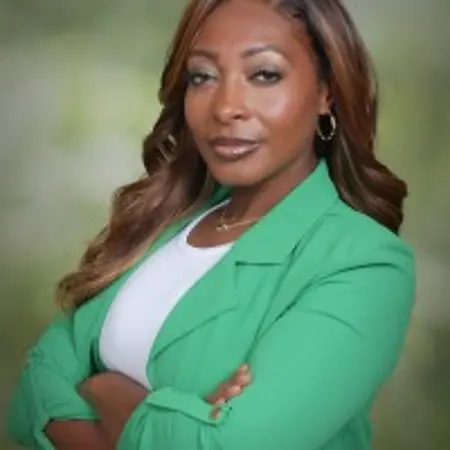
Her Story
About Alexandra
Alexandra Williams is an educator, leader, and systems-focused advocate with more than 18 years of experience in K–12 education, workforce development, and organizational leadership. Based in Oakland, California, she currently serves as a Math Teacher at AIMS K–12 College Prep Charter District, where she delivers equity-centered instruction and designs learning experiences that support diverse student populations. She is also a candidate for Oakland Unified School District Board Director for District 6, focused on strengthening alignment between vision, community voice, and systems to improve outcomes for every student.
Her journey in education is deeply personal and shaped by lived experience. Alexandra began her career through AmeriCorps at a drop-back-in academy supporting students in court-ordered programs, including youth on probation and house arrest. Raised in Chicago and educated through Chicago Public Schools, she experienced both gifted identification and systemic mislabeling, along with the impact of bullying and transitions between public and private schooling. These experiences shaped her belief that students are often misunderstood when systems prioritize compliance over learning and do not fully recognize their potential.
Alexandra went on to serve as a high school mathematics teacher in Duval County Public Schools for eight years and one year in Clay County Public Schools before relocating to the Bay Area. There, she became a founding teacher at KIPP Bay Area Public Schools, where her students achieved top national math performance. She later served as a math teacher and assistant principal at Summit Public Schools, supporting instruction, culture, and school transitions, followed by leadership as Director of STEM Programs at a nonprofit serving hundreds of classrooms. She is currently pursuing a PhD in Organizational Development and Leadership, and throughout her career has remained committed to ensuring students understand that education is a powerful form of currency that expands opportunity and opens doors.
Her Interview
Ten minutes with Alexandra
01What do you attribute your success to?
I attribute my success to viewing education as currency it's been something that has allowed me to transition and pivot throughout my career. Living in the Bay Area, the workplace volatility is crazy, so you were working somewhere one day and the next day you're laid off. I tell students and even people that the fact that I have gone to school, gotten higher ed degrees, and been certified as a math teacher means I really feel like every time I need to transition and pivot, I always have that to fall on. I have my education to pick me back up and get me to the next step. I'm not always trying to figure out what to do next. When they did an org restructuring at my last organization, everybody was crying asking what are you gonna do, and I was like, I guess I'll just start subbing. I can sign up for that tomorrow. And that's what ended up happening - I ended up at this school meeting kids. It just happens really quickly. When you have a currency of education, you can navigate and pivot really quick. I've seen that for myself, and so I try to tell that to my students. They say they don't have to go to class, and I tell them, you don't, but what are you doing? Whatever else you're doing, it helps to expand your network. You gain social economics through education. It's not something that is told - everybody thinks about it as a learning experience, when really it's more of a social growth and capacity. I stayed in this field because I see students who look like me, and I want to let them know that this is a piece of currency that you need to get so that you get as many doors open as possible. Because we don't have currency as in money, but we do have currency in education.
02What’s the best career advice you’ve ever received?
The best career advice I've received and carried throughout my life and career is that education is a currency. I believe that knowledge, skills, and continuous learning create opportunities that no one can take away and open doors to a brighter future. That mindset has inspired me to champion education, empower students, and encourage others to invest in themselves because learning is one of the most valuable assets a person can possess. I tell students that education helps to expand your network and you gain social economics through education. It's not just a learning experience, it's really more of a social growth and capacity. When you have a currency of education, you can navigate and pivot really quick, which I've seen for myself throughout my career transitions.
03What advice would you give to young women entering your industry?
I would tell young women entering education to lean into being a student of the work. When you start, you're terrible, like most jobs - it's a skill. You may have all the content knowledge, but you may not have all the pedagogy to be a teacher. Even if you went to school for teaching, when you start to put it in practice, some things are dated and the generations change. You've got to lean into the evolution of the work and the technological growth of the work. Being a student of the work is probably the biggest thing - every year I'm learning, every year I'm changing, every year I'm adapting. You're not gonna stay the same as you were. When I started teaching, I was teaching on overhead projectors - a kid doesn't know what transparency is now. We're one-to-one computers with everyone hooked up on technology all at the same time, which is a lot. Some people haven't leaned into it and don't want to, but then you hold students back that way. It's not an easy job - you've got to have grit, and you've also got to take your emotions out of it. You are a human, and I hold that with my students to tell them that I'm a human, so the way you interact with me, I try to respect you and you respect me. But you've got to learn that it's not about power - you don't have to have the power in the space, you have to control the energy. Lean into it, be a student of the work, and control the energy, manage the energy of the room, instead of trying to control the people in it. That's the biggest thing I've learned. Also, create a vision for what you want your classrooms to look like. Leaders have to have vision, and understanding you're a leader in the room, in the space, and guiding that vision and what your passions are, and how do you help support and cultivate and push that forward.
04What are the biggest challenges or opportunities in your field right now?
I see that there's a lot of challenges, but I also see opportunities. One of the biggest things is that education has been under-resourced - that has been forever since I've been in education, they've been saying that. Then there's this whole growth of AI situation going on. I actually just went to a forum on the higher ed level where they had a panel committee talking about how they start to collaborate, and I think collaboration is one of the biggest things that I see. If people can learn to collaborate together, you start to move forward. A lot of times I work at a charter school where it's just siloed off, but I have seen the beauty of when you're in a place, in a space, where you want to collaborate with people. It's easy to be siloed off, but if you can collaborate with somebody to figure out ways to make new things happen and be more innovative, that helps to push you forward, because every space is different. You can't do a one-size-fits-all, but you can at least collaborate with other people to figure out what works. I would not be the kind of teacher, the kind of leader that I am, if I thought I could do anything by myself. It is a big challenge when you sit in a room by yourself, but if you sit with others, you can push some things forward. I also see challenges when looking at data - there are students who get overlooked because people aren't actually investing in them intentionally. When you look at students with economical disadvantages, Black students, and students who were in SPED, you could see that the school score kept rising but those students' scores kept declining. One of my old principals would say, is this school an A school for all students? Those students who get overlooked because they're not - people aren't actually investing in them intentionally. People are looking at the big scene, like oh we're an A, but I'm like, yeah, but we've got kids in here who are operating at a C, at a D. How do you support them to pull them up too, even though they're a small population? Their parents put them here because they thought that this would be the place where they would excel.
05What values are most important to you in your work and personal life?
The values most important to me are rooted in seeing students who look like me and helping them understand that education is a piece of currency they need to get as many doors open as possible. I believe in academic excellence, equity, and supporting all students, particularly students of color and those who are economically disadvantaged. I'm passionate about creating environments where students feel seen and supported. I also deeply value taking care of myself so I can show up fully for others. I actually went through some panic attacks and was losing it when I first became an administrator, and I had to figure out something for myself. I put myself on a challenge for 60 days to go to the gym every day and drink a gallon of water, because sometimes your life is consumed by the work and by all the other expectations that people have on you, instead of fueling yourself first. I decided one day I was gonna compete in a bodybuilding competition because I wanted to transform my body, and I fell in love with the sport. I'm a pro bodybuilder now. Bodybuilding is the most selfish thing you can possibly do as a sport - it's not a team sport, nothing is tailored to anybody else, it's tailored to you. I have a coach, and sometimes I'm struggling at work, struggling in class trying to finish this PhD, and my coach always is like, you need to wake up for you. Do the thing that you do. Bodybuilding has allowed me to focus really on doing the things for me and waking up for me. It's my thing. I believe strong leaders must care for their own well-being in order to show up fully for those they serve.
Join Influential Women and start making an impact. Register now.