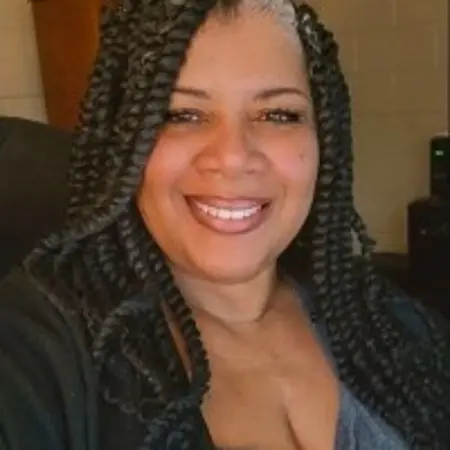
Her Story
About Alicia
Alicia V. Hall, PhD, is a seasoned clinical psychologist and forensic specialist based in Columbia, South Carolina, with more than two decades of experience working at the intersection of psychology, forensic assessment, and neurodevelopmental disorders. As a Clinical Supervisor and Psychologist II with the South Carolina Department of Behavioral Health and Developmental Disabilities’ Office of Intellectual and Developmental Disabilities, she oversees a clinical forensics program that evaluates individuals with autism spectrum disorder, intellectual and developmental disabilities, traumatic brain injuries, and other neurological conditions for competency to stand trial. She also supervises psychologists conducting these evaluations and provides consultation on complex cases involving developmental disabilities.
Dr. Hall’s path into forensic psychology began during graduate school, where she initially planned to become a child psychologist. While studying clinical psychology with a child focus, she developed an interest in juvenile forensics and later added a forensic concentration to her training. During her internship, she completed a rotation focused on developmental disorders, an experience that shaped the direction of her career. Since around 2006, she has combined her expertise in forensic psychology and developmental disabilities to create a highly specialized practice centered on patient-focused, individualized evaluations that avoid diagnostic overshadowing and emphasize understanding each person’s unique communication style and abilities.
In addition to her clinical and supervisory work, Dr. Hall has spent years contributing to research and education. She previously conducted autism-related genetic research and received the Innovative Clinical Research Award from The Alan B. Slifka Foundation and the International Society for Autism Research. She also serves on the clinical faculty at the University of South Carolina School of Medicine and the Medical University of South Carolina, where she teaches medical students, residents, and forensic fellows. Through her leadership, mentorship, and dedication to improving outcomes for individuals with developmental disabilities, Dr. Hall has become a respected voice in both forensic and clinical psychology.
Her Interview
Ten minutes with Alicia
01What do you attribute your success to?
I would say that on the path to becoming an expert in neurodevelopmental disorders, Dr. Harry Wright was a mentor. He was a psychiatrist who is now deceased, but he really helped shape the way I think about neurodevelopmental disorders. He was the psychiatrist in the clinic while I was training. My other mentor from that same clinic is a psychologist, Dr. Michael Cuccaro, who really helped me in terms of shaping how I view the interactions when doing assessments. He taught me about maintaining your professionalism, but also not being so rigid that there's an even greater separation from you and the patient. He really taught me that you need to get on their level, particularly when you're working with folks with autism spectrum disorder. An assessment is still a social interaction, and to be able to pay attention to everything in that social interaction, even how you are interacting with that person, can be instructive for your clinical assessment and clinical decision-making. He was really important for me to understand about diagnostic overshadowing. He helped me understand that if a person comes in and they say their kid has autism or intellectual disability and they're exhibiting a behavior, that behavior should not automatically be attributed to the primary diagnosis. It's my job as the psychologist to figure out, is this behavior part of their primary diagnosis, something you typically see with individuals who share that diagnosis, or could this behavior also be hallmarks of something else that also needs attention and treatment.
02What’s the best career advice you’ve ever received?
The best career advice I’ve received is to maintain professionalism while still being approachable and willing to “get on their level.” Especially in assessments, paying close attention to social interaction and avoiding diagnostic overshadowing can make a meaningful difference in truly understanding the individual in front of you.
03What advice would you give to young women entering your industry?
The field is wide and big in terms of forensic psychology, so I would ask her what areas does she want to pursue. Does she want to do criminal work? Does she want to do family-related work, like child custody and guardianship? There's also work-related forensic work, like readiness to return to work and work place violence risk assessment. I have colleagues that do evaluations of people who have been officers or military personnel who have been removed from the field because they've experienced trauma. It's a wide field, and so I would want them to try to get as much exposure to the field as they could so that they could find something that really fits for them. I would also stress that there's the treatment side of forensics too. Do they want to provide treatment? I think the other big piece that people don't think about necessarily when they think about forensics or going into forensic psychology is that you have to be a strong clinician. Your clinical skills have to be well developed, and that takes time, which is another reason why you want to get exposure to as many different people in the field and how many different practices as you can. That's really going to help sharpen your own clinical skills and your own clinical knowledge.
04What are the biggest challenges or opportunities in your field right now?
One of the biggest opportunities in the field is the growing need for professionals with expertise in both neurodevelopmental disorders and forensic psychology, as relatively few practitioners have deep experience in both areas. At the same time, developing the strong clinical foundation needed to work effectively in this niche can be a significant and time-intensive challenge.
05What values are most important to you in your work and personal life?
The values most important to me in both my work and personal life are professionalism, approachability, and maintaining a patient-centered perspective. I believe in taking the time to conduct careful, accurate assessments and avoiding assumptions that behaviors are solely tied to a primary diagnosis, while staying engaged with professional and community organizations that support psychology, autism research, and developmental disabilities.
Join Influential Women and start making an impact. Register now.