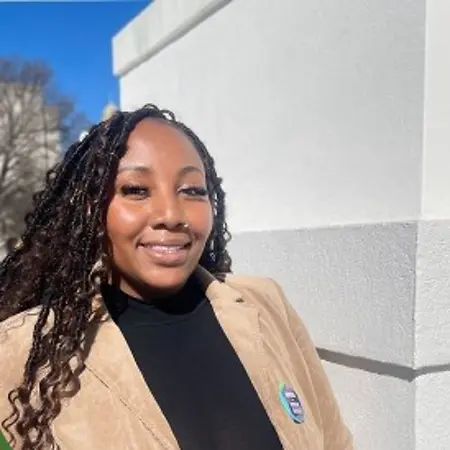
Her Story
About Allanah
I started my career after earning my bachelor's in political science from Norfolk State University, and honestly, I just stumbled across this job at the LGBT Life Center. What kept me was that my job is ever-changing - I'm in and out of the office, working directly with marginalized communities that are oftentimes forgotten. There's a certain level of altruism because I get to be physically boots on the ground in my community. I started as a temporary field interviewer for just 6 months and worked my tail off. I actually built the system for giving people resources, because what we had were very outdated basic pamphlets from VDH. Now I have a Rolodex of resources and contacts, so when I have a person in active crisis or substance use, I know who to call and which resources to reach out to. As field supervisor for the National HIV Behavioral Surveillance Study, I oversee data collection on high-risk demographics including intravenous drug users, men who have sex with men, and high-risk heterosexuals. We run in 3 cycles and provide critical data to the CDC. Beyond my day job, I serve as president of the Urban League of Hampton Roads Young Professionals, where we bring professional and personal development to the community. We've organized hackathons, an AI fluency lab, partnered with the Virginia Nature Conservancy for the eelgrass Restoration Project in the Chesapeake Bay, hosted Black History Month events, and I'm serving as a judge for the National Youth Poet Laureate competition. I'm also on the racial equity committee at work, where we organize monthly cultural events. I went to Capitol Hill for AIDS Watch to advocate for HIV and AIDS research, speaking with Tim Kaine, Mark Warner, and Bobby Scott. I've connected with local councilmen to address food accessibility in food deserts where our field sites are located, and started a garden club with Urban League Young Professionals to help the community get access to affordable grocery stores.
Her Interview
Ten minutes with Allanah
01What do you attribute your success to?
I credit my success to the Most High. I credit my success to my ancestors, where I am their wildest dream - the folks who have come before me, who have put in the work for me to even be here, where I'm a college-educated woman. I have my own place, I have my own car. I travel, and I leave and go when I please. I'm such a free person, and a free woman. I really appreciate and am grateful for the community that I have around me, whether that's my friends, my family members, my aunts who spoke life into me, who have clothed me and fed me when I was at my lowest. And my siblings, who I always want to be a good example for. In a world where everything is going to hell, it's like, things can only go right from here. And that's kind of where I credit my success from.
02What’s the best career advice you’ve ever received?
The best advice I was given by my aunt was to just shut up. If you feel like you need to say something, just shut up, because there's a time and a place to say things. Sometimes it takes time for you to understand the system, and even if you might not agree with it, make note of it so that you can do something about it later, once you're in position to do something about that. The other best advice I would say is, when you can't do anything else, do what you can. I take that advice, and that is how I've ended up where I am.
03What advice would you give to young women entering your industry?
I would tell them, be open, be flexible. Have a curious mind, ask questions. Be non-judgmental, compassionate, have empathy, because the things that you see in this industry, you're touching base with people sometimes when they're at their lowest. You're connecting with folks sometimes when they're in active crisis, or active substance use, or they're unhoused, or they were recently incarcerated. Just make sure that you look at every single person at the same level. It doesn't matter whether they're a councilman, it doesn't matter whether they are unhoused, it doesn't matter if there's somebody's Meemaw or somebody's kid out on the street. You treat each person with the same level of respect and platitudes that you would the CEO. That person matters just as much. As a matter of fact, they more than likely matter more. People that you work with that you think are at a certain level, that are above you, they are supposed to be of service to the community. We are servants to the community. We service the community. Just remember that every person that you come into interaction with, treat them with the same level of respect. Talk to them like they are human. I've had people that I've had conversations with, and I'm just talking to them like a person, and they've cried in front of me, simply because I was having a regular conversation with them. There's value in basic decency.
04What values are most important to you in your work and personal life?
Integrity is most important to me. That's base level, but moving with integrity is how I have really maintained these relationships and networking. People know they can count on me, people know that I'm going to move with a certain level of consideration and be a dependable person. When you're in these spaces, you're navigating so many different energies and so many different people from different walks of life, people who have been raised different from you. You take what people say with a grain of salt, but you also think about how you can bring people together for the better of the collective. I've learned that by taking every day as what you can do, and being upfront and transparent with who you're working with about what you're capable of doing and how we can negotiate. A lot of people have a certain level of respect for transparency, and they can see that you're putting in the work and that you're not being dishonest with them. I'm also learning how to pivot from situations that may not work out how you think. At work, I'm starting to realize you think you know what it's gonna look like, and it completely never looks like what you think it's gonna look like. But somehow, when you just go with it, most of the time it works, as long as you have a good attitude about it and you communicate with people about it.
Join Influential Women and start making an impact. Register now.