Her Story
About Allyson
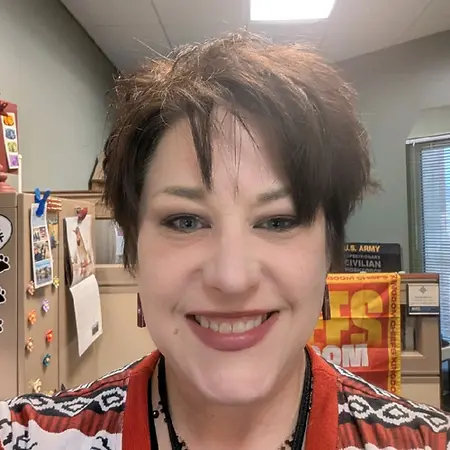
Allyson McNitt, PhD, is a seasoned editor based in Kansas City, Missouri, currently serving at the U.S. Army at Fort Leavenworth. With a PhD in English from the University of Oklahoma, she has dedicated over a decade to writing, editing, and teaching, with a particular focus on military publications and scholarly work in medieval studies. In her current role, she manages a military journal that she built from the ground up, overseeing all editorial processes, layout, and design while ensuring authors retain their voice and intent. Her experience also includes coordinating multiple programs that highlight innovation in warfighting and military learning.
Before launching her current journal, Allyson spent five years as an editor for The Military Review, where she honed her expertise in editing article submissions, managing author communications, and ensuring adherence to professional and academic standards. She also works as a copy editor for The Chicago School, assisting students in preparing dissertations that meet rigorous formatting and style requirements. Allyson’s editorial work spans a wide range of styles, from academic and professional publications to creative writing, demonstrating her versatility and meticulous attention to detail.
Beyond her professional achievements, Allyson is deeply committed to volunteer work, particularly in animal rescue and welfare. She has fostered numerous dogs and cats, actively participating in adoption events and long-term volunteering with organizations such as the Humane Society of Greater Kansas City. Her professional philosophy centers on integrity, precision, and fostering excellence in written communication, while her personal dedication to helping animals reflects her enduring compassion and community engagement.
Her Interview
Ten minutes with Allyson
01What do you attribute your success to?
I attribute my success to stubbornness, honestly. A lot of people get to a certain point, whether they're in school and thinking, God, I've got another 5 years of this, and they consider walking away. But to me, you invest the time and the effort and the money just to drop out? That doesn't make any sense. I was raised to just follow through on commitments, and that became a stubborn area for me. When you've put in the work, the resources, the dedication, you don't just quit because it gets hard or takes longer than expected. That commitment to seeing things through, that refusal to abandon what I've started, has been the driving force behind everything I've accomplished. It's not about being flashy or having some grand strategy. It's about showing up, doing the work, and not giving up when the road gets tough. That follow-through, that stubbornness to finish what I start, is what has carried me through 12 years of college, through building a journal from scratch, and through every challenge I've faced in my career.
02What’s the best career advice you’ve ever received?
The best career advice I've received is to keep true to your skills. Don't try to be something you're not. People are always saying things like, you're good at this, you know, you got this, you can do whatever. And there are moments when you might think, I don't want to do this anymore. But you've got to be true to your skills. When you know what you're genuinely good at, when you've developed those abilities over time, you can't just abandon them because you're frustrated or tired. Your skills are your foundation. They're what you've built, what you've proven, what makes you valuable. Staying true to them means not getting pulled off course by doubt or outside pressure. It means recognizing what you bring to the table and honoring that, even when the work gets hard. Being authentic to your strengths isn't about limiting yourself. It's about knowing who you are and what you do well, and building from that solid ground rather than chasing after things that don't fit.
03What advice would you give to young women entering your industry?
My advice is to stick with getting the education if you can get it. That's only going to help you, and it's only going to make you a better editor. Formal training gives you a foundation that's hard to replicate on your own. Beyond that, internships are a good idea, and volunteering is a good idea. Get hands-on experience wherever you can find it. But don't stop there. Stay active in the field. Read articles that other editors are writing. Pay attention to what's new in the field, what trends are emerging, what conversations are happening. Just keep yourself educated on what's going on. I think that will help give people advantages in certain areas. The industry is constantly evolving, and if you're not staying engaged with it, you'll fall behind. Continuous learning, whether it's formal education, practical experience, or just staying informed about the work others are doing, is what will set you apart and give you the tools you need to succeed.
04What are the biggest challenges or opportunities in your field right now?
The biggest challenge in my field right now is oversaturation. There are a lot of people trying to be editors, and not enough people hiring editors. The number of people who want to break into this field far outweighs the available opportunities, which creates a really competitive landscape. It's not just about being good at what you do anymore. You have to stand out in a crowded market, and that takes persistence, continuous improvement, and a willingness to keep pushing even when the opportunities feel scarce. Another challenge is AI. I think it's making editing more difficult. You want original articles that people actually wrote, not something generated by a machine. We send things through detectors, but they're not always going to pick up on AI-generated content, so sometimes things are just going to slip by you. You try to be aware, but it's an ongoing concern. I'm not teaching anymore, so I would probably be crying a lot if I was still teaching English, because AI and composition classes? I can't even imagine. But you would like to think that people who like to write aren't going to be using it, or they use it for editing or something like that. I think there's potential there for it to help clarify thoughts, but it's definitely complicating the work we do.
05What values are most important to you in your work and personal life?
Honesty and openness are the values most important to me, both in my work and personal life. Not too open, obviously, but professional openness. Being transparent, clear, and straightforward in how I communicate and collaborate. Honesty in writing is crucial. You don't rip off other people's ideas and credit them as your own. You give credit where it's due, you respect the work of others, and you maintain integrity in everything you produce. That honesty extends to how I work with authors as well. I make sure that what I edit doesn't change what they were trying to say, so they always have final approval. It's about being truthful in the work itself and in how I engage with the people around me. These values, honesty, integrity, and professional openness, guide how I show up every day, how I build trust, and how I ensure that the work I do is ethical, respectful, and authentic.
Join Influential Women and start making an impact. Register now.