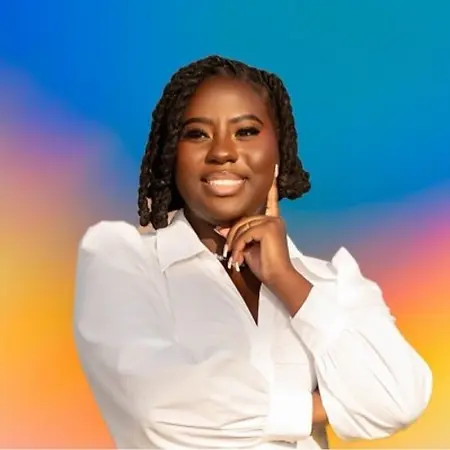
Her Story
About Alyse
My career journey has been defined by pivoting and aligning with what makes me feel whole. I got my bachelor's in biology and was in pre-med throughout undergrad, working full-time the entire way through. As the daughter of an immigrant, I knew I'd have to support myself 100% of the way, which made the path to medical school daunting. I didn't want to lose my interest in healthcare and being part of making the world better, so I got really into research. I worked with LabCorp in molecular microbiology during the height of COVID, which was eye-opening - I realized I love research, but I don't love doing research. The repetitive wet lab work wasn't for me. I had an internship at the Department of Health and Human Services in the State Lab of Public Health, where I worked in the microbiology lab and had a project assessing why samples were coming in as ambient and therefore untestable. That really made me interested in lab directing - being over the research, creating study designs and plans, but not being the person directly doing it. I got another internship with a clinical studies department for a tobacco company, looking at study designs in private industry, and that's when things started to click. I'm an alum from North Carolina A&T State University - the number one HBCU in the country. I wanted to marry my interest in science with regulation, and ensure that disparate communities, whether by disability, gender, or race, are represented in clinical studies. A mentor asked if I'd ever thought about getting my law degree, and after sitting with it, I realized it aligned perfectly with what I want to do. I'm studying for my LSAT right now and gunning for a JD and MPH program through the evening program at North Carolina Central University. My journey has been about having an insatiable curiosity and being flexible - science is not just facts and data, it's also art.
Her Interview
Ten minutes with Alyse
01What’s the best career advice you’ve ever received?
A lot of my mentors have really helped me learn that stepping into the unknown is not scary, especially because it's never truly unknown - you always know your end goal, you always know your plan that you're taking to get there, you just question if it's actually going to get you there. You don't have to know for certain, you just have to take the step. And if it doesn't work out, you can pivot. My mentors helped me navigate the unknown and learn that lesson through hard situations that were placed in front of me from external factors. They helped me really consider what I value in my education, what I value in my execution, and what I value in my personal relationships.
02What advice would you give to young women entering your industry?
I would say really align with what it is that you want to do and have a clear path getting there, especially when it comes to working in the regulatory affairs space. It combines a lot of law and science, and you don't necessarily have to get a law degree - you could get a PhD in your typical sciences - but that marrying and understanding is a part of that insatiable curiosity. With regulatory affairs, you're working with the government and trying to understand the regulation as you're applying that to the science that you're conducting. Having the curiosity to explore the science and making sure that what you're working on is appropriate is really, really important, and that comes with that curiosity and wanting to make sure and learn and grow in that sense as well. You really have to be flexible. Science is not just facts and data, it's also art, in my opinion.
03What values are most important to you in your work and personal life?
My biggest value is growth. I think as we get older and achieve goals, we kind of get comfortable, and we think once we've achieved something, 'what more else?' But it doesn't have to always be that. I think listening to yourself and your emotions, and really listening to who you are is something important. Changing is a part of what it means to be human, and you'll end up being happier that way, especially if you don't ascribe something material to that. You could get a whole bunch of positions or titles, and that's fine, but you don't need to ascribe your value to that, especially thinking that that's what you need in order to grow. You should want that for yourself. Growth is really, really important to me. And on top of that, authenticity. I don't think authenticity is just being genuine and a good person all the time. I also think that being authentic means knowing that you've had a setback or a mistake, owning up to that, and then moving on from it. Not trying to push or invalidate or minimize anything - owning that these are the moments in my history. So just authenticity and growth.
Join Influential Women and start making an impact. Register now.