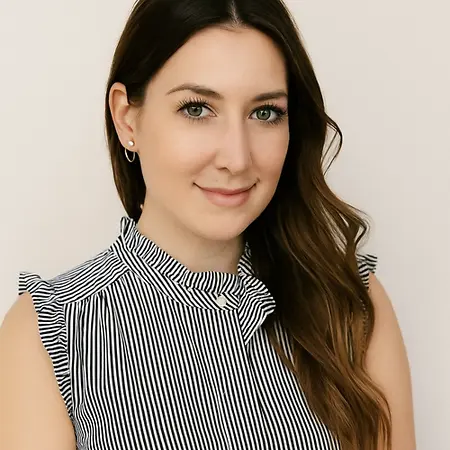
Her Story
About Alyssa
Alyssa Auerbach is a medical education and social impact professional with extensive experience in healthcare operations, program management, and education. She most recently served as the Continuing Medical Education (CME) and Undergraduate Medical Education (UME) Program Manager at Garnet Health Medical Center, where she led initiatives in compliance, budgeting, onboarding, stakeholder coordination, and program development. She also brings experience as a K–12 substitute teacher, supporting diverse student populations across multiple grade levels and strengthening her commitment to accessible, equitable education.
Alyssa holds a Bachelor’s degree in Business Operations with a concentration in Project Management from Southern New Hampshire University and is currently pursuing a Master of Social Work (MSW) at Capella University. Her academic and professional background blends operational strategy with a human-centered approach, allowing her to design and support systems that are both efficient and compassionate. Her work is grounded in a strong commitment to service, equity, and improving outcomes across healthcare, education, and community-based settings.
A brain tumor cancer survivor, Alyssa brings a deeply personal perspective to her work in oncology and patient support services. This lived experience informs her passion for supporting patients, survivors, and families navigating complex health journeys. She is especially dedicated to oncology social work, survivorship support, and program development that bridges clinical care with emotional and psychosocial well-being, ensuring individuals feel seen, supported, and empowered throughout their healing process.
Her Interview
Ten minutes with Alyssa
01What do you attribute your success to?
I have always been a big risk-taker who refuses to dwell on setbacks, choosing instead to accept the lesson and immediately move forward. Many people have told me they cannot believe my internal strength, such as when I boldly picked up my life and relocated to Florida for my MSW practicum without a secured job, simply trusting myself to figure it out as I went. If I had allowed myself to get stuck ruminating on past difficulties or the many bumps in the road that temporarily set me back over the years, I wouldn't be where I am standing today. Life is about having the resilience to cope with what you are dealt and actively moving on, because sitting in stagnation without taking action never makes a situation any better. I fearlessly pursue my passions without overanalyzing or worrying about the immediate logistics, maintaining deep faith that the journey is guiding me exactly where I need to be. Ultimately, despite the obstacles and detours, my ability to take calculated risks and consistently push forward is what keeps me evolving and driving toward my true potential.
02What’s the best career advice you’ve ever received?
The best advice I have ever received is to try everything because you are never permanently locked into one path from the very beginning. When I first started college, I went into IT, but after taking just two classes, I quickly realized it wasn't for me and made the choice to switch. I went through a few direction changes, exploring different options before finally finding my true alignment in social work, which taught me that not knowing your ultimate destination shouldn't stop you from starting the journey. You should boldly pursue anything that sparks your curiosity, and if it doesn't work out, you simply take the lesson, move on, and try the next thing. It is completely normal to pivot a few times, but the key is to actively follow your curiosity until you discover the unique passion that truly rings your bell. Ultimately, every detour is just a necessary step that brings you closer to where you are genuinely meant to be.
03What advice would you give to young women entering your industry?
In today's society, it is far too easy to become a follower and let the opinions of others or the negativity on social media dictate your beliefs and career paths. When people say that social work doesn’t pay enough or that the obstacles are too high, they are projecting their own limitations onto your journey. The truth is that you have to live your life exactly the way you want to, recognizing that what works for others is not what works for you. True happiness is an internal job, and you are the only person responsible for creating your own fulfillment. By tuning out the external noise and having deep faith in your choices, you protect your personal autonomy and stay aligned with your true purpose. Following your unique passion and doing what genuinely makes you happy is the ultimate form of self-advocacy. Ultimately, when you refuse to let society influence your direction and instead rely on your own perseverance, you regain complete control over your future.
04What are the biggest challenges or opportunities in your field right now?
While analyzing the pathway to clinical social work licensure, it is clear that systemic and financial disadvantages, particularly regarding early career compensation remain significant hurdles for emerging professionals. Upon earning a Master’s degree, navigating the state licensing process presents a massive structural obstacle; for instance, completing a full year of intensive university practicums does not legally count toward the post-graduate licensure clock. Instead, a Registered Clinical Social Worker Intern must navigate an additional 1,500 to 2,000 face-to-face clinical hours alongside 100 hours of post-graduate supervision, which often must be personally financed out of pocket. Preparing for and passing the national ASWB clinical board exam represents a temporary step back when trying to establish professional autonomy as a fully licensed therapist or clinical social worker. However, maintaining a strong work ethic, a resilient mindset, and a commitment to one's ultimate career goals makes this rigorous process completely manageable, as the time passes remarkably fast. Viewing licensure not as an insurmountable barrier but as a structured, time-limited process proves that consistent discipline and strategic perseverance ultimately pay off. The key to successfully traversing these early career challenges lies in maintaining professional dedication and taking calculated risks despite the immediate economic realities in the field.
05What values are most important to you in your work and personal life?
My core values are deeply rooted in the unconditional love and support of my family and friends, who serve as my ultimate anchor and provide the foundation for everything I do. Alongside them, my dogs are a massive part of my life, teaching me the value of loyalty, comfort, and non-judgmental companionship every single day. To balance life's daily demands, I intentionally prioritize holistic wellness and mindfulness, finding my absolute peace, mental clarity, and favorite self-care outlet spending time at the beach. My faith and connection to my church community serve as my personal moral compass, guiding how I walk through the world with integrity and helping me see the inherent worth in every person I meet. Furthermore, my love for reading books fuels a natural curiosity and a continuous desire for personal growth, allowing me to constantly expand my perspective and learn from different stories. Ultimately, keeping my life grounded in faith, relationships, and nature helps me maintain a healthy, balanced lifestyle where I can truly thrive.
Join Influential Women and start making an impact. Register now.