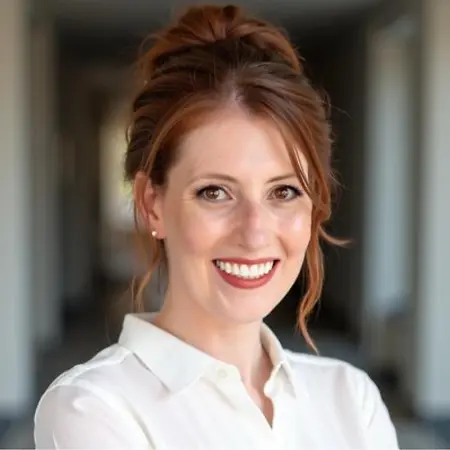
Her Story
About Amanda
I always knew I wanted to make an impact with my career, even back in high school. I was an athlete and went through multiple injuries, including too many concussions to play collegiately, which led me through what's called the athlete Identity Crisis. I initially thought about teaching and coaching basketball, but during my first semester in college, I really reflected on where my skills would be best used. Growing up as the youngest of three, I watched my mom and godmother volunteer with Susan G. Komen when it was first starting out - they were international event planners who took me to all these events. While I didn't appreciate it as a kid, I got a first-hand view of how nonprofits work, and it stuck with me. I realized that many people start nonprofits because they see a need and have that visionary ability, but they don't always have the skills to run the nonprofit as a business. I saw these gaps where nonprofits were doing great work and filling needs, but weren't being run effectively. That's when I decided to do business management for my undergrad and get my master's in nonprofit management. Now, as a Senior Program Officer at the David Merage Foundation, I work on confronting anti-Semitism through partnership building. We're a small team of three at a foundation that was founded in 2024, so we're still in early stages. My work is very relational, which is my favorite part - I'm talking to partners, potential grantees, understanding the field, and helping to change the ecosystem on the philanthropy side of things by bringing funders together.
Her Interview
Ten minutes with Amanda
01What do you attribute your success to?
Honestly, my village. I'm sure lots of people have heard it takes a village, and I think I really was raised by a village. I learned some things early on that really helped set me apart. One of the examples that my mom and my godparents and the rest of my village always say is, the worst they could say is no. That's kind of a mindset that I've had from a very young age, and I feel like a lot of people are scared to ask sometimes, which is so completely valid. But I didn't have that fear, because I was taught that the worst that they can say is no, and if they say no, that's okay. I'd say the encouragement and support of my village and community, and then honestly, my strive to just leave the world a better place. That's always been my motivating factor in everything I do. I'm always looking to make sure that whatever I'm doing, whether it's my career or personal life, that it's reflecting those values. And yeah, I'd say so far that's working out.
02What’s the best career advice you’ve ever received?
The advice that I give to other people that I've taken has kind of morphed over time. In college, I always heard, it's not what you know, it's who you know. And then eventually one of my mentors was like, no, it's not who you know, it's who knows you. Those are the people that are standing up for you in the room that you're not in. Those are the people thinking of you, pushing your name along. I always start off with that sentence of, it's not who you know, it's who knows you. What I take from that meaning is that relationships, at the end of the day, are one of the most important things. How you show up for people, whether it's coworkers, partners, constituents, that's what matters the most, because our actions speak louder than words. It's how you show up and how you create those relationships and continue to sustain them.
03What advice would you give to young women entering your industry?
First, it's not who you know, it's who knows you. Those are the people that are standing up for you in the room that you're not in, thinking of you, pushing your name along. Relationships are one of the most important things, and how you show up for people matters the most. But I also want to emphasize that nonprofit work is really tough, especially with roles that are really close to the cause. We see a lot of burnout, we see a lot of people who care so much that it almost hurts them in a negative way. You really need to make sure you're putting up healthy boundaries and taking care of you, because you can't help other people if you're not helping yourself. I always make sure I harp on this to people who are newer into the field - you need to make sure that you are taking time for you, you need to make sure that there's boundaries up. One of the causes I worked on was mothers and babies in Uganda who have the highest mortality rate, and we were working on solutions to lower that mortality rate. That's a hard one to think about constantly. This work is so important, and we need more people in it, but it's not going to be sustainable if we don't take care of ourselves.
04What are the biggest challenges or opportunities in your field right now?
I think some of the biggest challenges that we've discovered, and this is probably not just to our specific field within philanthropy and nonprofits, but to others as well, is that there's a lot of groups doing siloed work. Everyone's doing really great work, but they're not sharing it widely or sharing it to others. Maybe another group is replicating something that didn't work, and so now we're using money maybe less effectively. Or maybe we're putting money where it doesn't need to be put because it's already been tried. It's the infrastructure of the philanthropy and nonprofit side - how do we all work together towards this one cause?
05What values are most important to you in your work and personal life?
Integrity is a big one for me. I think doing work and having relationships with integrity is super important. Curiosity is another key value - I like to think of myself as a lifelong learner. I hope to never be the smartest person in the room, because I feel like there's always something you can learn from someone else. I think as soon as you think you're the smartest person in the room, then you lose out on that ability. I try to live with, leading with curiosity. And then the other thing that goes with curiosity is empathy. I think the world can use a lot more empathy. I think the world's very nuanced, and I think that we all have - humans are just so complicated. I think we could just have more empathy and compassion for one another, because I think that's what really leads to bridge building and relationship building, and that's truly what I believe is at the center of a lot of these problems that we're seeing.
Join Influential Women and start making an impact. Register now.