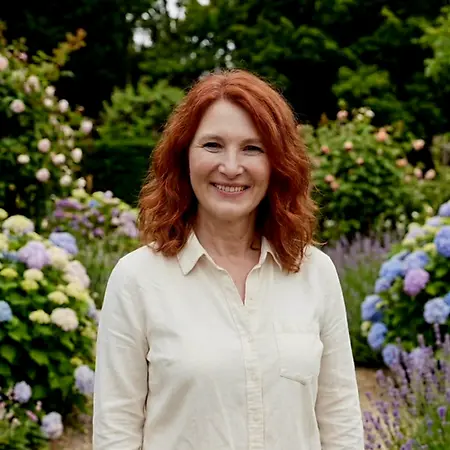
Influential Woman · Consultant
Amanda J. Richer
Displacement Consultant, Amanda J. Richer
Seattle, WA
Her Story
About Amanda
I work at the seam between the street and the institutions that shape it. I came to this field through my own experience of homelessness, and rather than leave that behind when I got housed, I made it my compass. My conviction is simple and stubborn: the people closest to a problem belong in the rooms where it gets solved, and a system built without them will keep designing for a reality it has only read about.
I am, at heart, a translator and a builder. I move between worlds that rarely speak the same language, the clinic and the encampment, the research team and the policy hearing, the United Nations and the neighborhood, and I carry what I learn in each back to the others. When the right tool does not exist, I build it, whether that is an app that helps people find services, a game that teaches human rights, or a simulation that shows decision-makers the human cost of a policy before it reaches a real person.
My work insists on inherent dignity. I believe housing is a human right, that no one should have to perform their worst moment to be believed, and that care extends to the whole of a person, including the animals who survive alongside them on the street. That belief in the bond between people and their animals runs through my health work and my advocacy alike.
As an artist and photographer, my camera does the same work as the rest of me: it bears witness and brings issues kept in the dark, to light.
Her Interview
Ten minutes with Amanda
01What do you attribute your success to?
My success can be first attributed to human rights. Provision of healthcare treatment so that I could live to survive. The upholding of housing first principles which gave me the floor from which I could get up from. Digital access which allowed my skills to sharpen, my education to expand, to answer the questions that plague myself and others, to document for other's eyes so they can understand the depth of issues. My core belief that every person has dignity and worth is what pulled me forward, and it is still the ground I stand on.
I did not get here on my own, and I would never pretend otherwise. The people that saw something in me before I could see it in myself, opened doors: saved a seat at the table, gave an invitation to speak, a chance to help build something real were the catalyst. My part was to be ready to walk through them, and to refuse to waste what I had learned and lived through.
This worldview has been critical to understanding and working on very complex challenges. Nothing is a silo, not even ourselves.
02What’s the best career advice you’ve ever received?
The best advice I have ever received, and the advice I keep coming back to, is to lead with authenticity. For a long time I believed I had to become someone more polished before I could belong in the rooms I was entering: someone with the right credentials and the right background, who had never known the underside of the systems we were discussing. Trying to be that person was exhausting and deflating. The moment I stopped editing myself down and started showing up as exactly who I am, story and all, everything changed. Authenticity is not the absence of professionalism. It is the most honest thing you can bring to a table.
In the day to day, that authenticity shows up as transparency. I try to be clear about what I know, how I came to know it, and where my knowledge ends and needs to expand. One of the most freeing lessons of my career has been learning to say three simple words, "I don't know," and to follow them with "but I will find out." Being frank and honest about what I do not know is what makes people trust what I do know. People can tell when you are performing and when you mean it, and trust only grows from the second. So I lead with who I am, I stay transparent about what I bring and what I am still learning, and I let that be enough, because it is.
03What advice would you give to young women entering your industry?
You are enough, and you always have been. Your voice belongs in the room before you feel ready for it. Almost every woman I know, myself included, has waited for some future version of herself who would finally feel qualified enough to speak. Readiness is not a prerequisite. It is something you grow into by showing up. Do not wait for a title or a credential to hand you permission. Walk in as you are, and let the work and action prove the rest.
When you get there, lead with who you are, not with a polished version you think the room wants. You do not need to have every answer. Some of the most trusted people I know are the ones willing to say "I don't know, but I will find out," and to be transparent about what they are still learning. Honesty is not a weakness in a professional setting. It is the very thing that makes people believe you when you do speak with certainty. Shrinking yourself to fit a room has never helped anyone, and the rooms that ask you to do it were never going to let you do real work anyway.
Finally, remember that no one arrives alone. People opened doors for me before I could see what they saw in me. I came to this work without a traditional path, and I have still been able to publish, serve on national boards, and carry testimony to the United Nations. I tell you that not to impress you but to promise you that it is possible. So find the people who will hold those doors for you, learn relentlessly, and when you are further along, reach back and pull someone else forward. Ground yourself in something larger than any single job, whether that is human rights, justice, or simple human dignity, and let it steady you. Then say the true thing, even when your voice shakes. Especially then.
04What are the biggest challenges or opportunities in your field right now?
The biggest challenge in my field is that we are no longer facing one crisis at a time. We are facing converging crises that compound one another's risk and effects, and they land hardest on the same people. Someone without stable housing is now navigating an affordability crisis, a public health and overdose crisis, a climate that brings wildfires and heat that can kill, and a political climate that is cutting the very supports meant to catch them. And the biggest challenge in a society based on capitalism is of course funding solutions. We are conditioned to justify lives in monetary worth. None of these operate in isolation. A heat wave becomes a health emergency, a health emergency becomes a lost job, a lost job becomes an eviction, and an eviction becomes exposure to all of it at once. We too often treat each piece as separate, and in doing so we miss how the risks stack and multiply for the people who can least absorb them.
On top of those overlapping emergencies, is the significant effort to move away from evidence and science to arbitrary opinions. Unfortunately there is a narrative that we can solve homelessness by making it more painful to be homeless. It's a tale as old as time, which interestingly hasn't even changed wording much since the 1300's. The public has been conditioned to see a person without housing as a nuisance to be managed rather than a neighbor in crisis, and that story makes it politically easy to pass camping bans and order sweeps that criminalize the crisis instead of ending it. The idea that it is a personal failure is prevalent even while historic disasters wipe out towns. Choices based on the removal of inherent dignity produce scattered people, destroyed belongings, and broken trust, and they push people further from help at the very moment the compounding crises make that help most urgent.
The opportunity, and it is a real one, is that the ground is genuinely shifting. Rights-based approaches are gaining traction, and the tools of the field are catching up: technology that helps people find resources, data that shows decision-makers the human cost of a policy before it lands, and integrated models of care that treat a person as a whole, including their animals and their environment. That last point matters more than ever, because problems that converge have to be met by solutions that connect. Used responsibly, even artificial intelligence can help us see those connections and reach people in ways we could not before.
So the field is standing at a hinge. We can keep spending enormous energy pushing people out of sight while the crises pile up, or we can put the people closest to the problem at the center of solving it and build something that actually holds. I am spending my career on the second path, from a neighborhood consumer panel through to the United Nations, because I have seen what changes when the person who survived it, shapes the ways in which we can solve it. I believe in us, and our ability to do better by this beautiful world.
05What values are most important to you in your work and personal life?
Persistence, honesty, truth, honor, and kindness. Those are the ones I try to live by. Persistence, because the problems I care about do not resolve on any timeline that rewards quitting, and because I know from my own life that things can change if you refuse to stop. Honesty and truth, because I would rather say the uncomfortable thing, or admit that I do not know, than pretend my way through. Honor, because your word and your integrity are the only things no one can take from you. And kindness, because it is the simplest and most underrated force I know, and it costs so little to extend.
Every living thing has worth, and I hold that as seriously as I hold anything. I aim my honesty and my persistence at us, at the systems we built and can rebuild, while trying never to forget that the goal is a world that is kinder to all of it. If I can leave things a little more humane than I found them, and hold the door open for whoever and whatever comes next, I will have spent my life on the right things.
Join Influential Women and start making an impact. Register now.