Discover why "communication is key" may be sabotaging your relationships and what really matters when arguments keep repeating themselves.

Verified Member
Influential Woman · Professional Services
Amber Frazier-Finkelstein
CEO & Founder, Battles Insights
Durham, NC 27713
2Articles published
“
I started a pandemic-era business for underserved businesses, but it failed. It taught me that seeing a need and believing in a mission aren't enough.
Amber Frazier-Finkelstein · In Her Own Words
Her Story
About Amber
I'm Amber Frazier-Finkelstein. I run Battles Insights and I built the Conversation Cores Method.
I did not start this company because I saw a pattern in other couples first. I started it because Jake and I had the same fight for ten years. Different Tuesdays. Same fight. The love was never the problem. We just could not see what was actually happening between us.
The shift came in a season when his work fell to me and my work fell to him. Three weeks in, he came home and said four words. I had no idea.
That sentence did not fix anything overnight. This is not a Hallmark movie, and nobody learned the lesson by minute 82. What it did was make the same problem visible to both of us at the same time, for the first time. We started writing things down. What each of us thought was happening. What each of us assumed. Where we were right. Where we were wildly wrong. The gaps had almost nothing to do with effort. We had been living from different maps of the same household, and every fight had been about the difference between those maps, but neither of us had seen the maps clearly enough to compare them.
The process we built that season became the early version of the Conversation Cores Method.
What I did with it from there is the part that turned it into a company. I took it into other couples' lives. Couples who looked nothing like Jake and me on the surface, and exactly like us underneath. I watched the same structural pattern surface in marriages that had nothing in common with mine, except this: two people working from different sets of facts about the same shared life. The Method got sharper every time. The 56 pairings stopped being a theory I had written down and started being something I could name on sight.
Before this work I spent years in education, then ran my own content and social media business for about six years. Then I got pregnant with our daughter Penny, closed the business, took contract work, raised our kids, and wrote science fiction on the side. I never used the label. Not because I was above it. Because I had spent years being the person who heard it and quietly wrote women off. That tends to change your relationship with a word.
Battles Insights is what I do because the same problem kept showing up everywhere I looked. In founders. In spouses. In parents. In women who did not want to be reduced to the house but were still running most of it. In men who believed their value depended on what they earned. In couples who loved each other and were working from completely different sets of facts.
Her Interview
Ten minutes with Amber
01What do you attribute your success to?
A few things, none of them especially glamorous.
The first is that I built the Method out of a real failure and refused to dress it up. Jake and I had the same fight for ten years. We are loyal people, we are capable people, and we still spent a decade missing each other. That is the experience the work is grounded in. The Method exists because I lived inside the problem long enough to see its structure.
The second is that I did not stop at the version that came out of our season of role reversal. The Conversation Cores Method that lives in the world now is the one that got tested against couple after couple, refined when the pattern did not hold the way I thought it would, and rebuilt when the evidence required. Eight Cores. 56 pairing profiles. Each one with a friction pattern I can describe specifically because I have seen it run.
The third is what I learned before any of this existed. Years in education. Six years running my own content and social media business. An MBA in organizational management and psychology. Contract work. Raising two kids while writing science fiction. None of that looks like preparation for couples communication work from the outside. From the inside it is the entire reason I can see the structure underneath what couples are saying. I have spent my career watching how people present themselves when they are trying to look fine while everything behind the curtain is smoking.
The fourth is Jake. The Method was developed with him. He does not run workshops or teach the work. He is the partner the Method came out of, and the reason the work is honest is that he pushes back on anything I cannot defend.
02What’s the best career advice you’ve ever received?
The best advice I ever got was not delivered as advice. It was the way I was raised.
Nobody in my family ever suggested I should make myself smaller to be likable or easier to manage. I was expected to be smart, to have opinions, to back them up, and to take responsibility for what I built. That expectation became the floor I worked from.
The closest thing to a formal piece of advice that stuck came years later, from someone who told me to stop performing competence and start demonstrating it. There is a real difference. Performing competence is a constant tax. You spend half your energy proving you belong in the room. Demonstrating it is doing the work clearly enough that the question stops getting asked. The shift saved me a decade of effort I would have spent on the wrong audience.
The other piece that has held up across every job and every business is this. Be careful what you agree to absorb. Other people's anxiety, other people's urgency, other people's framing of what your work should look like. None of it is automatically yours. You can decline.
03What advice would you give to young women entering your industry?
Do not enter this industry trying to be the calm, agreeable version of an expert. There is already a glut of that, and most of it is not helping anyone.
The couples communication space is full of soft language built to avoid offending anyone. The result is content nobody reads twice, advice nobody acts on, and a category of work that has been positioned as a last resort instead of a normal practice. If you are coming into this field, the most useful thing you can do is be specific. Name what you actually see. Build something a real couple would use in their actual house on a Tuesday night, when one of them is making dinner and the other one is mad about something neither of them has said out loud yet.
The second thing. Pick a specific person to build for. Not "women" or "couples" or "leaders." The exact kind of person whose life you understand from the inside. You do not have to be everything to everyone. You will do better work, faster, if you are honest about who you are actually qualified to serve.
The third thing. Do not let people frame your work as a passion project just because it is about relationships. The work I do is structural. It uses organizational psychology,
Ccommunication theory, and pattern recognition built across years of professional experience. Letting other people call it a hobby because the subject matter is domestic is a mistake. Correct the framing. Out loud.
The last thing. Build something you would still want to be doing in ten years.
The last thing: build something you would still want to be doing in ten years.. Pick the work you would do even if nobody celebrated, and then go build the business case around it.
04What are the biggest challenges or opportunities in your field right now?
The biggest challenge is structural. Couples communication support has been positioned for decades as a last resort. You go when the relationship is failing. You go when you have run out of other options. That framing keeps the whole category underdeveloped. The couples who could most benefit from this work are the ones who are functional, committed, and still running the same fight every six weeks, and they have almost nowhere to go that is not therapy or a self-help book.
The second challenge is the buyer unit. Most personal development products are built for individuals. A couple is not an individual. It is two people who both have to agree to engage, both have to show up, both have to keep showing up. That changes how you build the work, how you price it, how you deliver it, and how you define success. Very few people in this space have solved for it, because the answer is not to make the product easier. The answer is to make the work specific enough that both people see themselves in it.
Both of those problems are also the opportunity. Battles Insights is built directly into that gap. The Realignment Lab is the 90-minute solo session for the partner who has been doing the noticing and needs to sort what is happening before trying another conversation. The Fight That Keeps Coming Back is the six-week intensive for couples who already know what they need to talk about and cannot get there. The Conversations That Change the Pattern is the six-month version for couples who need integration. The Business of Us is the full-day workshop Jake and I co-facilitate for leadership couples whose business and household are tangled together. The Conversation Cores Assessment is free, takes about ten minutes, and gives both people a first read on the pattern affecting their conversations.
The broader opportunity is that emotional intelligence has stopped being a soft skill. Organizations are paying for it. The architecture underneath the Conversation Cores Method has serious leadership applications, because the same skills that hold a marriage together under pressure hold a business partnership together under pressure. That is the crossover we are actively building.
05What values are most important to you in your work and personal life?
Honesty without apology. I would rather say the accurate thing than the comfortable approximation of it. Most couples I work with are not stuck because they have stopped loving each other. They are stuck because nobody in their life is willing to name what is actually happening. Polite circling is not a kindness. It is a way of leaving people in the same loop they came in with.
Rigor about what I build. The Conversation Cores Method has been revised more than once, because real couples surfaced gaps the original version did not account for. I am more attached to what is true than to what I already made. A framework that cannot survive contact with real life is not worth keeping.
Treating couples like adults. The work I do is for capable people who do not need a sticker chart for basic communication. I assume my clients are smart, exhausted, and tired specifically of generic advice. The Method is built for that. The workshops are built for that. The assessment is built for that.
Building something that compounds. Battles Insights is not a course with a shelf life or a workshop you take once and forget. The assessment feeds the Lab. The Lab feeds the six-week. The six-week feeds the six-month. The Business of Us pulls leadership couples into the work through the door of their company. Couples leave with a written communication guide built specifically for their relationship. That guide is theirs. They keep using it.
And Jake. He was my best friend long before he was my husband. The marriage we have now is more honest than it has ever been. Not perfect, not tidy, not some staged after-photo where we figured it out and now drink coffee in matching sweaters like beige weirdos. More honest. Building Battles Insights with him in the picture, not despite him, is the version of this work I want to be doing.
Her Content Hub
Articles by Amber
"Communication Is Key" Is the Worst Advice You Have Ever Been Given
Why Better Communication Won't Fix Your Recurring Arguments

"Communication Is Key" Is the Worst Advice You Have Ever Been Given
By Amber Frazier-Finkelstein
Every woman I know has been told that communication is the key to her relationships, her marriage, her team, and her sanity. It is the advice featured on every podcast, in every workshop, during every HR training, and on every wedding card. It is also the reason most of us keep having the same argument.
It is Tuesday. The dishwasher is full. You ask your partner if they can unload it. They say, "I'll get to it."
You say, "You said that yesterday."
They reply, "Why are you starting?"
Forty minutes later, you are no longer talking about the dishwasher. You are talking about last weekend, the in-laws, who said what at dinner in March, and the toilet paper roll. Nobody knows how you got there. Both of you are convinced the other person started it.
You did not have a communication problem. You had this same argument in November. And in August. And the Tuesday before that.
What were you thinking when the dishwasher conversation started?
Not about the dishwasher.
The same thing happens when an issue keeps resurfacing at work. The one-on-one that keeps getting tense. The project that keeps stalling. The person who goes quiet during the same type of meeting. The conversation you have had with the same direct report three times this quarter.
The topic changes.
The reaction does not.
Here is what most people miss: the topic is the costume. The argument is what is wearing it.
You keep trying to fix the costume.
"Communication is key" is the worst advice you have ever been given because it sends you back into the same conversation armed with better wording. It tells you to use "I" statements, softer tones, and active listening, but none of that addresses the real argument.
You are communicating.
You are simply communicating about the wrong thing, using the wrong tools, and operating at the wrong layer.
Your shoulders know the next round is starting before your mouth does.
When that happens, stop the conversation.
Not the relationship.
Not the meeting.
The conversation.
Then ask three questions.
Ask them out loud.
Write them down if you have to.
What did I say?
What might they have heard?
What keeps showing up, no matter what the topic is?
The third question is the answer.
The first two are how you get there.
Discover why "communication is key" may be keeping you stuck in repetitive arguments. Learn how to identify the real underlying issue beneath surface-level conflicts and break the cycle of recurring disagreements in relationships and the workplace.
"Communication Is Key" Is the Worst Advice You Have Ever Been Given
Why Better Words Won't Fix Your Recurring Arguments—It's What You're Really Fighting About
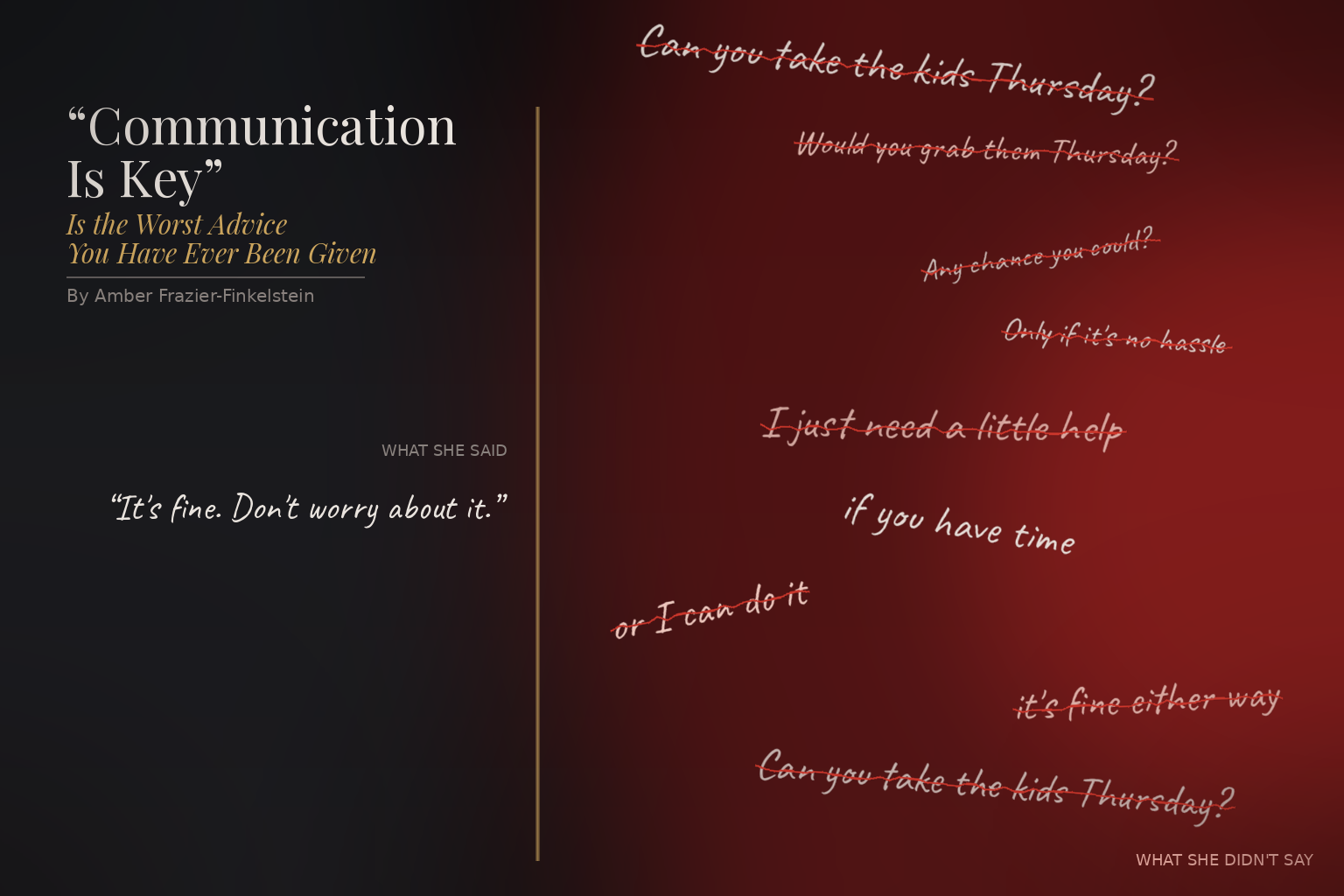
"Communication Is Key" Is the Worst Advice You Have Ever Been Given
By Amber Frazier-Finkelstein
Every woman I know has been told that communication is the key to her relationships, her marriage, her team, and her sanity. It is the advice on every podcast, in every workshop, in every HR training, and on every wedding card.
It is also the reason most of us keep having the same argument.
It is Tuesday. The dishwasher is full. You ask your partner if they can unload it.
They say, "I'll get to it."
You say, "You said that yesterday."
They say, "Why are you starting?"
Forty minutes later, you are no longer talking about the dishwasher. You are talking about last weekend, the in-laws, who said what at dinner in March, and the toilet paper roll.
Nobody knows how you got there. Both of you are convinced the other person started it.
You did not have a communication problem.
You had this same argument in November. And in August. And the Tuesday before that.
What were you thinking when the dishwasher conversation started?
Not about the dishwasher.
The same thing happens when an issue keeps coming up at work. The one-on-one that keeps getting tense. The project that keeps stalling. The person who goes quiet in the same kind of meeting. The conversation you have had with the same direct report three times this quarter.
The topic changes.
The reaction does not.
Here is what most people miss:
The topic is the costume. The argument is what is wearing it.
You keep trying to fix the costume.
"Communication is key" is the worst advice you have ever been given because it sends you back into the same conversation with better wording. It tells you to use "I" statements, softer tones, and active listening, yet none of that touches the real argument.
You are communicating.
You are simply communicating about the wrong thing.
With the wrong tools.
At the wrong layer.
Your shoulders know before your mouth does when the next round is starting.
Stop the conversation when that happens.
Not the relationship.
Not the meeting.
The conversation.
Then ask three questions.
Ask them out loud.
Write them down if you have to.
What did I say?
What might they have heard?
What keeps showing up no matter what the topic is?
The third question is the answer.
The first two are how you get there.
Join Influential Women and start making an impact. Register now.