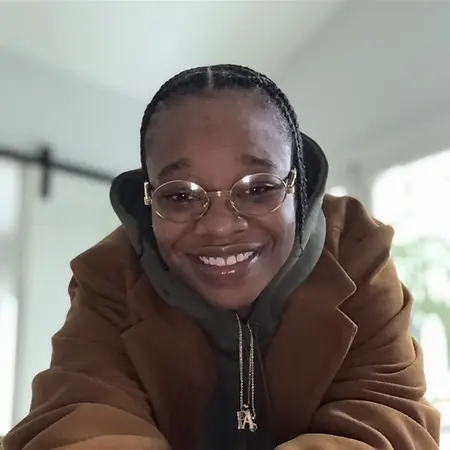
Her Story
About Amber
Amber Portis, Psy.D., MFT Student, is a seasoned behavioral specialist and clinician based in Los Angeles, California, with over 18 years of experience supporting individuals with diverse developmental, behavioral, and neurological needs. She entered the field due to a deeply personal connection her nephew, who is on the autism spectrum and will be 21 in January. As a Black woman, she recognized early on that conversations around special needs were often limited within her community, and her own family initially lacked understanding and acceptance of autism. Over time, her professional training and lived experience helped her and her family fully understand her nephew’s diagnosis, shaping both her personal purpose and professional calling. Today, she grounds all of her work in his experience, consistently asking herself how she would want her nephew to be treated in every home, system, and clinical interaction. Throughout her career, Amber has worked across a broad range of service settings, including regional center programs, school-based services, health insurance–funded interventions, in-home therapy, and center-based programs. For the past four and a half years, she has specialized as a behavioral consultant in private, high-profile households, providing intensive behavioral support and family-centered care. Her experience includes extensive work with nonverbal individuals, an area she approaches with deep sensitivity and understanding of the emotional impact on families. Drawing from her psychotherapy training in Marriage and Family Therapy, she is skilled in meeting households where they are emotionally particularly in moments of grief, adjustment, and redefinition following a diagnosis—while also delivering structured, evidence-based behavioral interventions grounded in autism specialization. In her role as a Behavior Consultant and liaison with The Stepping Stones Group, Amber develops and implements individualized behavior intervention plans, conducts data analysis, prepares comprehensive clinical reporting, and collaborates closely with families, caregivers, and interdisciplinary teams. She is a certified autism specialist and has advanced through roles ranging from entry-level therapist to supervisory leadership positions. Her clinical approach blends behavioral science with psychotherapy-informed insight, allowing her to support both skill development and emotional processing within the home environment. One of her greatest professional rewards is maintaining long-term relationships with families who, years later, share updates and milestones such as children graduating or achieving significant life goals reflecting the lasting impact of her work. Across all roles and settings, Amber remains grounded in the belief that every position she has held has contributed to a larger purpose centered on dignity, compassion, and meaningful outcomes for the individuals and families she serves.
Her Interview
Ten minutes with Amber
01What do you attribute your success to?
I attribute my success to my compassion, my ability to create and build relationships, and being able to meet people where they are. My authenticity is a huge part of it. I think I disarm people by being able to show them who I am through my heart and through my actions. I focus on building a relationship with people because I understand you can't do a lot with an individual if you don't have a relationship with them. You can't say a lot of tough things that you may need to say to someone if you don't have a relationship with them. My ability and my understanding of that has really created a space for me to kind of get where I'm at and has helped me with networking and having some of the relationships that I have to this day.
02What’s the best career advice you’ve ever received?
The best career advice I ever received came from my principal during my senior year of high school. I had moved to another location and thought I could just skate by since I had everything done, but she enrolled me in all these AP classes because of my grades. When I protested, she told me: just because you have shown that you could do it doesn't mean you still don't have to continue to show it. That resonated with me, especially now, because this was a Black woman saying this. It resonates now more than it did before because of the constant need to stay present and on top. I don't really have space to lax or lollygag. What she was telling me in that moment was that as a Black woman, you don't really have the space to stop at that just because that's what you want to do. You have to continue to show your greatness, because if you don't show it, no one's gonna see it. You're gonna be blended. I was always able to do well in school, so I didn't really feel like I needed to keep performing, but then I understand that you do. I have to keep performing until I don't want to do it anymore. That advice really helped put me in different positions because I understood that you just gotta keep going.
03What advice would you give to young women entering your industry?
My advice is consistency, and you have to know that this has to be something that you really want to do. A lot of people get into it because they say they love kids, and that's great, but these are not the type of children that you would see in the forefront of the classroom. These are the children in the back. Loving children is great, but are you going to be able to really support a child when they are experiencing dysregulation and behavior that you may be targeted for? My advice is consistency and making sure that this is really something that you want to do, because this is essentially prescribed medication for an individual, and it's not fair for someone to get into this field and not know if they really want to do it, because it means a lot for other people. It changes lives. It is important, and it really sets the tone for a lot of different things. If you're coming in and you're unsure and you don't really know and you're not confident, it may show. But your consistency, and if it's something that your heart is really into it, and it's not about accolades and it's not about a pat on the back, the most reward you get is seeing your work in the life transaction. My advice is being okay with being the underdog while also knowing that you're the most needed in the room.
04What are the biggest challenges or opportunities in your field right now?
I think the biggest challenges could be misinformation. A lot of individuals may take pieces of information and run with it, and try to develop understanding and may potentially give this information over to other people, but it's just not suitable for your situation. I think sometimes there's this one-size-fits-all mentality, but it's not. Everything is very uniquely personalized in this field, and I think that although some things definitely look similar, we should always think about how things are individualized, and that one person's success doesn't mean that it's another person's failure, and vice versa. As for opportunities, I think there's opportunity for psychoeducation. So many more diagnoses are happening, and I think the fear or sometimes shame that some parents feel, where they don't want to admit those things because it gives this negative connotation versus just a true feeling of 'I don't know what to do, I'm not prepared for this,' not because they don't want to experience it, but because they don't know what to do when these things happen. I think there's an opportunity for more real conversations, conversations that provide parents the space to be candid and not judged, with an understanding that they have a different journey than other people. I think there's opportunity for real conversation, not fluffed, but real conversation that allows for people to be seen and heard, so people aren't suffering behind closed doors or guilt-tripping themselves or having these overwhelming emotions where they feel like they can't share it because it doesn't fit what you would expect a mom to feel or what you should adapt to feel.
05What values are most important to you in your work and personal life?
Authenticity is definitely one of my core values. I want people to be exactly who they are. I don't want to have to guess anything. I want to know that we have connected because I see you and you see me, not because you think I want to see this version of you. If this version of you cannot be sustained, if it's not something that can last with longevity because it's not truly you, then there's no real connection. Respect is equally important to me. I want to be able to know that I'm respected just through my career, my experience, what I can bring to the table, and I come into every environment with every person showing and providing respect as well. If I'm in your home, I'm respecting, I'm greeting, I'm doing everything that I need to do for you to understand that I am a guest in your home. Respect is definitely something that I hold high, because I respect the children that I'm with as well. I believe in respecting children, I believe in providing that autonomy, because they are humans, and I just don't understand why it would be this idea that they don't deserve those things as well. I think with authenticity, the trust and the honesty and all those things kind of come hand in hand, and those things all just kind of mesh together.
Join Influential Women and start making an impact. Register now.