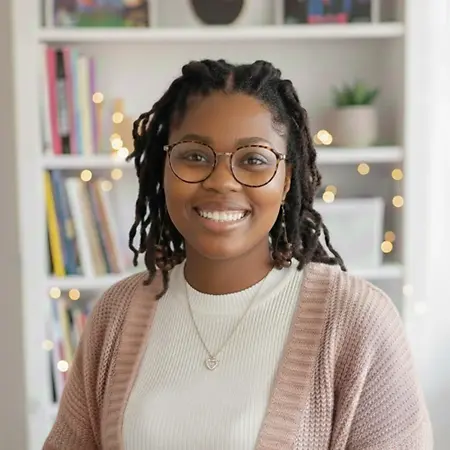
Her Story
About Aminah
I've been in my current role for about a year at Amora Health, where I work with adolescents and young adults. My journey into social work came from my own long history with mental health - I found there was a gap between practical resources and mental health care, and I wanted both. I wanted the empathy and charismatic care that social workers are known for, but I also needed those practical, clinical, evidence-based skills and connections, not just 'here are some services for you.' Getting into clinical work gave me that evidence base so I wasn't just out here being nice, but had something proven to help people. I've done a lot of outpatient and inpatient psychiatric hospital work, primarily with youth. I was an inpatient women's therapist at Rockswings Hospital in Georgetown, Texas for a few years. I've also done contract positions with Austin ISD doing mental health evaluations for kids, worked at Ellie Mental Health doing individual psychotherapy, and completed internships with some really great people in the Austin area. My clinical supervisor Bolu Dosmu allowed me to work under her practice for a few years, take clients, and get an understanding of what it's like to run a practice. Now I'm starting my own PLLC to reach out to BIPOC communities, hosting events about women, mental health, and faith. My most notable achievement was getting my clinical license - I was diagnosed with epilepsy during my master's program after getting COVID and the shot, and everyone told me I needed to stop. I was at the point where I couldn't even care for myself, but finishing my master's and then those two years of clinical supervision and passing that exam without stopping was a huge achievement for me.
Her Interview
Ten minutes with Aminah
01What do you attribute your success to?
I gotta say, my Lord Jesus. My faith is big to me. Even when I got diagnosed with epilepsy, that was a very hard season, but I feel like I've been healthy and on a good track. Everything that I do, I serve others out of love, because that's what He commanded us to do - to love God and then love our neighbors. That is what keeps me going, even when I don't want to sometimes. This is a hard field, but that's my purpose and the drive behind everything that I do. So definitely, God.
02What’s the best career advice you’ve ever received?
The best advice I've received is that you don't have to try so hard to gain clientele. The right people will come to you, and they'll come to you for a reason. You'll find that those people that naturally come to you are the ones that you need to be working with the most. It's sort of like divine intervention - you don't have to try so hard. I know a lot of clinicians worry about income flow and things of that nature, but the right people will come to you. Focus on the population that you want to serve rather than trying to be a jack-of-all-trades.
03What advice would you give to young women entering your industry?
I think the same advice that was given to me - you don't need to cater to everyone to feel like you have a leg up on people or that you stand out. The right people will come to you, and they'll come to you for a reason, because they see something significant in you. Find your niche, but don't push so hard. Things will happen as they need to happen. Trust the process.
04What are the biggest challenges or opportunities in your field right now?
There are a lot of political things going on right now, even with the whole ICE thing. As a social worker, we're supposed to treat everyone with equity, and it's really hard to do that when you have a lot of political barriers. People don't get access to the same services, and there are confidentiality concerns - what do you do in that situation? With a lot of political movements and things going on in our public school systems, it makes it difficult sometimes to serve the population in the way that meets their needs because of laws. In the social work community, we're always getting notifications and staying up on it to make sure that our primary concern is the clients that we serve, while also following the laws and regulations of this nation. Political changes are presenting barriers to serving the community in a fair way.
05What values are most important to you in your work and personal life?
I really value communication. I feel like that one is not as deep, if you will, but transparency is important, and I find that a lot of communication will just eliminate confusion and eliminate a lot of conflicts that can transpire. I love the fact that I'm just communicative, and that cuts down a lot of barriers with my clients, with my family, and just in general. Even if it's uncomfortable, even if it's not. I also very much value quality time. I don't care much for social media, I don't really care much for talking on the phone or texting - I really want to see you in person and spend time with you and see your face. So those are my two values: communication and quality time.
Join Influential Women and start making an impact. Register now.