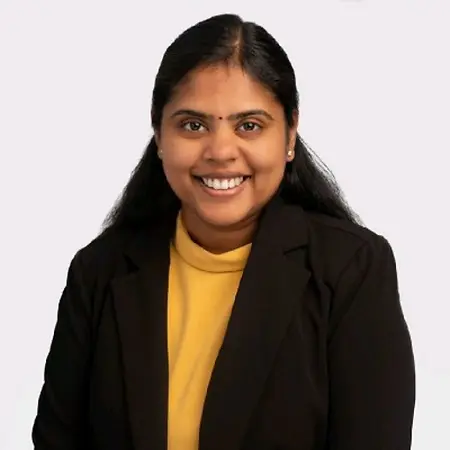
Her Story
About Amrutha
I have about 20 years of experience in the technology industry, starting as a data engineer in India where I worked for a couple of years. I then moved to the United States for a job opportunity at Honeywell Aerospace, where I spent 4-5 years in consulting roles. For the past 14 years, I've been with Jefferies, a financial services organization, where I initially built all of their data platforms from the ground up. I've grown significantly in my career there and now manage a global team, currently heading AI for corporate data. My proudest recent achievement is building an AI-powered data marketplace that enables secure enterprise-wide data democratization. Beyond my technical contributions, I care deeply about who gets opportunities in technology. I was one of the founding members and have chaired Jefferies' Women in Tech Enterprise Resource Group for the past 3 years. When I joined Jefferies 14 years ago, I was literally the only woman in the room for many years, so creating change has been personal for me. Through our ERG, we've made significant progress - advancing from one female managing director across all of technology to three, improving summer internship hiring of female students, and seeing much better engagement scores and promotion rates for women. I recently spoke at Sonata Software's International Women's Day fireside chat, which had about 150 senior leaders attending from across the globe. The session focused on mentorship and the theme of 'Give to Gain,' and the feedback I received was that my personal experiences really resonated with attendees. As a mother of two pre-teen girls, this work is especially meaningful to me because I know the environment we create at work quietly shapes the world they're growing up into.
Her Interview
Ten minutes with Amrutha
01What do you attribute your success to?
I would say that my family is my biggest strength. My mother was a single child, and during her time, especially back in India, everyone told my granddad he had no successor for his business. But he brought up my mom like a son, and she was definitely an inspiration to me. Given the opportunities she had, she had to fight against a lot of odds to get to where she was, but I would say in my generation, I definitely had it easier than her. She is my inspiration, even today, and given what she has achieved within the parameters that she had, I felt like it would not do justice if I wasn't able to really chase my dreams and get to where I am today. My husband is my pillar of support - I'm sure behind every successful woman, there is a man. He has really been the pillar of my support, and my two pre-teen girls understand what dad's contribution to the family is. They see that responsibilities don't have to be a woman's job, and that girls can do anything they put their heart to. There's no difference between a girl and a boy. I'm hoping they can see that we are just equals, and I think we are almost there - they don't even differentiate the responsibilities between a man and a woman anymore.
02What’s the best career advice you’ve ever received?
One line that my CEO once said to us in one of the meetings has really stood out to me: to be authoritative without being arrogant. That's something that has really resonated with me and shaped how I approach leadership.
03What advice would you give to young women entering your industry?
As a first-generation immigrant, I have been through a lot, and one thing that I have learned from my career is to speak up for myself and stand up for myself. I know that's not very easy, especially when you come to a country where English is not your primary language. Language was definitely a barrier for me, but I really worked very hard, persevered, and overcame that barrier. In today's world, though, there's a lot of difference since the time I came here almost 20 years ago. AI is now one of the big things in the mix today, and I think this language barrier that I was talking about is really being removed as part of AI, because we have so many tools now, even to write emails or make presentations. I know there is a lot of controversy around AI, but positivity is one of my biggest strengths, and that's how I have persevered and reached where I am today. I always like to see the positive side of things, and that is one positive side of AI that I see - it empowers not only women, but everyone to kind of get over their fears. It is like a tool that you have in your hand, and you don't need anybody's help, you don't need to be hesitant to ask anyone, and you can use it to really excel.
04What are the biggest challenges or opportunities in your field right now?
I think even with all of the information that's available and all of the ERGs and everything that we are trying to do, there is definitely still some disparity, especially at a global level. When I was talking at Sonata Software, many of their employees were based out of India, where their working hours are different and their family structures themselves are different. Women are still treated as the primary caregiver. The allyship, I feel, is something which is very critical. We have a lot of managers who still make assumptions - both within and outside the industry. Family assumes that you are the primary caregiver and responsible to take care of the child, and managers assume that because you are the primary caregiver, you're not going to show up at work. I feel that these assumptions are definitely an issue, and what I would advise is to have an open conversation, both at home and at work. It is not just the family or the manager's responsibility, it has to be the woman's responsibility as well, which ties back to standing up and speaking up for yourself. We need to set the boundaries and expectations up front, and once the expectations are clearly set, both at the family and at the employer level, then things become much smoother than people making assumptions. One of the good initiatives that we do at Jefferies is a maternity leave buddy program - when our employees return from maternity leave, we pair them up with somebody who is a recent returner, and we also welcome them with flowers and a personal greeting card. These may sound like small things, but it really means a lot to them, especially everything that they're going through during that period.
05What values are most important to you in your work and personal life?
A couple of value systems that have been imbibed into me even from my childhood are hard work and empathy - and I can never go without those two things. That's what I'm passing down to my children as well. And of course, integrity, which goes without saying. As a leader, I think empathy is a very important characteristic, and I have been fortunate enough to have managers who have been empathetic towards me, and that's what I am hoping to pass on as well. When you manage global teams, it becomes really important - simple things like time zones matter. Recently, we've been interacting a lot with Asia, and we have to make sure that we don't schedule calls at 10 PM their time. The other thing that I myself have faced when I came here is the language barrier - there are different idioms and metaphors that are spoken that not everybody will understand. So being aware of the audience and aware of your team members, and being empathetic, I feel really connects me to my team and goes a long way in leadership. Once that relationship is built, then my teammates have an open conversation with me because I first display my vulnerability and give them the impression that there are so many things that I have been through, so I can understand what they are going through. That's how I really form that relationship.
Join Influential Women and start making an impact. Register now.