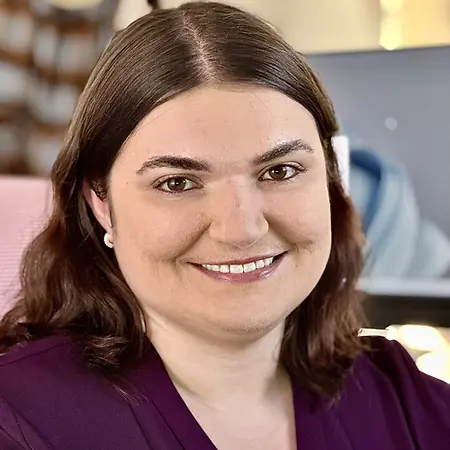
Her Story
About Amy
Amy is a Solutions Architect at LTN Global, based in the Philadelphia, Pennsylvania area, where she designs end-to-end IP video and broadcast streaming solutions for customers across the media and entertainment industry. With nearly a decade of experience in broadcast technology, she partners directly with clients to identify technical challenges, translate business needs into scalable workflows, and collaborate with engineering and infrastructure teams to build reliable, future-ready video delivery systems. Her work focuses on IP video transport, streaming applications, and modern broadcast architecture, helping organizations transition from legacy systems to flexible, software-driven distribution models.
She began her career at The Walt Disney Company, working within ESPN’s broadcast and streaming operations, where she gained hands-on experience supporting live streaming systems, monitoring digital video workflows, and contributing to major initiatives such as the launch of the ACC Network in 2019. Over time, she progressed through roles including Broadcast Systems Specialist and Content Systems Engineer, developing expertise in cloud technologies such as AWS services, including Lambda, EC2, S3, and FSx. This foundation gave her a strong technical background in both traditional broadcast environments and emerging streaming ecosystems.
Amy holds multiple advanced degrees from Penn State World Campus, including a Master’s in Data Analytics and an MBA, and she has also pursued certifications in networking and enterprise systems. She is known for her collaborative approach, combining technical precision with strong communication and customer engagement skills. Outside of her core technical work, she is active in industry discussions around media innovation and IP-based distribution, and she is recognized for her ability to bridge the gap between complex engineering systems and practical business outcomes in the evolving broadcast landscape.
Her Interview
Ten minutes with Amy
01What do you attribute your success to?
I’d describe myself as very open-minded and adaptable. I think a lot of people naturally stay within their comfort zones because it feels safe and familiar, but I’ve always been willing to step into new environments and learn as I go.One of my strengths is observing how teams operate, understanding existing processes, and quickly adapting so I can contribute effectively. I’m comfortable taking on new challenges, even when I don’t have every answer immediately, because I trust my ability to learn, collaborate, and grow into the role. I also believe mistakes are part of professional growth. Throughout my career, I’ve learned that the important thing is being accountable, adjusting quickly, and applying those lessons moving forward. When I worked with newer engineers at Disney, I always emphasized that nobody is expected to be perfect immediately. We train, we learn, and mistakes will happen, what matters is how you respond to them and continue developing from the experience. I feel that mindset is a big part of long-term success.
02What’s the best career advice you’ve ever received?
One of the best pieces of career advice I’ve received is to not take things personally. Early in my career, I took a lot of pride in the work I delivered, so when something went wrong or I received negative feedback, I tended to internalize it and view it as a reflection of my abilities. Over time, I’ve learned to step back and evaluate situations more objectively. Not every challenge or negative outcome is personal, sometimes it’s driven by external factors such as technical limitations, shifting priorities, or circumstances outside of my control. That perspective has helped me become more resilient and more effective under pressure. I’ve also learned to focus on what I can control; how I communicate, how I respond to issues, and how I contribute toward improving the outcome. Understanding the difference between what I can influence and what I can’t has helped me approach challenges with a much more balanced and solutions-oriented mindset.
03What advice would you give to young women entering your industry?
The technology side of broadcasting has traditionally been a very male-dominated field, and throughout my career there have been many situations where I was the only woman in the room. At the same time, I’ve been fortunate to work with mentors and leaders who recognized my potential early on and encouraged my growth. Those same leaders provided support and guidance, especially early on, which had a lasting impact on me and helped shape the confidence I carried throughout my career. Because of those experiences, one of the biggest pieces of advice I give to women entering the field is to seek out strong mentors, trust in their abilities, and continue pushing forward even when they feel outnumbered or challenged. Having leaders who support and believe in you can make a significant difference in both confidence and long-term career growth.
04What are the biggest challenges or opportunities in your field right now?
A key challenge in broadcasting right now is understanding how to effectively integrate AI into existing workflows. Across the industry, there is a strong focus on improving content delivery speed, streamlining operational processes, and enhancing how quickly services can be brought online by utilizing AI tools. To stay current, I’ve been proactively learning about how AI tools are being applied in these areas and experimenting with commonly used platforms such as ChatGPT, Copilot, and Gemini. This has helped me build familiarity with how these technologies can support day-to-day work and improve efficiency. I see AI as a tool that will continue to play an important role in the industry, particularly in enabling teams to work more efficiently and focus more on higher-value problem solving and innovation.
05What values are most important to you in your work and personal life?
I would say two of the values that guide me most are integrity and authenticity. I believe it’s important to be realistic and transparent, especially in collaborative environments where teams are balancing competing priorities and expectations. I’ve seen situations where people overcommit or make assumptions too early, which can lead to burnout, missed expectations, or projects being scoped inaccurately. One approach that has helped me throughout my career is focusing on the human side of projects, not just the technical side. Successful delivery is not only about systems, timelines, and resources, it’s also about understanding the people involved, how teams operate, and what challenges or priorities they may be managing. I also try to lead with empathy when working across teams. What may be an urgent priority for one group may not carry the same level of urgency for another, so I’ve found it important to understand different perspectives and find practical ways to align goals across multiple teams. That mindset has helped me build strong working relationships, collaborate effectively across organizations, and contribute as a reliable and supportive team member.
Join Influential Women and start making an impact. Register now.