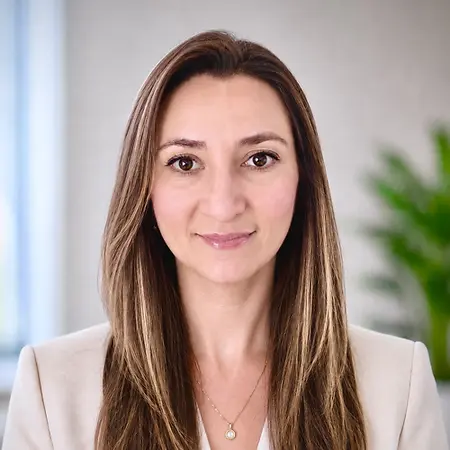
A powerful personal narrative exploring how heritage, resilience, and responsibility shape one's journey from Armenian immigrant to neuroscience educator, emphasizing that true influence lies in empowering others through lived experience and unwavering persistence.
“
Confidence isn't believing you'll never fail. It's trusting yourself enough to keep moving forward, even when others stop believing in you.
Anahit Hovhannisyan, Ph.D. · In Her Own Words
Her Story
About Anahit
Anahit Hovhannisyan is an interdisciplinary neuroscientist, biophysicist, educator, and research mentor whose career spans more than two decades of research, teaching, and innovation at the intersection of neuroscience, electrophysiology, STEM education, and emerging technologies. Her work is guided by the belief that meaningful impact comes not only from scientific discovery, but also from helping others recognize and develop their own potential.
Born and raised in Armenia, Dr. Hovhannisyan grew up with a strong sense of identity, responsibility, and resilience. Like many Armenian families, hers was shaped by the Armenian Genocide, which scattered relatives across the world while leaving a legacy of service, scholarship, and contribution. She grew up aware that she was part of a larger story and a family legacy that included Armenian Genocide survivors, scientists, educators, and Archbishop Babken (Hovsep) Apatyan of Argentina. Those examples reinforced her belief that every generation inherits both opportunities and responsibilities.
Her childhood was also shaped by the First Nagorno-Karabakh War, a period marked by shortages of electricity, water, and other basic resources. Watching her father, a physicist, develop creative solutions to support the family during difficult circumstances left a lasting impression on her and helped shape the scientific mindset that would guide her future career. to support the family during difficult circumstances left a lasting impression on her and helped shape the scientific mindset that would guide her future career. Inspired by both his discipline in physics and her own fascination with biology, she pursued biophysics as a way to bridge the two fields and contribute to advancing healthcare through science.
Dr. Hovhannisyan earned her bachelor's and master's degrees in biophysics from Yerevan State University in Armenia, where she trained in biochemistry and immunology before securing a fully funded doctoral position in Germany at the Werner Reichardt Centre for Integrative Neuroscience, part of the University of Tübingen. Arriving with limited English and unfamiliar scientific terminology, she immersed herself in late nights of independent study to close the gap with her peers, ultimately completing her Ph.D. in just four years, roughly half the typical timeline. Her doctoral research on retinal circuits, optogenetics, and neuron glia interactions laid the foundation for a joint postdoctoral fellowship at UC Santa Cruz's Byers Medical Center and Stanford University's Department of Ophthalmology. There, she investigated retinal plasticity and neural repair mechanisms, applying techniques ranging from electrophysiology and adaptive optics imaging to electron and confocal microscopy. Her findings contributed to a deeper understanding of how the adult mammalian visual system can reorganize and recover function after photoreceptor loss.
Since relocating to Fresno, California, Dr. Hovhannisyan has built a multifaceted career as an educator and researcher at California State University, Fresno, where she has spent nearly a decade developing brain computer interface research, mentoring hundreds of student presenters, and designing curricula that integrate virtual reality, artificial intelligence, and high impact teaching practices into the classroom. She has also served as an adjunct professor at Clovis Community College since 2019. Her contributions have earned her recognition including the Outstanding Teaching Award and multiple President's Faculty and Staff Service Awards from CSU Fresno, along with international honors such as the ZEISS Scientific Poster Award.
Beyond academia, she has remained active in community and civic life, having volunteered with youth conflict resolution programs in Armenia and currently serving as an Armenian language, history, and culture educator at her local church. A mother of four young children who has balanced the demands of family, research, and teaching, Dr. Hovhannisyan approaches her work and her life guided by the belief that every individual carries a distinct history worth honoring. She believes that legacy is not only what we inherit, but what we choose to do with what we inherit.
Her Interview
Ten minutes with Anahit
01What do you attribute your success to?
I attribute my success to having a clear goal and the persistence to keep moving toward it, even when the path is difficult.
When I began my Ph.D. in Germany, I faced significant challenges. My English was limited, I came from a country with fewer research resources, and much of the scientific terminology I had learned in Armenian did not translate directly into English. While many of my peers arrived with stronger laboratory experience, I spent countless evenings and weekends teaching myself how to read scientific papers, analyze data, and master a new scientific language.
A friend once told me something I have never forgotten: what matters is not where you start, but whether you are willing to keep moving until you reach the finish line. That idea stayed with me because I had a clear purpose. I wanted to honor the sacrifices my parents made while raising a family through war, economic hardship, and the collapse of the Soviet Union. Their resilience taught me that obstacles are challenges to overcome, not reasons to stop.
That persistence helped me complete my Ph.D. in four years while many students required considerably more time. Today, as a university educator, researcher, and mother of four young children, I continue to apply the same mindset. I have learned that circumstances, institutions, and opinions may change, but a clear sense of purpose provides direction through uncertainty. Looking back, the most important lesson has been learning not to let other people's doubts define what I believe is possible.
02What’s the best career advice you’ve ever received?
One of the most valuable pieces of career advice I received came from a friend during my Ph.D. in Germany. She told me something I have never forgotten: what matters is not where you start, but whether you are willing to keep moving until you reach the finish line.
That advice stayed with me because I often felt behind my peers. My English was limited, I came from a country with fewer research resources, and much of the scientific terminology I had learned in Armenian did not translate directly into English. Yet over time, I learned that determination, preparation, and persistence matter far more than perfect beginnings.
That same lesson shaped how I approached my career. I attended conferences whenever I could and shared my work. Those experiences taught me that many opportunities come through people, not applications. Several research groups approached me directly about postdoctoral opportunities after conference presentations, and those conversations helped shape the next stage of my career.
Today, I give my students the same advice. Show up. Share your work. Build relationships. Some of the most important opportunities in life begin with a conversation long before a formal application is ever submitted.
03What advice would you give to young women entering your industry?
The most important advice I can give is to know who you are and not let other people's opinions define your value or your potential.
Throughout your career, you will encounter people who believe in you and people who do not. You will work with leaders, institutions, and colleagues whose goals and perspectives may align with yours at times and differ from yours at others. It is easy to become discouraged when someone fails to recognize your strengths or questions your abilities.
I have experienced those moments myself. There have been times when I questioned my own abilities because of the opinions of others. What helped me move forward was looking back at the path I had already traveled, the challenges I had overcome, and the goals I had achieved. Those experiences reminded me that temporary opinions should never carry more weight than a lifetime of effort, growth, and accomplishment.
Know who you are. Know your values. Know your goals.
Listen to feedback, learn from experience, and continue growing, but never allow someone else's opinion to take away your belief in yourself. The people around you may change, circumstances may change, and opportunities may change, but your sense of purpose does not have to.
Keep moving forward, and never let someone else's opinion take away your belief in yourself.
04What are the biggest challenges or opportunities in your field right now?
One of the biggest challenges facing higher education today is uncertainty. Budget constraints and reductions in government funding are forcing many institutions to rethink staffing models, often replacing full-time positions with multiple part-time appointments. This creates instability for educators and makes it more difficult to build long-term programs, mentor students, and sustain innovation.
At the same time, I see tremendous opportunity in the rise of artificial intelligence and its growing role in education. The question is no longer whether students will use AI, but whether they will learn to use it thoughtfully and responsibly. At California State University, Fresno, I developed AI literacy initiatives that help students critically evaluate AI-generated information rather than simply consume it. Those efforts have gained recognition across the CSU system, and elements of the approach are now being adopted by other educators.
What excites me most is that AI is shifting the focus of education toward skills that matter deeply: critical thinking, scientific judgment, creativity, problem solving, and responsible use of emerging technologies. I have seen firsthand that deeper levels of judgment and engagement develop when students actively question, analyze, and apply information rather than simply memorize it. In many ways, I believe the future of education will depend not on teaching students what to think, but on helping them develop the critical thinking and scientific judgment needed to evaluate information, adapt to change, and make informed decisions throughout their lives.
05What values are most important to you in your work and personal life?
The value I hold most important is recognizing that every person carries their own history, identity, and experiences, and that those differences matter. This belief shapes both my professional and personal life.
In my classroom, I begin each semester by asking students to share information about themselves so I can better understand who they are and create learning experiences that help them feel engaged, supported, and comfortable participating. I believe education is most effective when students feel seen and valued as individuals. I often tell my students that I am giving them knowledge, not a grade. The grade is simply a reflection of the knowledge and skills they have developed along the way.
I also believe deeply in the value of every role within a community. Whether in education, research, family, or society, we function as an interconnected system. No contribution is insignificant, because when one part of a system struggles, the effects are felt throughout the whole. Some contributions happen in the spotlight, while others occur quietly behind the scenes, but all have value.
That perspective influences how I approach my work every day. Whether I am mentoring students, developing new educational approaches, conducting research, or raising my four children, I try to remember that every person carries a story that I may not fully see. When people feel valued and supported, they are more willing to take risks, ask questions, and grow. For me, meaningful work is not measured by recognition. It is measured by the opportunities we create for others, the knowledge we share, and the positive impact we leave behind.
Her Content Hub
Articles by Anahit
The Power of Persistence
From Armenian roots to scientific leadership: how inherited resilience shapes education and mentorship in the Central Valley.
Those words describe how I have learned to move through life. I was born and raised in Armenia, one of the world’s oldest nations—a small country with its own language, culture, faith, and history. Like many Armenian families, mine was shaped by the Armenian Genocide of 1915, which scattered relatives across the world while leaving a legacy of survival, service, education, and contribution. I grew up knowing that I was a descendant of Armenian Genocide survivors and of Archbishop Babken (Hovsep) Apatyan of Argentina. That history gave me pride, but more than pride, it gave me responsibility. It taught me that every generation must decide what it will do with what it has inherited.
My father was a particle physicist, and my mother was a cyberneticist. Science was part of my world before I understood it as a career. During the first Nagorno-Karabakh war, Armenia faced difficult years marked by economic hardship, limited electricity and water, and lost professional opportunities for many families, including mine.
What shaped me most was how my parents responded. My father built an incubator and raised chickens to support us. My mother spent sleepless nights sewing, knitting, helping him build the business, and doing whatever was needed to keep our family moving forward. As the oldest of three children, I watched closely. They taught me that when life removes the expected path, you study the problem, make a plan, break it into pieces, and begin again.
A Promise to Become a Scientist
Watching them changed the way I understood my own future. As a child, I promised myself that I would become a scientist. I wanted to continue the path my parents had started, not only for myself but for them and for the larger family tree I came from. Because I loved both physics and biology, I chose biophysics. I earned my bachelor’s and master’s degrees at Yerevan State University, where I worked in an immunology laboratory and later as a research assistant in an eye research laboratory at the Institute of Biochemistry.
I loved research, but I reached a point where I knew I needed broader training and stronger scientific preparation. That goal led me to Germany, where I joined the Centre for Integrative Neuroscience at the University of Tübingen for my Ph.D. The transition was hard. English was not my first language, and I did not arrive with the same laboratory background that many of my peers had.
I could have allowed that difference to define me. Instead, I treated it as work to be done. While others rested or went out in the evenings, I often stayed late into the night studying, learning techniques, and catching up. During those years, a friend told me something I have never forgotten:
She said that what matters is not where you start, but whether you keep moving until you reach the finish line.
That idea stayed with me because it reflected my own experience. I did not begin with the same advantages as many of my peers, but I learned that determination, preparation, and discipline can matter more than where you begin.
Research, Teaching, and a New Way Forward
I completed my Ph.D. in Neuroscience and later continued my research in California through work connected to the University of California, Santa Cruz and Stanford University. My scientific work has focused on neuroscience, biophysics, retinal plasticity, neuron-glia interactions, electrophysiology, imaging, and brain function. When I later moved to Fresno after getting married, I expected to continue primarily as a researcher. The opportunity that fit my background led me to Fresno State, where teaching became a central part of my professional life.
At first, I was not sure how to keep research alive within a teaching-focused path. Then I did what I had learned to do since childhood: I stepped back, studied the problem, made a plan, broke it into pieces, and began building a new way forward. I started bringing research into the classroom. That became a win-win path. Students gained access to authentic research experiences, and I continued asking scientific and educational questions while developing methods to improve learning outcomes.
Teaching in the Central Valley
For nearly a decade, I have taught and mentored students in California’s Central Valley. Many are first-generation college students. Many are working students. Many carry family histories shaped by migration, sacrifice, culture, language, and responsibility.
When I trained in Germany, I worked in an international environment where students often knew clearly where they came from and how their national identity shaped them. In the Central Valley, I learned that many students live inside several histories at once. Their identities are layered, and their stories matter. That understanding changed the way I teach.
Before my classes, I often ask students to complete a learner profile survey so I can better understand who they are, how they learn, and what they bring into the classroom. I do not see students as empty pages waiting for information. I see them as people with histories, responsibilities, strengths, doubts, and goals. My responsibility is to help them connect science to their lives and futures.
I often tell my students that I give knowledge, not grades. A grade is only a reflection of learning. I want students to leave my classroom able to ask better questions, evaluate evidence, communicate ideas, and trust their own ability to grow. Throughout my career, I have been most fulfilled not by the positions I have held, but by the opportunities I have helped create for others.
The Work I Have Built
That philosophy has shaped the work I have built. I have taught more than 2,400 students and mentored hundreds of student research projects and presentations. I have implemented course-based undergraduate research experiences, active learning, scientific communication projects, virtual reality in neuroanatomy education, artificial intelligence literacy assignments, and interdisciplinary work connecting biology, neuroscience, engineering, psychology, data science, digital health, and healthcare education.
My current research continues that same pattern of building connections through EEG-based brain-computer interface projects, music perception and brain activity in collaboration with engineering, data science, and psychology colleagues, and future prosthetic control concepts.
Motherhood and the Example We Set
That commitment to helping others grow also shapes my life as the mother of four children. Motherhood is not separate from my professional path. It is one of the reasons I continue to pursue it. My children remind me every day that the example we set often teaches more than the words we speak. Each time I feel tired or discouraged, I remember that they are watching how I respond to difficulty. I want them to see that challenges are not reasons to stop, that education matters, and that a person can continue growing, learning, and contributing even when the path is difficult.
Being watched by my children has also made me more thoughtful about how I respond when the world is uncertain. One lesson I have learned throughout life is that people change, institutions change, and leadership changes. Sometimes those changes support your goals, and sometimes they challenge them.
There may be moments when you begin questioning yourself because the voices around you no longer reflect the values or direction that guide your path. During those moments, I have learned to pause and look back before I look forward. I look at the life I have built, the challenges I have overcome, and the promises I made to myself long ago. I also think about my ancestors, my parents, and the challenges they faced. Their stories do not make my own challenges disappear, but they give me perspective. If they found a way to move forward, then I can find one too. Temporary opinions should never have more power than a lifetime of experience. Knowing who you are does not eliminate uncertainty, but it helps you keep moving forward when uncertainty appears.
Know Who You Are
This is the same advice I pass on to my students and my children: know who you are. Know your goal. Be flexible about the path. Step back when needed. Think clearly. Make a new plan. Break the problem into manageable pieces. Then keep moving.
For me, influence is not only a title or recognition. It is the ability to turn lived experience into strength for others. My ancestors remind me that suffering does not have to erase contribution. My parents remind me that adaptation is a form of strength. My students remind me that every person carries a story. My children remind me that what we model becomes part of what the next generation inherits.
Legacy is not only what we inherit. It is what we choose to do with what we inherit. My responsibility is to carry those lessons forward through the students I mentor, the opportunities I create, the work I continue to build, and the example I set for my four children.
That, to me, is the true power of persistence.
Join Influential Women and start making an impact. Register now.