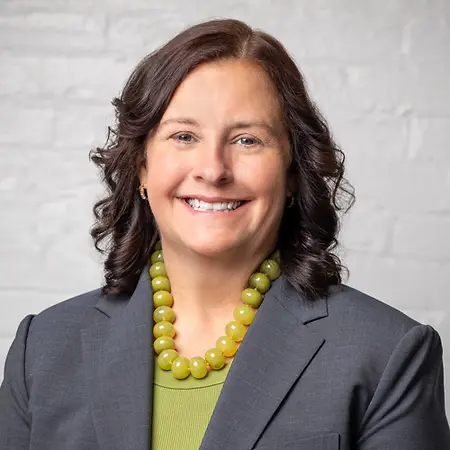
Her Story
About Andrea
Andrea Ross, CAE, is a transformational nonprofit executive and incoming Executive Director of The American Ceramic Society (ACerS), where she will become the organization's 12th executive director and first woman to hold the position on November 1, 2026. She joined ACerS in 2017 and progressed from Marketing Projects Manager to Director of Meetings, Membership, and Marketing, leading three business units and an eight-member team serving more than 9,000 members across 67 countries. Her leadership spans nonprofit association management, strategic planning, marketing, membership development, conference management, financial stewardship, business development, and organizational transformation. Throughout her career, Ross has demonstrated a strong record of generating revenue, managing complex operations, and leading organizational change. At ACerS, she negotiated the elimination of $1.9 million in contractual penalties during the COVID-19 pandemic, led the transition from in-person to virtual conferences in less than six months, and generated more than $1 million in revenue during the disruption. She has overseen an annual 8-10 conference schedule with a budget over $2 million, launched an inaugural ACerS Spring Meeting that exceeded revenue and attendance projections by 50%, and led major technology initiatives including Salesforce Marketing Cloud implementation and a comprehensive website redesign involving more than 1,000 pages. Her earlier career includes executive leadership of Brad Keselowski's Checkered Flag Foundation, where she built a 501(c)(3) charitable foundation from the ground up, as well as public affairs and strategic communications roles with the U.S. Navy, business development leadership, and higher education instruction. Ross combines nonprofit leadership, business development, communications, military public affairs, and philanthropic experience with a strong commitment to mission-driven results. During her Navy career, she led a $9 million national recruiting program, pioneered a celebrity-affiliated recruiting initiative, developed the Navy Fleet Honoree Program, and earned the Navy and Marine Corps Achievement Medal for exceptional performance and program leadership. She holds a Master of Arts in Organizational Communication and a Bachelor of Arts in Journalism and Communication from Western Michigan University and earned the Certified Association Executive (CAE) credential in 2025. Her professional career reflects a consistent focus on organizational growth, innovation, financial performance, stakeholder engagement, and creating measurable impact across nonprofit, government, military, and private-sector environments.
Her Interview
Ten minutes with Andrea
01What do you attribute your success to?
I attribute my success to hard work, dedication, and being detail-oriented and goal-driven. I am always eager to learn and believe strongly in the value of continuous education and professional development, which is part of why I pursued my CAE credential.
I also think my path has shaped how I define success. My career started as a sport reporter, then I served in the Navy Reserve, went on to manage a high-profile national sponsorship program, and later ran a charitable foundation before finding my way into association management. Each of those roles required me to learn a new industry quickly, build credibility with people who did not yet know what I could do, and prove myself through the work itself rather than a title. That is largely how my time at ACerS has gone too. I joined as a Marketing Manager and worked my way up through roles in meetings, membership, and marketing before being named Executive Director, the first woman to hold this position in the Society's history. I do not think that happened by chance. It came from consistently delivering, being someone people could rely on, and being willing to take on more responsibility before it was formally handed to me.
Beyond that, I strive to lead by example, build and support great teams, and make sure the work we do has a real impact, whether that is for our members, our volunteers, or the broader mission of the organization. I believe success is rarely a solo achievement. It is built with and through the people around you, and I try to make sure the people I work with feel that.
02What’s the best career advice you’ve ever received?
The best career advice I have received is that it is okay to pivot and change direction when circumstances or opportunities evolve. I believe in empowering my team, bringing positivity to those around me, and understanding that the energy we give to others often comes back to us. I have also learned to embrace change because it creates opportunities for growth, both personally and professionally.
03What advice would you give to young women entering your industry?
My advice to young women entering the industry is simple: be well-prepared and work hard. I have a daughter who recently graduated from The Ohio State University with a marketing degree, and she has already started her career as a marketing coordinator for a for-profit organization. My advice to her has been to show up every day, do the job, do it well, and become the person others know they can count on to get things done. It may sound like simple advice, but I've told her that consistently doing those things is what makes you stand out to management, and opportunities to move up will follow.
It's also important to be resilient, stay open to feedback, and keep pushing forward when challenges arise. Growth often comes from the moments that test us most, so use those experiences to become stronger and more confident.
04What are the biggest challenges or opportunities in your field right now?
The biggest challenge in association management right now is demonstrating value to a membership base whose expectations are shifting. Younger professionals want different things from a professional society than the generation before them did: more flexible engagement, clearer ROI, digital-first access to content and community. At the same time, our core members still value the in-person connection and technical depth that meetings and journals provide. The challenge is serving both without diluting what makes the organization distinct.
That tension shows up directly in how we manage our meetings portfolio. Conference costs have risen sharply, venues are more expensive, and members are more selective about which events justify the travel. That means every decision has to be weighed carefully against long-term financial sustainability and member value, not just short-term registration numbers.
I see this as an opportunity as much as a challenge. Associations that get this right can strengthen their position by diversifying revenue, being more intentional about international partnerships, and giving volunteer leaders like our Divisions more ownership over what their communities actually need. That is a lot of what I have been focused on as I step into this new role: making sure the decisions we make now, on governance, on meetings, on membership, position the Society to stay relevant and financially sound for the next generation of ceramic and glass scientists.
05What values are most important to you in your work and personal life?
The values most important to me are integrity, honesty, and accountability. I believe in treating others with empathy, understanding different perspectives, and approaching both my professional and personal relationships with respect and compassion. At the same time, I believe strongly in creating a clear plan with those I lead, with roles assigned and expectations set, and then trusting people to follow through.
That approach comes from experience. Whether I was managing a sponsorship program in the Navy, running a charitable foundation, or now leading a professional society, the pattern holds: a team performs best when everyone understands the plan and owns their piece of it.
I saw this play out closer to home too. When my kids were in elementary school, I served as a volunteer race director for a Thanksgiving morning 5K that donated all proceeds to our local food bank. My kids didn't just watch me lead a large group of volunteers to pull off a fun, well-run race. Each of them had a role assigned on race day, whether it was stuffing race bags, handing out t-shirts, or working the refreshment table, and they were expected to see it through.
Join Influential Women and start making an impact. Register now.