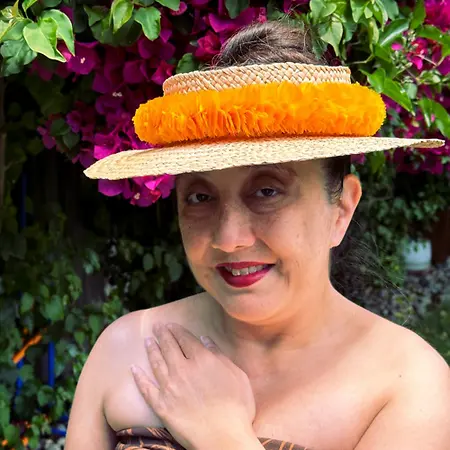
Her Story
About Anela
Anela Freeman Kuma is the Assistant Division Chief at the California State Lands Commission, where she leads multidisciplinary administrative operations including human resources, fiscal services, procurement, and business services. With over 15 years of experience across federal, state, and nonprofit sectors, she brings a deep understanding of public service, relationship management, and community advocacy to her leadership role. Her work is grounded in supporting staff development and ensuring efficient, people-centered government operations.
Throughout her career in public service, Anela has held a wide range of leadership roles, including positions with the California State Senate, the Office of Tax Appeals, and other state agencies. She has also worked in education and community-focused organizations, giving her a broad perspective on policy, administration, and constituent engagement. She earned her bachelor’s degree in International Relations from the University of Southern California and later completed her master’s degree in Political Science and International Relations at California State University, Los Angeles while working full-time in government.
Anela’s professional philosophy centers on servant leadership, cultural respect, and creating environments where people can thrive. As a Hawaiian cultural practitioner, she also integrates her identity and traditions—such as hula, lei making, and language—into her sense of community and connection. She is committed to fostering respectful workplaces, uplifting her teams, and ensuring that public service work is carried out with integrity, collaboration, and care for the communities it serves.
Her Interview
Ten minutes with Anela
01What do you attribute your success to?
For me, I think I can attribute my success to having examples, and I'm not defining examples as just examples of who you want to be - I think examples of what doesn't work out so well are just as important as examples of who you want to become. I think those are equally powerful examples that shape who you are. Because I saw someone do something, I'd never want someone to feel that way, so I need to make sure I'm not putting someone in that position. It's just as powerful as seeing someone do something well and wanting to emulate that. I've had great examples that have shaped how I lead. And then I'm painfully aware that in the position I'm in, I can create negative or positive space, whether that's our intent or not. Through action, behavior, even the smallest of them, you can create either a negative or positive space. Having strong examples - both positive and negative - has been the foundation of my success, because it's helped me become very intentional about the kind of leader I want to be and the kind of environment I want to create for others.
02What’s the best career advice you’ve ever received?
One of my kumu used to say, 'Be gentle in your dealings with others, so that others may be gentle in your dealings with you.' And I truly, truly try to do that. Because we never know what someone is going through, just like no one knows what I may be going through. That advice has really stayed with me and shaped how I approach my work and interactions with others. It reminds me to be kind with my words and with my actions, because we don't know what it takes for people to get up in the morning to show up, whatever the case may be.
03What advice would you give to young women entering your industry?
Give yourself space and grace. We're human. We're humans living a very human experience. We're going to make mistakes, we're going to stumble, and we're going to be met with obstacles. Give yourself space and grace to be able to learn lessons, to be able to grow from the experience, to be able to then help someone else when they're in that same situation. That's how things get passed on. I have a philosophy that everything in life is fixable but one thing. And we just have to be able to call a thing a thing. Acknowledge how we're feeling, give ourselves the space and grace to acknowledge what we're feeling, so that then we can get past it and figure out, okay, now how do we fix it? The fix doesn't mean that the fix is going to be easy, it's going to involve many steps, but it is fixable. And as long as you're honest with yourself and with others around you, it's okay. I think with social media and all these things, we have a tendency to think we have to be perfect, or our life has to be this way or that way. So when we're met with obstacles and make mistakes, I think we're a lot harder on ourselves than we need to be. And if we just give ourselves some space and grace, we'd realize it's gonna be okay, and actually, learning this lesson is gonna shape who I am 10 years from now.
04What are the biggest challenges or opportunities in your field right now?
I think the biggest challenge really is collaborative communication. We have all these technologies - Teams, and email, and all these technologies, which is great, don't get me wrong. That's what got us through the pandemic. Imagine if the pandemic happened in the 80s - we wouldn't have been able to work. But I think one of the challenges with that is communication. We think we might be communicating, but are we communicating effectively? There's a propensity to send a Teams message or an email when sometimes you just gotta do the good old pick up the phone and call and talk. I think some of the technologies make it so we don't have to, but then you get these 20 email back and forth of a conversation. So the challenge is, how do you balance technology with communication? I use my Outlook calendar as a communication tool - not as a micromanaging tool, but as communication. Like, hey, if you need something from me, I'm in a meeting, that's not a good time. I block off time to communicate that I'm going to be focused. But I don't think that's a prevalent mindset. The opportunities I see really is using those technologies effectively to bring people together. During the pandemic, when we were able to work remotely, what it did was it increased the span of who we could hire. I may have a job here in Sacramento, but if you lived in Fresno, you could still apply for that job, whereas before you probably wouldn't be able to. So how do we leverage technology in such a way that we can foster talent, intelligence, and creativity? I think there's a greater opportunity there beyond just AI or using some of these tools.
05What values are most important to you in your work and personal life?
To me, I value respect. Respect, on a basic level, is I respect you because we are both human beings. That level of respect increases through our interaction, through our experiences together, through however many years, but it never falls below that respect that you are a fellow human being. That's an important value for me, because I'm not a leader that thinks I have to be everyone's friend or like everybody. I can respect that you're coming to work to do this job. You may not be the type of person I would interact with outside the office - different personalities, different interests - that doesn't mean I can't respect you. Kindness is a huge value of mine. We don't know what it takes for people to get up in the morning to show up, whatever the case may be. So we just have to be kind with our words and with our actions. One of my kumu used to say, be gentle in your dealings with others, so that others may be gentle in your dealings with you. And I truly, truly try to do that, because we never know what someone is going through, just like no one knows what I may be going through. The other value that I think is important is belonging. I try to make people feel that they belong. It doesn't mean I have to be your best friend, doesn't mean we have to have hours-long conversations, but I never want someone to feel like they are not welcome or that they don't belong there. If I see someone in a meeting just sitting in a corner by themselves, that would not be okay with me. So making sure - and that's the ground rules I set in anything - we're gonna be respectful, we're gonna be kind, and we're gonna hear everyone out. We're going to give space for everyone to be heard, because just as you want to be heard, other people want to be heard too. Those are the three big things for me - respect, kindness, and belonging - and everything else fits in one of those three buckets.
Join Influential Women and start making an impact. Register now.