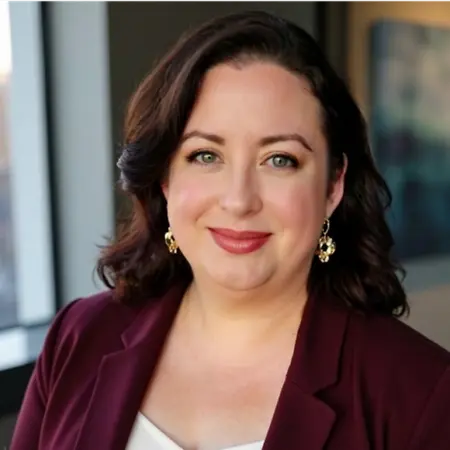
Her Story
About Angela
Angela Cabado is a risk management and insurance leader known for combining strategic thinking, data analytics, and human-centered problem solving to transform claims and risk operations. As Director of Risk at Clark Associates, she oversees all aspects of enterprise risk management, driving operational excellence through technology innovation, cross-functional collaboration, and performance-focused risk strategies. Her work centers on building proactive systems that connect operational decisions, financial outcomes, and human factors to strengthen organizational resilience and improve claims outcomes. Angela’s career path reflects a unique blend of business process improvement, insurance expertise, and analytical leadership. Originally studying biomedical sciences at University of South Florida, she entered the insurance industry through claims operations and quickly developed a reputation for solving complex operational challenges. Prior to joining Clark Associates, she worked in workers’ compensation claims management and operational strategy roles where she gained firsthand experience managing high-volume claims, improving workflows, and translating frontline insights into scalable business solutions. Throughout her career, she has helped build and modernize risk management departments, leading initiatives that have reduced claims costs, improved return-to-work outcomes, and advanced reporting and analytics capabilities. A recognized thought leader in the insurance and claims industry, Angela is passionate about breaking down silos between claims, legal, risk management, and operations to create more integrated and effective strategies. She frequently shares insights on organizational systems, human behavior, leadership, and the evolving role of data and technology in claims operations. Her contributions to the industry have earned her recognition including the CLM Phenom Under 40 honor and a Young Professional of the Year nomination. She also serves as a mentor and industry advocate, helping guide the next generation of insurance professionals while continuing to advance innovation and collaboration across the field.
Her Interview
Ten minutes with Angela
01What do you attribute your success to?
I attribute my success to my father, who passed away when I was 12. Even though he was only in my life during my early childhood years, he gave me so much insight that rings through to this day. He was just this rock in my life. He would tell me, 'Collazos never quit' - Collazo was my maiden name. When he passed away, I kept hearing his voice in my mind saying that through every challenge and struggle I faced. That really pushed me despite any doubts, regardless of people telling me I don't belong somewhere, financial reasons or any other obstacles. It gave me the mindset of: if quitting is not an option, what can you do? That's what allowed me to become resourceful and find solutions. So that is what I would attribute my success to - my father's encouragement and that mantra that quitting was never an option.
02What’s the best career advice you’ve ever received?
The best career advice I've received was actually what I absorbed through watching two incredible leaders. The first is Brandon Acevedo, who was my leader at the financial firm. He is very open-minded about what his employees bring to the table. He isn't someone who says 'you have to do things this way' - instead, he provides people the space to tackle challenges however they feel is best, and then provides feedback after. That is something I've adopted in my own leadership because I feel that's the best way for people to learn and grow. The second leader is Vic Marmo, who retired about a year and a half ago but is still my mentor today. Vic is incredible at what I would call quiet leadership - he taught me the importance of not saying something just to be heard, but because you've been able to dissect something, analyze it, and know that your voice matters. When you speak, you should bring something valuable to the table. I'm extremely grateful for the impact both leaders have had on my journey and the tremendous encouragement and guidance I received from having them as resources and mentors in my life.
03What advice would you give to young women entering your industry?
I would tell them to trust your gut. Don't let your fear override what your ultimate desire is. If you wait for all the lights to turn green, you might never move. So you have to trust yourself, even if you're hearing 'you should act more like this, you should be more like that.' Confidence comes with time and experience, and sometimes you have to just put yourself in that moment, in that space, to become the person that you're meant to be, instead of hoping one day to wake up and be there.
04What are the biggest challenges or opportunities in your field right now?
The biggest challenge is also the biggest opportunity. There is a need for more young professionals in the risk management and insurance space, especially those who embrace data and technology advancements.
05What values are most important to you in your work and personal life?
Relationships. I always value, regardless of where I'm at or what I'm doing, keeping an open mind about the people around me. There's always going to be someone you have to work with, someone you report to, people that report up to you, clients, stakeholders - and I approach everything I do from the lens of relationships. I ask myself: what can they help you with? What wisdom can they impart on you? What can you do for them? I think where we are today as a society, sometimes there's a mentality of 'if you know what's best, just do it' - it's about speed and getting to that finish line. And while I can appreciate those values, I prefer to make sure that everyone feels heard, that everyone involved is placed in the right capacity to showcase their talents, and to explore the appropriate framework and strategy. Then hit go. In my opinion, that actually gets you to the finish line faster at the end of the day, rather than bumping into all these hurdles along the way because you didn't do the pre-work and understand the people around you.
Join Influential Women and start making an impact. Register now.