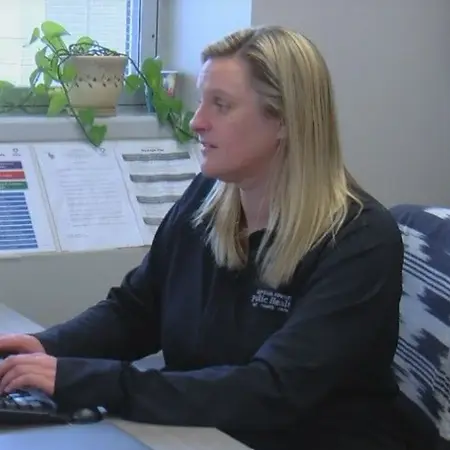
Her Story
About Angela
Angela Weideman is a seasoned public health and human services leader with more than two decades of experience spanning education, clinical practice, and executive leadership. Currently serving as the Human Services Director for Eau Claire County, she oversees a large, multidisciplinary department of nearly 300 staff delivering critical services in mental health, substance use prevention, and community wellbeing. Her career began in education as a high school social studies teacher, later evolving into clinical and leadership roles after earning her master’s degree in Marriage and Family Therapy. She has since built a reputation for integrating compassionate care with systems-level strategy to improve outcomes for individuals and families.
Throughout her career, Weideman has held key leadership roles across Wisconsin, including serving as Public Health Director for Chippewa County, where she led the department for seven years. In this capacity, she guided the organization through national public health accreditation and played a central role in managing the county’s response to the COVID-19 pandemic through the incident command system. Her earlier work includes directing early childhood initiatives at United Way of the Greater Chippewa Valley, leading regional services for children and youth with special health care needs, and supervising prevention and counseling programs. She has also contributed to academia as an instructor at the University of Wisconsin–Eau Claire and previously operated a private counseling practice in Milwaukee.
Weideman’s professional focus centers on the integration of physical and mental health, with particular emphasis on childhood trauma, resilience, and prevention strategies, including alcohol and other drug abuse (AODA). She is also actively advancing innovative housing partnerships that connect health outcomes with stable living conditions. Holding a Doctorate in Global Public Health Leadership from Indiana University Indianapolis, she is currently pursuing a second doctorate in International Health through Maastricht University. Known for describing herself as an educator, therapist, and health leader, Weideman brings a holistic, collaborative approach to advancing community health and human services systems.
Her Interview
Ten minutes with Angela
01What do you attribute your success to?
I attribute my success to over 22 years of diverse experience in human services, where I have grown from a high school social studies teacher to a public health leader overseeing a department of nearly 300 people. My career has spanned clinical work, nonprofit leadership, and seven years as Health Director of Chippewa County, where leading the county’s COVID-19 response through the incident command system became a defining achievement. I hold a doctorate in Global Public Health Leadership and am currently pursuing a second in International Health, viewing education as a way to gain perspective, especially through cohort-based learning. I am also recognized for my work on childhood trauma, providing ACEs and resiliency training across my community.
02What’s the best career advice you’ve ever received?
The best career advice I’ve received has come from mentors who taught me how to navigate leadership as a woman in challenging environments. They emphasized the importance of trusting my expertise, standing firm in my value despite bias or adversity, and maintaining resilience under pressure. Just as importantly, they reminded me to prioritize my well-being—recognizing when to step back, reset, and seek perspective. Their support helped me understand that strong leadership is not only about perseverance, but also about self-awareness, boundaries, and confidence in the face of difficulty.
03What advice would you give to young women entering your industry?
My advice to young women entering this field is to be prepared for constant change and growth—this is an evolving space that requires adaptability and resilience. Public and mental health are still developing in many ways, and one of the most important things to understand is the deep connection between physical and mental health, which are too often treated as separate. It’s essential to approach your work holistically and remain open to new knowledge, especially as technology and social media continue to shape well-being in complex ways. Stay curious, stay grounded, and be ready to navigate a field that is both challenging and full of opportunity.
04What are the biggest challenges or opportunities in your field right now?
One of the biggest challenges in my field is navigating persistent gender bias in leadership, where women can be overlooked for opportunities despite strong qualifications and experience. I’ve personally encountered situations where standards were adjusted in ways that disadvantaged me, along with moments of disrespect and hostility—especially during the pandemic, when public health leaders were under intense scrutiny. At the same time, a major professional challenge and opportunity lies in addressing the disconnect between physical and mental health. These two aspects of health are deeply interconnected, yet they are often treated separately, limiting the effectiveness of care and policy. Bridging this gap—particularly in emerging areas like long COVID—presents a critical opportunity to reshape how we understand and deliver health services in a more integrated, holistic way.
05What values are most important to you in your work and personal life?
The values most important to me in both my work and personal life center on being a lifelong learner and seeking meaningful perspective. I believe education is not about collecting credentials, but about continuously growing and learning from others, particularly through shared experiences. Some of the most impactful learning in my journey has come from cohort-based programs, where small groups and diverse perspectives shaped deeper understanding. This commitment to ongoing learning and openness to others’ experiences continues to guide how I lead, make decisions, and engage with the world around me.
Join Influential Women and start making an impact. Register now.