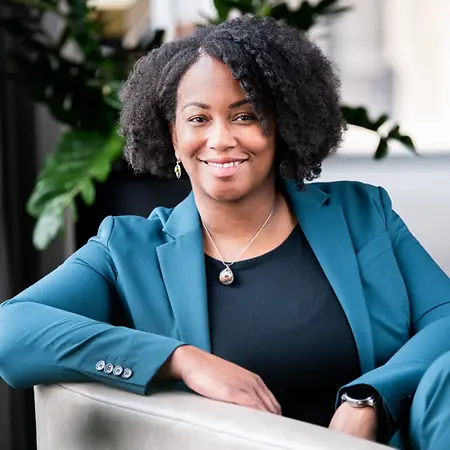
Influential Woman · Non-Profit Education & Workforce Development
Angelica Thompson, Ph.D.
Vice President of Research and Evaluation, Per Scholas
Bronx, NY 10454
Her Story
About Dr. Angelica
I am a data-driven researcher and evaluator with a deep commitment to equity, accountability, and impact. My work sits at the intersection of analysis, strategy, and systems change—helping organizations understand not only whether programs work, but for whom, and under what conditions.
I hold a Ph.D. in Educational Psychology & Research and bring over 17 years of experience leading evaluations across K–12 education, higher education, workforce development, and nonprofit systems. Currently, I serve as Vice President of Research & Evaluation at Per Scholas, where I lead the organization’s learning agenda and evaluation strategy at a national scale. In this role, I partner closely with program, innovation, and executive teams to measure outcomes, assess implementation quality, and strengthen evidence in support of scaling effective workforce development solutions—particularly those aimed at increasing diversity and economic mobility in the tech sector.
Earlier in my career, I spent more than a decade serving as a Research Advisor within a large urban school district, where I designed and led evaluations of academic and behavioral programs, conducted research on disciplinary inequities, and supported district-wide decision-making through rigorous analysis and reporting.
Across all my work, I am guided by a core belief: equity-focused innovation requires evidence. Access alone is not enough. Sustainable change demands clarity about outcomes, differential impact, and unintended consequences—and the courage to act on what the data reveal.
Her Interview
Ten minutes with Dr. Angelica
01What do you attribute your success to?
My success starts with my parents. My mother, a retired RN, taught us care, resilience, and responsibility. My father, who worked for the Department of the Navy and holds an MBA, showed us the importance of structure, integrity, and long-term thinking. Education was always prioritized, and effort was never optional. As the oldest of three girls—all of whom went on to earn advanced degrees—I benefited from a home that believed in preparation, perseverance, and purpose.
I also attribute my continued success to my wife—my rock and my biggest cheerleader. Her constant support, encouragement, and belief in me make it possible for me to lead, grow, and take on new challenges with confidence.
02What’s the best career advice you’ve ever received?
You're not here to fit into broken systems - you are here to redesign them.
03What advice would you give to young women entering your industry?
Master the fundamentals, and don’t underestimate the power of clarity. Learn how to ask good questions, understand data deeply, and communicate your thinking in ways others can act on. Your credibility comes from your competence, not just your passion. You don’t need to know everything to belong in the room—but you do need to be prepared. Advocate for yourself, seek mentors who challenge you, and remember that your perspective is an asset, especially in systems that weren’t originally designed with you in mind.
04What are the biggest challenges or opportunities in your field right now?
Innovation without evidence. Organizations are under pressure to launch new models and scale quickly, or risk appearing stagnant to the community and funders. What often lags is rigorous evaluation, particularly subgroup analysis that helps us understand what works, for whom, and under what conditions. Responsible innovation requires evidence about outcomes, implementation, and impact across populations. Strong evaluation doesn’t slow progress—it empowers it.
05What values are most important to you in your work and personal life?
The values that matter most to me are integrity, accountability, and care for people. Integrity means telling the full truth of the data, even when it’s uncomfortable. Accountability means being responsible to the communities behind the programs I evaluate—representing their voices accurately and pushing for systems that better serve them. Behind every dataset are real lives, and how we listen, respect lived experiences, and show up consistently matters as much as the results we produce.
Join Influential Women and start making an impact. Register now.