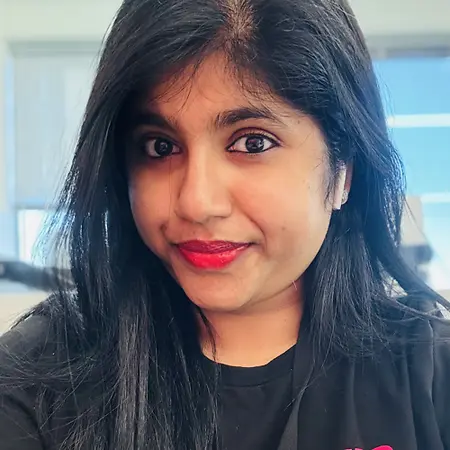
Influential Woman · Telecommunications
Anjani Nandigam
Inventor
Principal Engineer, T-Mobile USA, Inc
Bellevue, WA 98006
Her Story
About Anjani
Anjani Nandigam is a Principal Engineer – Software Engineering at T-Mobile US with more than 13 years of experience designing and delivering large-scale distributed systems, telecommunications platforms, and enterprise software architectures. Her expertise spans systems architecture, activation security, subscriber identity management, eSIM lifecycle orchestration, cloud-native platforms, and AI-enabled enterprise technologies.
Throughout her career, Anjani has focused on solving complex engineering challenges that directly improve customer experience, platform reliability, and operational efficiency. She has led the architecture and implementation of production platforms supporting secure device activations, wearable connectivity, digital identity management, and intelligent customer support frameworks. Her innovations have resulted in multiple U.S. patents covering predictive customer care, secure device activation, and eSIM lifecycle technologies, reflecting her commitment to building scalable, reusable engineering solutions with lasting business impact.
Beyond her engineering leadership, Anjani actively contributes to the global technology community as a technical reviewer, innovation judge, and author. She reviews technical publications covering modern software engineering, FastAPI, Generative AI, LangChain, and Model Context Protocol (MCP), while participating in professional judging initiatives that recognize excellence in engineering and technology innovation.
Anjani believes the best technology is often invisible—platforms that quietly deliver secure, reliable, and seamless experiences for millions of users. She is passionate about mentoring engineers, advancing secure digital platforms, and exploring the convergence of artificial intelligence, distributed systems, and telecommunications to shape the next generation of connected experiences.
Her Interview
Ten minutes with Anjani
01What do you attribute your success to?
I attribute my success to a combination of curiosity, persistence, continuous learning, and the willingness to embrace challenges that push me beyond my comfort zone.
Throughout my career, I have found that the most meaningful opportunities rarely come with complete certainty. They often begin as complex problems that others hesitate to take on. Rather than looking for the easiest path, I've tried to focus on understanding the root cause of a problem and designing solutions that create long-term value rather than temporary fixes. That mindset has shaped the way I approach engineering, innovation, and leadership.
Another important factor has been my commitment to lifelong learning. Technology evolves at an incredible pace, and I believe staying relevant requires humility and the willingness to learn every day. Whether it's exploring artificial intelligence, distributed systems, cloud-native technologies, or modern software architectures, I continuously invest time in expanding my knowledge. At the same time, I enjoy learning from younger engineers who often bring fresh perspectives, just as I value the guidance and experience of mentors who have helped shape my own journey. I believe the best ideas emerge when different generations and experiences collaborate rather than compete.
I also attribute much of my growth to the people I've worked with throughout my career. Every manager, mentor, colleague, and team has contributed something valuable to my development. Engineering is fundamentally a collaborative profession, and many of my most successful projects have been the result of open discussions, diverse perspectives, and a shared commitment to solving difficult problems.
Equally important has been maintaining perspective. As a mother, I've learned that success is not measured solely by professional milestones but by the ability to grow in multiple roles while remaining present for the people who matter most. Balancing family and a demanding technical career has taught me resilience, discipline, empathy, and the importance of prioritizing what truly matters.
Ultimately, I believe success isn't defined by titles, patents, or recognition alone. It comes from consistently creating meaningful impact, continuing to learn, helping others grow, and leaving every project, team, and organization stronger than you found it.
02What’s the best career advice you’ve ever received?
The best career advice I ever received was to always look at the bigger picture when designing solutions. It's easy to focus on solving the immediate problem in front of you, but truly impactful engineering comes from understanding the broader business objective and anticipating how today's solution can continue delivering value as technology, products, and customer needs evolve.
That advice has shaped the way I approach every project throughout my career. Rather than designing solutions for a single product or a single release, I try to build architectural frameworks that are scalable, adaptable, and reusable. Technologies change rapidly, customer expectations evolve, and businesses continue to innovate. Well-designed systems should be able to evolve alongside them without requiring fundamental redesign.
Another important part of that advice was to always keep the customer at the center of every engineering decision. Behind every technical requirement, API, or architecture diagram is a real person who simply wants technology to work seamlessly. The best engineering solutions are often invisible to customers because they quietly improve security, reliability, and user experience without adding complexity.
I've also learned that looking at the bigger picture means thinking beyond your own team. Great solutions are built through collaboration, understanding how different systems interact, and designing platforms that other teams can build upon. Some of the most rewarding projects in my career succeeded because we invested time in creating reusable architectures rather than one-time fixes.
Today, I continue to apply that same philosophy in every project I work on. Whether it's telecommunications platforms, AI-enabled systems, or emerging technologies, I believe engineering is most valuable when it solves today's challenges while preparing organizations for tomorrow's opportunities.
03What advice would you give to young women entering your industry?
One of the most important lessons I've learned is that you don't need to know everything before taking on a challenge. Technology evolves constantly, and every engineer—regardless of experience—is continuously learning. Don't let self-doubt or the fear of making mistakes prevent you from pursuing opportunities that will help you grow.
Never be intimidated by the complexity of a problem or by the experience of those around you. Confidence doesn't come from having all the answers; it comes from being willing to ask thoughtful questions, learn continuously, and solve problems one step at a time. Some of the most meaningful opportunities in my career came from volunteering for difficult projects that initially seemed outside my comfort zone.
Find your voice and use it. If you have an idea that can improve a product, simplify a process, or solve a customer problem, speak up. Innovation often begins with someone asking, "Can we do this differently?" Some of my most rewarding engineering contributions started with challenging existing approaches and thinking about problems from a broader architectural perspective.
Build a strong support network. Seek guidance from mentors, experienced engineers, and industry leaders, and don't hesitate to ask for help when you need it. Learning from others accelerates your own growth, and mentoring relationships often become some of the most valuable parts of your career.
Remember that success is never achieved alone. Engineering is a team effort. Learn to collaborate, delegate when appropriate, and trust the expertise of those around you. Strong leaders aren't the ones who do everything themselves—they create environments where entire teams can succeed.
Finally, protect your work-life balance. Technology is exciting, but sustainable success requires taking care of yourself as well. Make time for family, friends, health, and the interests that inspire you outside of work. A balanced life not only helps prevent burnout but also makes you a better engineer, a better leader, and a more creative problem solver.
Most importantly, stay curious. Continue learning, embrace change, and focus on solving problems that make a meaningful difference. Your unique perspective is valuable, and the technology industry needs more diverse voices shaping the future.
04What are the biggest challenges or opportunities in your field right now?
One of the biggest opportunities in technology today is the rapid advancement of Artificial Intelligence. AI is transforming how we design software, make decisions, automate complex workflows, and solve problems that once seemed impossible. For engineers, it's an exciting time because we're not simply building applications anymore—we're building intelligent systems that can continuously learn, adapt, and support better experiences for both businesses and customers. The challenge is ensuring these technologies are implemented responsibly, securely, and in ways that genuinely improve people's lives rather than simply adding complexity.
At the same time, one of the biggest personal challenges is keeping pace with the speed at which technology evolves. Every year brings new programming frameworks, AI models, cloud technologies, and engineering practices. As both an engineer and a mother, I have learned that continuous learning isn't optional—it's part of the profession. Younger engineers often enter the industry with fresh perspectives and familiarity with the latest technologies, while experienced engineers bring systems thinking, architectural judgment, and lessons learned from building production platforms. I believe the greatest success comes from combining both perspectives and remaining open to learning from one another.
Another important challenge is maintaining a healthy work-life balance. Engineering can easily become an around-the-clock profession, especially as technology moves so quickly. I've learned that long-term success isn't about working the most hours; it's about staying focused, prioritizing effectively, and making time for family, health, and personal growth. Those experiences outside of work often make us better engineers because they improve our perspective, creativity, and resilience.
Ultimately, I believe the future belongs to professionals who remain curious, embrace lifelong learning, and are willing to adapt without losing sight of the people they are building technology for. Technical expertise is important, but empathy, collaboration, and continuous growth are what enable us to create technology that has a lasting and meaningful impact.
05What values are most important to you in your work and personal life?
The values that guide me most are integrity, continuous learning, collaboration, and balance.
In my professional life, integrity means building technology that people can trust. Whether I'm designing secure activation platforms, AI-enabled systems, or distributed architectures, I believe every technical decision should prioritize reliability, security, and the long-term interests of customers. I also believe in taking ownership of difficult problems and delivering solutions that are practical, scalable, and built to last.
Continuous learning has become one of the most important values in my career. Technology evolves incredibly fast, and staying relevant requires curiosity, humility, and the willingness to keep learning. I enjoy exploring emerging technologies, reviewing technical publications, engaging with the engineering community, and learning from colleagues across different backgrounds and generations. Some of my greatest growth has come from remaining open to new perspectives rather than assuming experience alone has all the answers.
Collaboration is equally important. The most successful innovations I've been part of were never the result of one individual—they were built by diverse teams working toward a shared goal. I value creating environments where everyone feels comfortable sharing ideas, asking questions, and challenging assumptions, because that's often where the best solutions emerge.
In my personal life, family keeps me grounded. As a mother, I've learned that success isn't measured only by professional achievements, but also by the relationships we nurture and the example we set for those around us. Maintaining a healthy work-life balance has taught me resilience, perspective, and the importance of being fully present, whether I'm solving a complex engineering problem or spending time with my family.
Ultimately, I strive to build not only meaningful technology, but also a meaningful life—one guided by curiosity, purpose, kindness, and a commitment to making a positive impact wherever I can.
Join Influential Women and start making an impact. Register now.