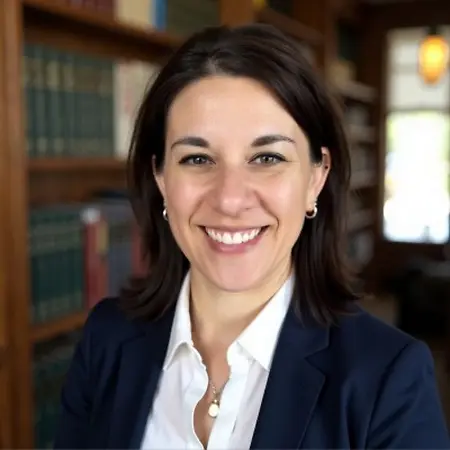
Her Story
About Ann
Ann Langton is a Director of Quality at Ferrotherm LLC, bringing more than 16 years of leadership experience across quality assurance and project management within the manufacturing sector. Her career path began in electrical engineering before shifting toward project management and, eventually, quality leadership—a progression that allowed her technical grounding and organizational skills to converge with the demands of her current field. Over the years, she has held senior positions with organizations spanning aerospace, power generation, rail transportation, power distribution, and advanced manufacturing automation, including a long tenure at The Timken Company, where she led global quality strategy across dozens of manufacturing and distribution sites, as well as leadership roles at DWFritz Automation, Powell Industries, and Rolls-Royce.
Langton's academic foundation is unusually broad for someone in her field: she holds a Bachelor of Science in Electrical Engineering from The Ohio State University, a Master of Business Administration with a focus on Organizational Behavior from The University of Findlay, and a Juris Doctor, earned with honors, from the University of Akron School of Law. This combination gives her the ability to interpret contracts, regulations, and legal documentation while also anticipating how organizational dynamics shape strategic decisions—skills she pairs with certifications including PMP, Six Sigma Black Belt, and lead auditor status in ISO 9001, IATF, and AS9100. Day to day, she describes her work as a form of organized chaos, balancing customer issues, investigations, and continuous problem-solving while striving to bring structure to unpredictable situations.
Beyond her technical and professional accomplishments, Langton is deeply engaged in mentorship and community service. She has volunteered with Habitat for Humanity for more than a decade and has served as chairperson of the Women's Network at three different companies, in addition to supporting workplace Pride Network initiatives. She credits her achievements to the mentors who encouraged her early on and to her father, who taught her to believe she was capable of anything, and she carries forward that spirit by advising young women in her field to be defined by their expertise rather than their gender. Grounded in integrity, respect, professionalism, and empathy, Langton continues to focus on developing leaders and fostering cultures where people are recognized for the value of their work.
Her Interview
Ten minutes with Ann
01What do you attribute your success to?
I attribute my success to the supporters and mentors who encouraged me to pursue opportunities in male-dominated fields like electrical engineering and aerospace, and to my father, who inspired me to take on a challenging path. I've also made a point of focusing on my advantages rather than dwelling on perceived disadvantages, and I've leaned on respect, professionalism, and empathy as core values in my work. Having the right management support along the way has also been essential in helping me navigate a male-dominated, global work environment.
02What’s the best career advice you’ve ever received?
The best advice I've received is to define myself by my expertise, not my gender — younger women entering manufacturing should focus on their skills and professional roles rather than their gender identity. I've also learned to focus on my advantages rather than perceived disadvantages when navigating challenging or male-dominated environments, and to seek out mentors and supporters who encourage you to pursue opportunities, even in fields where you may feel underrepresented. Maintaining integrity and professional standards regardless of the environment is essential, and I'd add that managing perception remains one of the most significant challenges in the manufacturing industry.
03What advice would you give to young women entering your industry?
I'd tell young women to define themselves by their expertise, not their gender — to focus on their professional role and skills rather than being identified as a woman in the field. Strive to be recognized for what you know and what you can do. My own father inspired me to pursue a difficult field, and that experience taught me that challenges can become stepping stones. I'd also encourage seeking out proper management support, since having the right support system makes it much easier to navigate male-dominated environments, and focusing on your advantages rather than dwelling on perceived disadvantages.
04What are the biggest challenges or opportunities in your field right now?
Perception management is, in my view, the most significant challenge in the manufacturing industry right now, particularly for women. Navigating male-dominated environments remains a reality in fields like electrical engineering, aerospace, and manufacturing, where women are still underrepresented, and there's a constant need to be recognized for one's expertise rather than one's gender. My current role also involves a fairly unstructured environment, with constant crisis management and "firefighting" as I handle frequent issues and customer contact. (Note: this thought was cut off in the original transcript before it could be fully completed.)
05What values are most important to you in your work and personal life?
Respect is central to how I approach every professional interaction — treating others with dignity, always. Professionalism matters deeply to me, especially having worked in a male-dominated field for so long. Empathy has also been important, particularly when conducting investigations and working closely with others. I hold integrity as non-negotiable, regardless of the environment I'm in, and mentorship is something I value greatly — investing in others and helping them grow into leadership positions is part of how I define my own success.
Join Influential Women and start making an impact. Register now.