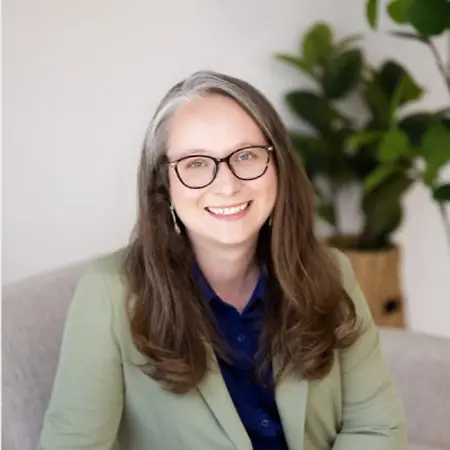
Her Story
About Anna
When I went to undergrad, I actually went intending to go and be more like a missionary. But then I took a counseling class during my third year and really fell in love with it. I ended up working in residential treatment with teenagers, and I just kind of fell in love with it, and so that's what got me on this path. I've been in children's mental health for 20 years now. I spent the first 8 years or so of my career doing shift work and frontline work, working overnights, working PMs, you know, doing that kind of thing. Then I've spent the last 12 years working as a clinician and then as a single site leader. The work that I've been in has all been at pretty high levels of care. I spent a couple years on call every 6 weeks for a 17-bed unit, so I'd get a call at like 2 AM and that would be when the day would start. A lot of my career has been devoted to caring for people with really distressing symptoms like depression, suicidal behaviors, self-injury, and relational symptoms that make it really hard to stay in relationships that feel good and drive caregivers away. Now I'm transitioning to be the Clinical Director of Mental Health for Mosaic Integrative Health in Edina, Minnesota, which is a leadership role with more flexibility than any job I've worked before.
Her Interview
Ten minutes with Anna
01What do you attribute your success to?
I've been really lucky to have leaders that have my back and have invested in me as helpful, useful, kind partners. Many of them have been other women, which has been especially important transitioning to motherhood. I really prioritize keeping a broad network with different perspectives, not just professional contacts but friendships with people that are very different from me and have different work experience. If you find yourself in an echo chamber, all you know is all you're gonna know. Having people with different perspectives keeps you grounded and keeps you learning different stuff. It makes sense to keep some similar stuff because medicine is so specialized and high-acuity mental health work experience is so weird, so having people that get how weird it is and where you don't have to explain things is really nice. But if you only stay there, you won't realize what you're missing and your blind spots can just get bigger.
02What’s the best career advice you’ve ever received?
With this recent change, two people really helped me think through it and make a wise choice. One talked about really thinking about if you were to die today, where would you still owe a debt? I owe time to my kids, you know, I owe time to my family. I have an aging parent and need to support her. The other leader gave me advice when I had a couple of offers on the table. She said you gotta take the one where you're gonna have to figure out boundaries. The job I'm moving into has more flexibility than any job I've worked before, and infinite flexibility means you can work 24-7. Her advice was that you gotta figure this out because this is gonna be the thing that stops you from moving forward if you don't learn that. I think the advice I would give to somebody that's early in their career or even mid-career is to really look to people who are different from you and really prioritize a broad network with different perspectives. Keep people in your life, not just professional contacts but friendships with people that are very different from you and have different perspectives and work experience because they'll keep you grounded and keep you learning different stuff.
03What advice would you give to young women entering your industry?
I think the advice I would give to somebody that's early in their career or even mid-career is to really look to people who are different from you and really prioritize a broad network with different perspectives. Because if you find yourself in an echo chamber, all you know is all you're gonna know. Really prioritize keeping people in your life, not just professional contacts but friendships with people that are very different from you and have different perspectives and work experience, because they'll keep you grounded and keep you learning different stuff. It makes sense to keep some of that similar stuff because medicine is so specialized and high-acuity mental health work experience is so weird, and having people that get how weird it is where you don't have to explain things is really nice. But if you only stay there, you won't realize what you're missing and your blind spots can just get bigger.
04What are the biggest challenges or opportunities in your field right now?
I think a huge opportunity and something to really be thinking about is AI and healthcare. There's opportunity to lighten clinical load and really bring clinicians closer to the moment-to-moment interactions in the therapeutic room or for those in programs, the moment-to-moment interactions from the minute that person steps onto your unit until the minute that they leave your hospital. Really, anything that brings us closer to those human relationships and brings more time and capacity to truly be with people, I think there's a lot to benefit from and we should really be careful about saying no to that. At the same time, I think really guarding patient autonomy and patient choice. Certainly for mental health, the connection between mental health services and political movements, and people who have different opinions politically than other people being punished with a mental health diagnosis, or mental health being the tool by which people are punished, I think that's a real risk. Being blindly optimistic or unthinkingly adopting anything without thinking, I think is really risky, particularly in the realm of mental health because it's political work as much as anything is. There's a layer of political fullness that's visible and invisible to the work that I think we need to be thinking about. So I think it's both a real opportunity and a real risk.
05What values are most important to you in your work and personal life?
I think the two main things that drive me professionally are building for capacity and building for the future. Building for capacity for me is about how do we continue growing and developing and be willing to be challenged and try, even when we know that it isn't gonna go well. Being clear and authentic with patients and with our team, like we don't know exactly how this is gonna go but we're gonna try. Because if we only stick to our comfort zone, that constricts and doesn't get broader. A lot of my career has been devoted to caring for people with really distressing symptoms, and if we only do what we're comfortable with, those people are never gonna get service because caring for people with those symptoms is really distressing and often doesn't go well. Being willing to try and fail, I think, is always going to be better than sticking to exactly what you're comfortable with. Building for the future is about building with humility in mind. When we look at the history of mental health 100 years ago, people were in state hospitals, it's a really dark history. We have to understand that what we're doing right now will be the past. We want to do our best but also do our best with so much humility and the ardent hope that when our great-great-grandchildren are looking back at what we're really proud of today, they're sort of appalled by it. Building for the future means both operational and financial sustainability and really being thoughtful about where, when, why we partner, take outside money, merge, and how we use our business practices and our clinical practices to really keep the future and a healthy future in mind, but also building with so much humility and not just the understanding but the hope that our best efforts are seen with a sort of pitying gentle eye by our professional great-great-grandchildren. Those are the two kind of big values for me: build for capacity and build for the future with that sense of always growing, always learning, humility, doing our best today and understanding that our best today is gonna be really different than it was yesterday and will be tomorrow. Really staying grounded in the humanness of the work.
Join Influential Women and start making an impact. Register now.