Her Story
About Anna
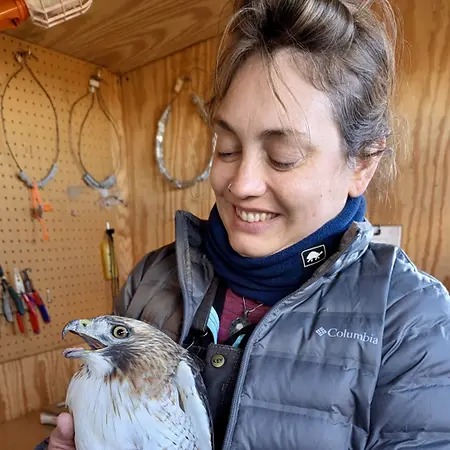
Anna Keenan is a Wildlife Biologist and Threatened & Endangered (T&E) Species Specialist at Terracon, based in Omaha, Nebraska. She has been with Terracon since July 2024, bringing nearly two years of experience conducting regulatory reviews for threatened and endangered species compliance, Section 7 consultations with the U.S. Fish and Wildlife Service, bald eagle permitting, biological assessments, and NEPA work. Anna also conducts field surveys for T&E species, with a recent focus on sensitive bat species as she works toward her 10(1)A permit to handle them, alongside a strong background in avian work, including raptor nest and migratory bird surveys focusing on species such as northern goshawks and red-shouldered hawks.
Before joining Terracon, Anna spent two years as an environmental scientist and staff scientist at another consulting firm and five years as a wildlife technician with the U.S. Forest Service on the Hiawatha and Colville National Forests, studying goshawks and red-shouldered hawks as well as grizzly bears, Canada lynx, and snowshoe hares. She has also collaborated with the U.S. Fish and Wildlife Service on the Fort Niobrara National Wildlife Refuge conducting research with mountain lions, elk, bison, and prairie dogs. Her academic foundation includes a Bachelor of Science in Wildlife Ecology and Research Management with a minor in Biology from the University of Wisconsin-Stevens Point and an Associate of Science in Wildlife Ecology and Fisheries Management from Minnesota North College, equipping her with a strong understanding of wildlife ecology, conservation biology, and field research techniques. Anna’s passion lies in connecting people with wildlife and finding ways for both to coexist. One project she is particularly proud of involved helping a community affected by severe flooding in 2019 replace their wastewater treatment plant and wellheads while also protecting a bald eagle nest perched above one of the water transmission lines. Balancing the needs of the community with wildlife conservation highlights her commitment to sustainable solutions, proactive collaboration, and using her expertise to positively impact both people and the natural environment.
Her Interview
Ten minutes with Anna
01What do you attribute your success to?
I attribute my success to the incredible mentors I've had throughout my journey who really encouraged me to stay on this path and give it my all. Through my volunteer work at Fontenelle Nature Center, I had a mentor who gifted me my first pair of binoculars when I was 12 years old. At the age of 14, I was given an opportunity to learn how to capture and band birds. I learned how to collect and record field data, as well as safely extract birds from mist nets and band them for the Monitoring Avian and Productivity and Survivorship (MAPS) program. I've been very blessed with mentors who supported my passion, and now I want to pay it forward by being a mentor to others as well. I also learned to never let somebody tell me what I can or can't do, because only I know what I'm capable of. When I was discouraged early on and told I couldn't be a biologist because of my ACT math scores, I eventually decided that my freshman year advisor was wrong, went back to school, and proved him wrong by getting my second bachelor's degree in wildlife ecology. I've kept that mantra with me throughout my career - when I feel like I'm doubting myself or somebody else is saying I can't do something, I remember that only I know what I'm capable of. That's really helped me go farther in my career and boost my confidence. I've also gotten better at speaking up for myself and knowing my own worth, which is really important.
02What’s the best career advice you’ve ever received?
Education isn't everything. Yes, earning a degree in your chosen field is undeniably important. But all the academic work in the world won't prepare you for the realities of field work--enduring subzero temperatures, swarms of biting flies, slogging through bogs miles away from any road or trail, or learning to truly listen to the world around you, to be observant out there in the wild. Experience is every bit as important as earning that Master's degree, sometimes even more so.
03What advice would you give to young women entering your industry?
Never let anyone decide what you can or cannot do, because only you truly know your own potential. When I gave a keynote speech at Minnesota North College, this was at the heart of my message I shared with the graduating class, and it's a mantra I've carried with me throughout my career. I think it's incredibly important to encourage young people to speak up for themselves and recognize their worth.
I also want young women to know that becoming a wildlife biologist is a real and rewarding career path. When I was growing up, I didn't even know this field existed. I thought that the only way I could work with animals was if I became a veterinarian. I think it is essential to make young women aware that these opportunities are available to them--especially in roles that were traditionally viewed as men's work. Even today, there are more men in this field than women, but you have every right to be there as much as they do, and your contributions are invaluable.
This field is extremely competitive and requires years of experience, many of which are expected even before you are hired. Seek these experiences early--volunteer, take an internship, join professional organizations. Put yourself out there and don't ever give up, even if you get discouraged at times along the way. If it's truly a passion, you'll get there through hard work and persistence.
04What are the biggest challenges or opportunities in your field right now?
The current administration is incredibly challenging to work under. Regulations are constantly shifting and much of what we do is dependent on regulatory stability. It is extremely challenging to assist wind and solar clients in achieving their goals, and there is a great deal of uncertainty in our day-to-day operations.
05What values are most important to you in your work and personal life?
The most important value to me is connecting people with wildlife and helping both people and wildlife coexist together. This is really my passion - I love being able to serve the community while also protecting wildlife at the same time. For example, with the bald eagle nest project where we're helping a community get clean drinking water while protecting the eagle nest, the community is really invested in the eagle nest too, and that's really rewarding for me. I feel like I'm actually doing something to benefit both wildlife and people, and that's what makes my work meaningful. I also really value being able to help clients navigate complicated regulatory compliance - I've realized that a lot of people really do care and they really do want what's best for the environment, and it's been really rewarding to work with them and guide them through these federal regulatory steps.
Mentorship is very important to me. I was fortunate to have exceptional mentors who supported my passion, and I'm committed to paying it forward. Supporting the next generation and helping them discover their own path in this field is one of the most meaningful ways I can give back.
Family comes first. At the end of the day, this life is more than just earning a paycheck; it's about being there for the ones you love the most and supporting them in everything they do. I had a supervisor once who told me that I should put my child "on the back burner "because "work is more important." I no longer work for that company.
Join Influential Women and start making an impact. Register now.