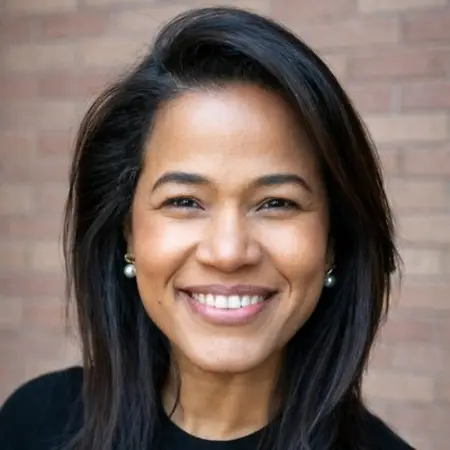
Her Story
About Annetty
I'm a dentist by training who specializes in geriatric dentistry, and I teach dental students how to manage patients that need additional accommodations to provide safe care. My career trajectory started from a desire to look beyond the conventional way of practicing dentistry, which led me to hospital settings and caring for medically complex patients. In a field where very few people are specialized, I believe teaching is part of the duty we owe to the profession. I've been in my field for about 14 years, and my work focuses on curriculum development to enhance both the clinical and didactic experience that students receive in their training. I help students learn to manage patients with medical complexities, physical and cognitive impairments, and I provide them with comfort alternatives for dental treatment. In addition to the programming aspect of curriculum activities, I also provide clinical services to patients so students have clinical experiences where they can see these patients in action. I work with the special care clinic where we draft curricular activities in an intentional way to help our students manage these patients. For the last 3 years, I've been developing more immersive training activities, including a dementia simulator that uses virtual reality and different chatbots to help prime students for clinical activity and simulate unconventional situations they might face in the clinic. My training in geriatric dentistry at Boston Medical Center was a 2-year federally-funded program that trained not only dentists, but physicians and psychiatrists in a very interprofessional environment. We were on the Clinician Educators track, and the premise of the training was to train future leaders in a field where very few people specialize, and to shape the way that generalists or primary care dentists and doctors see older patients. That training has definitely shaped the last 12-13 years I've had in academic dentistry.
Her Interview
Ten minutes with Annetty
01What do you attribute your success to?
I would say determination is one of the key factors. But I would also say support - I have found a lot of other women in my family and in my professional environment where they're just behind you all the way. And that fulfills that determination. We talked a little bit about things that have gone well, but there was a bunch of things that didn't go well, and you just have to keep moving forward. So that way of seeing your journey, not as a perfect straight line, but more as different opportunities, different pitfalls, and different aspirations to keep moving forward - that's what I attribute my success to.
02What advice would you give to young women entering your industry?
Be kind to yourself - that's number one. I think it's something that took a long time for me to understand. Allow yourself to be creative and to pursue different things. I think at times, society, different family frameworks, friendships, or life - our minds are kind of programmed to certain recipes, and it doesn't always work that way. Every stage will have different challenges and different opportunities. So that would be my advice, and that's how I think I attribute to my journey, kind of having that flexibility. But again, if things go in a different direction right now, you respect it. Especially being raised to expect certain outcomes, just be kind to yourself in all that. Tomorrow's a different day.
03What are the biggest challenges or opportunities in your field right now?
I think definitely the revolution of AI in teaching is going to be a major challenge that we're facing today - having the tools, understanding the boundaries, how to keep up with it, how to understand our audience as students, and how we can use these tools to maximize learning without losing that human-centered touch. I think it's a real challenge that we haven't figured out in every field. There's still a lot of strong positions, but it's happening already. In the realm of teaching, where the workforce is shrinking and we're expecting to have more healthcare professionals, it sounds counterintuitive that providing more standardized workflows using haptics, robotics, or chatbots is a fair way to provide that access to education. But at the same time, is the quality of the education the same? So there's a lot of ethical, professional, and workforce questions in this new way that we're practicing. That is something that I think about every day.
04What values are most important to you in your work and personal life?
What I value most is to be present - when I'm at work, and to be present when I'm at home. I don't always recognize that there's one person, and there's my professional activities and my family activities, and there's no separation between the two brains, it's like the same brain. But I've been very intentional about knowing that if I'm cooking for my children or if I'm enjoying one of these hobbies, that's where my brain is at. So I think the intention to be present, especially nowadays, is very important. That has been something that I value a lot - just being in the moment. If I'm in a meeting, if I'm talking about something, just dedicating my brain to that. It's very important to me.
Join Influential Women and start making an impact. Register now.