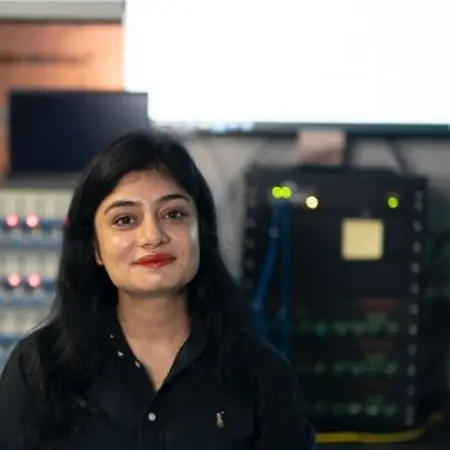
Her Story
About Aqsa
Dr. Aqsa Nazir is a Materials Scientist at Pacific Northwest National Laboratory (PNNL), one of the U.S. Department of Energy's premier research institutions, where she contributes to the prestigious Battery500 (B500) program focused on high-energy-density energy storage solutions. In this role, Dr. Nazir leads cutting-edge research on next-generation battery technologies, with specialized expertise in developing advanced electrolytes, cathode architectures, and functional materials for lithium-sulfur (Li-S) and lithium-ion (Li-ion) systems. Her research is strategically directed toward engineering electrochemical systems spanning key battery components including anodes, cathodes, and electrolytes that are not only high-performing but also safer and more cost-effective than existing battery technologies, a critical pursuit in the global transition toward sustainable energy.
Prior to joining PNNL, Dr. Nazir served as a Postdoctoral Associate in Materials and Mechanical Engineering at Florida International University (2022–2024), where her innovative research on catalysis and the application of platinum in lithium-sulfur battery systems including the development of high-loading Li-S battery cathodes and multilayer pouch-cell architectures attracted widespread media coverage, underscoring the broader scientific and societal relevance of her contributions.
Dr. Nazir earned her Ph.D. in Materials Science and Engineering from Chonnam National University, South Korea (2017–2022), where she developed conductive MOF-enabled silicon and antimony anodes for next-generation batteries and cultivated deep expertise in electrochemical materials and advanced characterization techniques. She holds a Master of Science in Chemistry, with a specialization in inorganic and analytical chemistry, from the University of Gujrat, Pakistan (2015), and a Bachelor of Science in Chemistry from the University of Punjab/Sargodha, Pakistan (2012).
Over the course of her academic and professional journey, Dr. Nazir has established a compelling record of scholarly and technical achievement, including 20+ peer-reviewed publications in leading journals such as Advanced Materials, Chemical Engineering Journal, and the Journal of The Electrochemical Society, three battery-related patents, and a Nature Energy manuscript currently under review. She is also the recipient of the Best Poster Award at the Beyond Lithium-Ion Battery Conference (2025) and has presented her research at prestigious international venues including ECS and MRS conferences.
As an international scholar and immigrant who has navigated one of the most competitive and technically demanding fields in modern science, Dr. Nazir's professional trajectory from her foundational studies in Pakistan to doctoral research in South Korea and ultimately to a distinguished position at a U.S. Department of Energy national laboratory stands as a powerful testament to her resilience, intellectual excellence, and deep commitment to advancing energy innovation. She considers it a privilege to collaborate with world-class scientists and engineers at leading national laboratories, and remains driven by the goal of translating fundamental materials research into practical, scalable, and impactful battery technologies for a more sustainable future.
Her Interview
Ten minutes with Aqsa
01What do you attribute your success to?
When reflecting on my journey from my early academic foundations in Pakistan to doctoral research in South Korea and ultimately to my current role as a Materials Scientist at Pacific Northwest National Laboratory,I attribute whatever success I have achieved to two fundamental principles: hard work and consistency. In my experience, hard work without consistency is ultimately incomplete. It is the quiet, unwavering commitment to showing up and pressing forward even in the absence of immediate reward or recognition that truly shapes one's professional and personal trajectory.
My path has been marked by its share of setbacks. Rejected manuscripts, cancelled plans, and unexpected obstacles have been as much a part of my journey as my publications, patents, and research milestones. Yet I have come to understand that failure is not the opposite of success it is an integral part of it. A retracted paper or a declined proposal is not a full stop; it is simply a comma in a much longer sentence. What matters is the decision to continue to remain consistent, to keep working with integrity and purpose, and to trust that sustained effort will, in time, yield meaningful results.
I do not measure my achievements against those of others, nor do I consider myself to have reached the summit of success. What I hold onto firmly and gratefully is the belief that these two words, hard work and consistency, are not merely professional strategies. They are a way of life. And it is that belief that continues to guide every experiment, every collaboration, and every new challenge I embrace in the pursuit of advancing energy storage innovation.
02What’s the best career advice you’ve ever received?
he most impactful career advice I have ever received came from my doctoral advisor, Professor Chan Jin Park, during my Ph.D. studies at Chonnam National University, South Korea. As Ph.D. is a long and demanding journey, marked by both significant milestones and profound challenges, and Professor Park was a rigorous and exacting mentor. Yet beneath his high expectations lay a deep and genuine investment in the growth and well-being of his students care that he often expressed not through words, but through quiet, timely moments of guidance.
One such moment has stayed with me ever since. During a particularly difficult period in my doctoral journey, Professor Park noticed a subtle change in my demeanor as I greeted him in passing a slight heaviness in my voice that I had not even fully acknowledged myself. He paused, looked at me with quiet seriousness, and said something I have never forgotten. He acknowledged that in many academic and cultural environments, women particularly those navigating the pressures of rigorous scientific training can sometimes carry a sense of suppression that manifests in their confidence and presence. He then told me, with unmistakable conviction: "I need a PhD doctor, Aqsa Nazir, with confidence. Always keep your chin up."
Those words were simple, yet transformative. In a single moment, my advisor reminded me not only of the standard he held for me, but of the standard I needed to hold for myself. To this day, in every moment of self-doubt, every professional setback, and every challenging transition from South Korea to the United States, from one research institution to the next, and ultimately to my current role at Pacific Northwest National Laboratory those words return to me with clarity and purpose. Chin up. Always keep your chin up. It is, without question, the most enduring and meaningful piece of advice I have carried throughout my entire academic and professional career
03What advice would you give to young women entering your industry?
Always keep your chin up, work with unwavering determination, and remain consistent in everything you do. Never be discouraged by failure every setback, every rejected manuscript, and every closed door is simply one additional step toward your success. What is truly meant for you will find its way to you, but only if you stay committed, keep pushing forward, and never allow disappointment to define your journey.
04What are the biggest challenges or opportunities in your field right now?
The main challenge I feel is moving from other countries to here along with your professional journey - it's kind of a little trouble. To focus on your field, you need some kind of calm environment, but immigration issues, being away from your family, and personal losses that happen on and off can distract you for little periods of time. Being away from your family is the biggest challenge I've faced. These immigration things and being separated from family while trying to maintain focus on your research creates difficulties that impact your ability to concentrate fully on your work.
05What values are most important to you in your work and personal life?
I care about the environment in which I am working - whether the team is raising each other up or not. Throughout my journey, I love to mentor my colleagues and juniors, and I expect the same thing from my seniors too. Whatever knowledge we have, we should share it with each other. That matters to me the most. In addition to these things, loyalty with your work and professionalism are supposed to be there. During my journey, I've met so many girls, and even more than male researchers, I love to talk with female researchers. I think their thought process is a little different than males - sometimes we can think about key points that male people ignore or cannot think about. That's why I still keep in touch with my PhD colleagues and my postdoctoral female colleagues. I love discussing with them.
Join Influential Women and start making an impact. Register now.