Her Story
About Ashlie
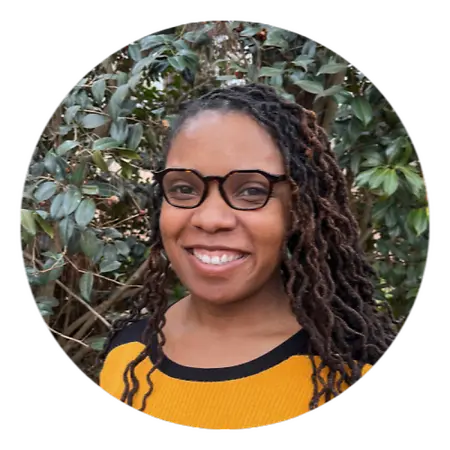
Ashlie Evans, MHA is a nonprofit leader, program evaluation specialist, and data strategy professional dedicated to improving outcomes for grieving children and families through evidence-based decision-making and compassionate community engagement. As Director of Outreach & Outcomes at Kate's Club, she leads organization-wide initiatives focused on program evaluation, outreach strategy, impact measurement, and data-driven innovation. Guided by the belief that data can be an act of service, Ashlie combines analytics with empathy to help organizations better understand the people they serve, transforming information into actionable insights that strengthen programs, improve experiences, and expand meaningful support for children and families navigating grief.
Ashlie's career reflects a thoughtful evolution shaped by both frontline service and strategic leadership. She began her professional journey as a Behavior Specialist at Hillside, Inc., where she spent five years supporting children experiencing severe mental health challenges and crisis situations while simultaneously earning her Master of Health Administration from Purdue Global. Although deeply rewarding, the emotionally demanding work inspired her to seek a role that would allow her to merge her passion for helping others with her strengths in research, evaluation, and data analysis. That opportunity came in 2018 when she joined Kate's Club as a Program Coordinator, introducing new assessment tools to evaluate program effectiveness and support grieving children. Immersed in the field of grief support, she gained a profound understanding that grief extends far beyond the loss of a loved one—it touches every stage of life and every community. Those experiences not only reshaped her perspective but also reinforced her commitment to building programs that are both compassionate and measurable. Since then, she has advanced through increasingly influential leadership roles—from Program Coordinator to Data & Outcomes Manager and ultimately Director of Outreach & Outcomes—leading initiatives that have enhanced organizational effectiveness through KPI development, mixed-methods evaluation, AI-enabled reporting, process improvement, grant reporting, and data system optimization.
Ashlie's leadership philosophy is grounded in compassion, integrity, service, and accountability. She believes that the most meaningful data tells the human stories behind the numbers and that effective organizations must pair rigorous evaluation with genuine empathy to create lasting impact. Working within a collaborative nonprofit environment has given her the opportunity to contribute to strategic planning, organizational decision-making, and cross-functional leadership while remaining closely connected to the children and families her work serves. She finds purpose in balancing direct community impact with analytical rigor—using data not simply to measure success, but to validate experiences, identify opportunities for improvement, and ensure every program reflects the evolving needs of those it supports. Through her leadership, Ashlie continues to demonstrate that when data is approached with curiosity, compassion, and purpose, it becomes one of the most powerful tools for strengthening communities and transforming lives.
Her Interview
Ten minutes with Ashlie
01What do you attribute your success to?
I attribute my success to staying curious and being a perpetual student. There is always something to learn, to be better, to know more about, and asking questions allows me to understand where those gaps are. If you're always curious, there's nothing you can't improve, there's nothing you can't make better. I also hold onto the belief that you're exactly where you're supposed to be, that you're in the right place at the right time. There's not a coincidence. Even when you're doubting yourself, doubting your abilities, asking why did I get this job, why did they put me here, there's gonna be moments where you're like, oh, okay, I do have it. I do have the things that will make me successful here. And if I don't, I'm competent enough to go find those things. I'm competent enough to ask. I have people in my life that will support me and make me better as well. Just knowing you're in the right place at the right time, you're exactly where you're supposed to be, probably saved my first two years of being director, because I was like, what is this? What is happening? But that mindset has given me solace in the choices I've made in my career.
02What’s the best career advice you’ve ever received?
The best career advice I've received came from my mom, who has been in leadership for a long time and is kind of my leadership guru at this point. I was a new director, thrown into the position without a lot of training, and I was dealing with a team that had a lot of issues. I was asking, what's going on? Why won't they just do what's been asked of them? What am I doing wrong? She told me, 'Most people do is a reflection of leadership, so you set the standard. You have to look at yourself first.' When she said that, I was like, okay, now I have a starting point. Now I can look at what I'm doing with a magnifying glass to say, what actions am I showing that elicited these responses? Am I role modeling bad behaviors? Just being able to have a starting point to say, this team has these things, and also, how do I become a better leader for them? The other piece of advice that has stayed with me since undergrad is that as long as you keep moving forward, you end up exactly where you need to be. As long as you keep pushing forward and you just don't become stagnant, you'll be exactly where you need to be. That has given me solace in the choices I've made in my career. You're always in the right place at the right time. There's not a coincidence.
03What advice would you give to young women entering your industry?
My advice to young women entering this field is to stay curious and be a perpetual student. There is always something to learn, to be better, to know more about, and asking questions allows you to understand where those gaps are. If you can, if you're always curious, there's nothing you can't improve, there's nothing you can't make better. I would also tell them what I was given: you're exactly where you're supposed to be. You're in the right rooms. You're not there by coincidence. Just know that you have everything that you need to be successful. And you have people in your life that can support your success as well. You deserve to be where you're at. Don't doubt yourself or your abilities. Even when you're asking why did I get this job, why did they put me here, there's gonna be moments where you're like, oh, okay, I do have it. I do have the things that will make me successful here. And if I don't, I'm competent enough to go find those things. I'm competent enough to ask.
04What are the biggest challenges or opportunities in your field right now?
The biggest challenge in childhood bereavement is that measurement is always the hardest thing, if we're being completely honest, with grief. It's not just grief. Yes, my person died, and also now I changed schools, and now I'm living with my grandmother, and now I'm not seeing my sister as much. There's a lot of secondary losses around grief, so being able to measure grief has been a very difficult thing. On that same side, being able to communicate how your program impacts someone's grief is even harder when you're talking about getting funding, communicating it to your individual donors and all those other things. That is the largest challenge that we have in our niche. Because of that, there should be some type of repository to a certain extent, where organizations can access tools and validate tools, or even get some type of guidance around how to make their own survey. We also need to give them language around, if you don't see what you think you should see, if you don't see your kids improving, or you don't get the pre and post data that says they're improved, this is how you communicate it to funders versus just saying, yeah, we don't see nothing. Being able to give them the language so we can continue to keep the dollars in our community, so we can still continue to support kids, even though the arc of grief is so long. It truly is. It's not a one thing that fits all, or in one year that they'll be better, or six months. It's just not how it works. So how do we communicate that with our funders, through our survey tools and all those other things, is probably the largest challenge in this field and the greatest opportunity.
05What values are most important to you in your work and personal life?
Compassion, integrity, service, and accountability are the core values that guide Ashlie's professional and personal life. In her work with grieving children and families, she believes empathy, patience, and respect for each individual's unique journey are essential to providing meaningful support. She is equally committed to accountability and excellence, emphasizing that organizations have a responsibility to build effective, sustainable programs that create lasting impact and consistently meet the evolving needs of the communities they serve.
Join Influential Women and start making an impact. Register now.