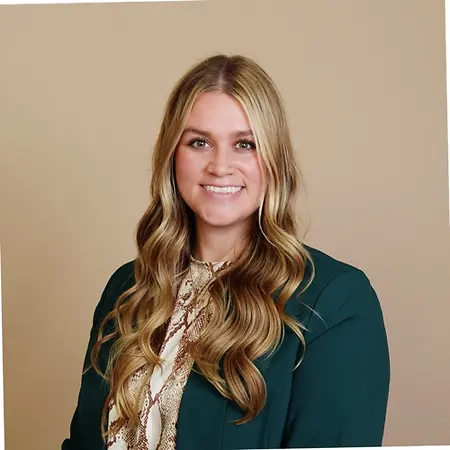
Her Story
About Ashlyn
Ashlyn Visser-Palauni, MHA, is a healthcare nonprofit executive serving as State Director of Utah Operations at Community Options, Inc., where she oversees operations supporting individuals with intellectual and developmental disabilities (IDD). With more than a decade of experience in human services, including specialized experience in the IDD field, Ashlyn is committed to expanding access to employment, housing, and community-based services. Her work focuses on helping people with disabilities live more independently and participate fully in their communities while strengthening awareness and collaboration among service providers, schools, government agencies, and community organizations.
Ashlyn’s professional background combines healthcare administration, nonprofit leadership, community engagement, and advocacy. Before joining Community Options, she served as an executive director with Generations and held leadership and administrative roles with Sunrise Senior Living and Mission at Maple Springs. She also worked as a graduate assistant at Weber State University, supporting student-athletes through academic mentoring, tutoring, organizational guidance, and financial well-being initiatives. Ashlyn earned both her Bachelor of Science and Master’s degree in Healthcare Administration from Weber State University and is a licensed nursing home administrator.
Beyond her professional responsibilities, Ashlyn is actively engaged in community and legislative efforts that advance services and opportunities for people with disabilities. She has participated in organizations and committees focused on community services, legislative affairs, and nonprofit leadership, while also volunteering as a meal server and navigator with the Bountiful Community Food Pantry and as a children’s mentor. Among her accomplishments is helping establish a stronger Community Options presence in Bountiful, Utah, including the expansion of day-program supports and partnerships with local schools for pre-employment transition services. Her leadership reflects a strong commitment to community inclusion, advocacy, and creating meaningful pathways for individuals with disabilities to work, live, and thrive.
Her Interview
Ten minutes with Ashlyn
01What do you attribute your success to?
I attribute a lot of my success to the core values and the character that I built at Weber State. I applaud Mary Kay Amicone for teaching me the way, and building that foundation for me once I started playing college softball at Weber State in 2016. I am forever indebted to the type of culture and character-building aspects that she gave me the opportunity to learn that was beyond the softball field. I attribute a lot of my success, my leadership values, my work ethic to the Weber State Softball Program.
02What’s the best career advice you’ve ever received?
The best career advice, especially as a young woman in leadership, is don't be afraid to take on challenges that are bigger than you think you're ready for, because most of the time, you're ready for them, you just don't believe in yourself yet. That advice was through my college coach. Growth often happens outside of anybody's comfort zone. You must be comfortable with being uncomfortable. It's about being willing to learn, and staying focused on the objective.
03What advice would you give to young women entering your industry?
Believe in yourself before everyone else does. You have to know that you're going to be ready and take opportunities, and be confident and kind when maybe not everybody else believes in you yet. I also encourage women to speak up and know their value, and feel confident in their value, and to never apologize for being ambitious.
04What are the biggest challenges or opportunities in your field right now?
One of the biggest challenges in my field is balancing growth with quality. There is a tremendous need for residential and day services for people with disabilities, yet our ability to expand services is limited by the availability of Medicaid funding. In Utah, only about 50% of individuals with a demonstrated need are currently supported through the Medicaid waiver, leaving more than 7,500 people on the waiting list for services. For those individuals and their families, the average wait can be approximately 25 years.
At the same time, Utah’s reimbursement rates for these services are among the lowest in the nation. This directly impacts our ability to recruit and retain Direct Support Professionals (DSPs), who provide essential, hands-on support every day. In many cases, we are competing with entry-level jobs in fast-food and other industries that can offer higher starting wages, making it increasingly difficult to attract and retain qualified staff. This creates a difficult cycle: the need for services continues to grow, but funding and workforce challenges limit our capacity to meet that need.
Another significant challenge is the continued existence of subminimum wage employment for people with disabilities. Section 14(c) of the Fair Labor Standards Act allows certain employers to pay workers with disabilities wages below the federal minimum wage of $7.25 per hour. These settings are often referred to as sheltered workshops.
At Community Options, our goal is fundamentally different. We believe people with disabilities should have access to competitive, integrated employment in their communities and earn competitive wages. Our work focuses on helping individuals build meaningful careers, achieve greater independence, and contribute to their communities alongside people without disabilities. Ultimately, I believe the challenge is not a lack of ability or potential among the people we serve—it is creating the systems, funding, and opportunities necessary for them to succeed.
05What values are most important to you in your work and personal life?
Three values that are especially important to me are compassion, accountability, and relationships. In human services and healthcare, compassion has to be at the center of everything you do. You have to genuinely care about the people you serve and believe in the mission, because the work is ultimately about improving people’s lives and helping them reach their full potential.
I also place a very high value on accountability. As a leader, I believe in taking ownership of my decisions, being confident in the choices I make, and being willing to acknowledge when something could have been done differently. Accountability builds trust, both within a team and with the people and communities we serve.
Finally, I believe strongly in the power of relationships. Building and maintaining meaningful relationships personally, professionally, and within the community is essential to long-term success. Strong relationships create trust, open doors to collaboration, and allow people to work together toward a shared mission. I believe the combination of compassion, accountability, and genuine relationships is what makes an effective and impactful leader.
Join Influential Women and start making an impact. Register now.