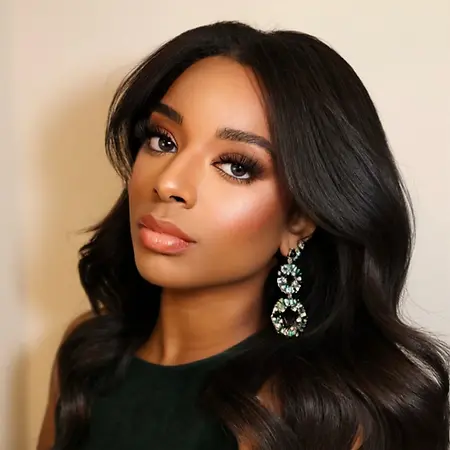
Her Story
About Asiana
Asiana is a Family Care Coordinator with Tennessee Donor Services, where she works closely with patients’ families during some of the most emotional and life-changing moments imaginable. Specializing in organ donation coordination, she facilitates compassionate end-of-life conversations, helps guide donation decisions with care and transparency, and ensures every case is handled thoughtfully and respectfully. For Asiana, the work is deeply personal and purpose-driven, centered on helping families create a lasting legacy through the gift of life while educating communities about the transformative impact of organ donation.
Her path into healthcare was unexpected. Originally attending the University of Alabama in Huntsville with plans to become a meteorologist, she discovered that her passion for weather was better suited as a hobby than a profession. During the COVID-19 pandemic, she pivoted into healthcare by completing an accelerated Certified Nursing Assistant program and later joined Vanderbilt University Medical Center, where she spent several years working in emergency medicine with trauma training and direct patient care experience. Those years in the ER strengthened her ability to remain calm in high-pressure situations while reinforcing her commitment to helping people during vulnerable moments.
Beyond her clinical work, Asiana is passionate about mentorship, advocacy, and personal growth. She currently attends Belmont University and is exploring future plans that include psychology studies and medical school. She also serves as a board member and alumni coordinator for the Distinguished Young Woman of Music City scholarship program, helping mentor young women in leadership, communication, and confidence-building. A strong believer in authenticity, honesty, and kindness, Asiana brings empathy and resilience into every area of her life, inspired in part by her own experience living with polycystic kidney disease and her understanding of the life-changing importance of organ donation.
Her Interview
Ten minutes with Asiana
01What do you attribute your success to?
I'm a Christian, and naturally, I'd say God. It's just simply because none of what I've been able to accomplish, what I've gone through to still stand on my two feet and be a stronger person than I was yesterday to what I am today, I couldn't have done it without him. So I give him all the credit, all of the glory, all the praise, because without him, I would not be able to be where I am today, truly.
02What’s the best career advice you’ve ever received?
Honestly, it's from my grandpa. He unfortunately passed away in 2020, thankfully pre-COVID, from polycystic kidney disease. One thing that my grandpa said to me is less crying, more thinking. It's really easy for us to get caught up in the what-ifs and the possibilities of things that go wrong, and also get caught up in the things that have grown wrong, and cry about it and sulk about it. But what we tend to not see is that when we cry about it or when we sulk about it and just focus on it, we're not thinking about, okay, what's next? What can we do to fix the problem? What can we do to enhance the problem? Or what can we do to resolve it? He told me, you know, cry if you need to, but don't dwell on it for long, because it prevents you from getting where you need to be. So I typically go by that motto, and I tell other people, cry it out, get it all out, but then when you're done crying, less of that crying and more thinking.
03What advice would you give to young women entering your industry?
Stand your ground. I unfortunately have faced a lot of adversity and have been in situations that have made me uncomfortable in a professional standpoint from higher-ups, unfortunately. But even patients sometimes, you know, they can get a little rowdy and a little mean. I believe that in the healthcare world, there isn't a lot of people who are willing to stand their ground because they're scared of what sort of reprimand or reactions from doing that. But I believe that standing your ground and holding firm to who you are, respectfully, honestly earns more respect. It shows that you are not afraid to stand your ground and take your chances, but also advocating for patients is part of standing your ground. If you've got a doctor who's saying this and that, and you're another doctor, and you have conflicting views with what they're trying to do for the patient's treatment plan, stand your ground and say, hey, I don't know if I agree with that, and this is why. There's nothing wrong with that. It doesn't mean that you are challenging them. It just means that it's two people who have beautiful individual opinions and ideas, and there's a way for us to find a common middle ground to agree on something, so we are doing what's best for the patient.
04What are the biggest challenges or opportunities in your field right now?
Challenges, I would say, surprisingly, I don't feel as though we have enough support. And I say that because we go into a hospital, and don't get me wrong, there are a lot of nurses and a lot of people that are doing their jobs, but in the higher-ups, when it comes to that, I do find that there is not as much support and as much kindness in higher-ups than there is when you're just around your colleagues. I've found and have witnessed and experienced that your nurses and your CNAs and your techs, they all stick together. And then when it comes to the higher-ups, it's not necessarily that they're against their higher-ups, but it is more so as though they have to band together to stand for what's right. And honestly, it shouldn't have to be like that. It should be a cohesive, collaborative conversation with higher-ups also part of that inner circle. I believe it's a lack of support that we have in the healthcare field, because everything, unfortunately, I hate to say this, but it's become a lot about money. It's become a lot about who can be the best, who can get more funding, more donations, more this, more that, and I feel like it's less focused on the people who are actually making the hospital go around. Without nurses, you don't really have that support. So I do believe that there's a lot of facilities who have lost sight of people versus their personal gain.
05What values are most important to you in your work and personal life?
I am very, very big on honesty and transparency. I feel as though that a lot of companies and just a lot of places that I've had the pleasure to either be a part of as an employee or I've walked in as a customer actually lacks honesty and transparency. And I find that it is very scarce to talk to someone who gives their honest opinion and isn't afraid to do so. I think that establishes trust, I think that establishes, of course, honesty, and I think that establishes a strong foundation. So honesty and transparency is one of my number one values. Along with that, I think there's a lack of love in this world, genuine love. I believe that everybody naturally has their own agendas, but I do think that there is room for love. There's always love, always make more love. Love is infinite. And so I just realized that there's not a lot of love in this world anymore, and so I believe that spreading love and spreading kindness is super important to me as a value. Authenticity is super important to me as well. I don't want to know the fake person. I want to know the real person, the nitty-gritty, the good, bad, and the ugly, because I think that's what makes us all human.
Join Influential Women and start making an impact. Register now.