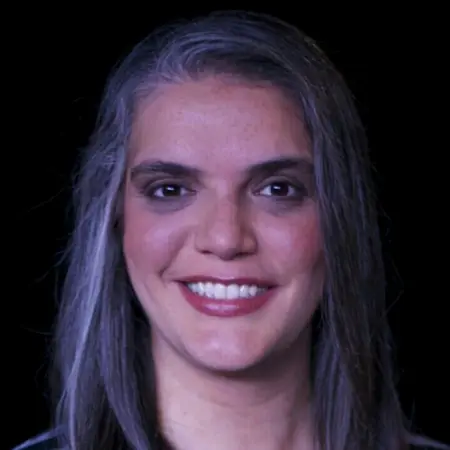
Influential Woman · Executive Communications, Enterprise Technology & Broadcast Production
Azadeh Taefi
Executive Communications & Enterprise Technology Leader
Los Angeles, CA
Her Story
About Azadeh
AZADEH TAEFI: BUILDING THE SYSTEMS THAT HELP PEOPLE CONNECT
Long before Azadeh Taefi learned to design global collaboration environments, direct executive broadcasts, or translate complicated technology into something that felt effortless, she learned to pay attention.
She learned it through Theatre, where every gesture carries meaning. She learned it through journalism, where the right question can uncover an entire story. She learned it in television control rooms, where dozens of people must act as one and where a few seconds can separate a seamless broadcast from a very public failure. And she learned it from her mother, Maryam Mottaghi, whose example taught her that intelligence means little without compassion, dignity, service, and the willingness to use one’s abilities for others.
Those lessons have shaped a career spanning more than 26 years across broadcast journalism, live production, executive communications, Unified Communications, enterprise technology, strategic storytelling, and nonprofit leadership.
Taefi began her professional broadcasting career in 2000. After gaining early experience in camera operation, technical directing, and live show direction, she joined CNN and quickly built a career that crossed the traditional boundaries between technical production and editorial storytelling.
At CNN, she worked on nationally recognized programming and major live coverage, including Larry King Live, Anderson Cooper 360, Piers Morgan Live, Showbiz Tonight, Nancy Grace, Dr. Drew, Jane Velez-Mitchell, breaking news events, red carpet productions, legal coverage, and high-profile trials.
She did not want merely to operate the machinery behind a broadcast. She wanted to understand why the story mattered, how it should be told, and what the audience needed to experience. That curiosity led her from technical production into editorial work, where she wrote, produced, directed, interviewed, coordinated field teams, and helped carry stories from an initial idea through their final broadcast.
Among the accomplishments closest to her heart is her work on CNN Heroes: An All-Star Tribute, which received a Peabody Award. For Taefi, the recognition represented more than professional achievement. CNN Heroes united two forces that have defined her life: the power of storytelling and the celebration of ordinary people performing extraordinary acts of service.
After more than sixteen years in broadcasting, Taefi was recruited into enterprise technology at Ares Management. The transition may have appeared unconventional from the outside, but for her, it was a natural evolution. Broadcast production had already taught her to manage complex technical ecosystems, demanding stakeholders, immovable deadlines, live audiences, and teams whose work had to converge perfectly at a specific moment.
At Ares, she brought that same operational discipline to a global business environment. Over nine years, she led Unified Communications, executive collaboration, audiovisual strategy, and live-production initiatives supporting offices throughout North America, Europe, and Asia.
Her responsibilities extended far beyond audiovisual systems. She worked directly with executives and business leaders to understand strategic objectives, then translated those goals into enterprise technology, communications, and operational solutions. She led initiatives from discovery through design, budgeting, procurement, vendor selection, implementation, testing, documentation, training, executive readiness, and long-term support.
Her work touched office expansions, mergers and acquisitions, global collaboration platforms, telephony, executive briefing environments, audiovisual infrastructure, multilingual accessibility, AI-enabled collaboration, and high-profile internal and external communications.
One of her defining projects began with an empty room in New York.
Senior executives needed an internal production environment that could support broadcast-quality interviews and executive communications without requiring repeated travel to outside studios across Manhattan. Taefi designed and built the capability from the ground up, balancing production quality, security, infrastructure, usability, and cost.
The result was not simply a studio. It was an entirely new organizational capability.
Within its first months, Taefi personally delivered more than forty executive productions from the space, including live financial news appearances, executive broadcasts, documentary-style productions, employee resource group storytelling, and corporate communications. She managed the technical and production ecosystem—from cameras, audio, lighting, routing, switching, and recording to remote contribution and executive readiness, often making intricate workflows appear invisible to the people using them.
That ability—to absorb extraordinary complexity while allowing everyone else to experience simplicity—became one of the defining characteristics of her leadership.
Whether she was restoring a critical executive boardroom after an unexpected security change, identifying a global communications outage before it had been widely recognized, rescuing an office deployment compromised by an unprepared subcontractor, or creating an alternate production workflow minutes before a live broadcast, Taefi became known for remaining composed when conditions were anything but.
Her first instinct was never to declare that a problem belonged to someone else. It was to understand what the business needed, determine what was failing, bring the right people together, and protect the outcome.
That philosophy also informed her approach to leadership. Taefi believes that expertise should not be guarded as a source of individual power. It should be documented, taught, transferred, and transformed into systems that allow other people to succeed. Throughout her career, she created operating standards, technical documentation, recorded instruction, user guides, training programs, escalation procedures, and governance models intended to make complex environments more accessible and sustainable.
Her education reflects the same refusal to remain inside a single discipline.
While studying Theatre at the University of Southern California, she simultaneously pursued Broadcast Journalism at California State University, Los Angeles, completing bachelor’s degrees from both institutions at the same time. She later returned to Cal State LA for a master’s degree in Counseling and School-Based Family Counseling. What might appear to be three unrelated fields, performance, journalism, and psychology, formed a unified foundation for her work: understanding people, communicating with clarity, and creating experiences that connect.
Today, Taefi continues to bring together executive communications, enterprise systems, research, production, and strategic storytelling to help people and organizations navigate complexity without losing the humanity at the center of the work.
Her deepest commitment, however, is The Maryam Mottaghi Foundation, which she created in honor of her beloved mother.
Maryam Mottaghi’s life crossed countries, professions, and generations. In Iran, she worked as a meteorologist and in human resources at Mehrabad International Airport. At only nineteen, she established a government-recognized fashion institute where she educated future designers and seamstresses. After immigrating to the United States, she returned to school and earned degrees in Computer Information Systems and Technology, mastering both programming and hardware before teaching those skills to her children and her students at the very University she graduated from, Cal State LA.
Yet her greatest influence could not be measured by titles or credentials.
She taught through sacrifice, encouragement, faith, resilience, and service. When her daughter showed an early love for performance, Maryam did not dismiss it as impractical. She found her an arts high school. When Taefi produced stories and broadcasts, her mother became a trusted sounding board, listening carefully and offering thoughtful feedback. When her children confronted something unfamiliar, she taught them to investigate it, learn it, and refuse to assume that difficulty meant impossibility.
Taefi attributes everything good in her own life to that example.
The Maryam Mottaghi Foundation carries those values forward by expanding educational opportunity, mentorship, leadership development, and storytelling opportunities for young people while advancing compassion, dignity, resilience, and service.
Taefi also serves as Executive Secretary of Women on the Move Network, supporting initiatives such as “Who’s Your Hero?," a program designed to help girls build confidence, discover their strengths, and envision larger possibilities for their lives. She serves as Secretary of the Local Spiritual Assembly of the Bahá’ís of San Dimas and as an executive board member of People for Peace and Prosperity.
Across all of these roles, her work returns to one belief: technology, storytelling, education, and leadership are not separate pursuits. Each is a way of helping people see more clearly, communicate more honestly, and recognize what may be possible.
Her career has taken her from television studios to global boardrooms, from breaking news broadcasts to enterprise transformation, and from telling the stories of heroes to preserving the legacy of the woman she considers her own.
The tools have changed. The purpose has not.
Build with integrity. Lead with compassion. Tell the truth well. And when someone insists that something cannot be done, understand the problem deeply enough to show them that it can.
Her Interview
Ten minutes with Azadeh
01What do you attribute your success to?
I attribute every meaningful success in my life to the love, example, and unwavering belief of my beautiful mother, Maryam Mottaghi.
She taught my brother and me that difficulty was not proof that something was impossible. It was an invitation to learn, work, and find another way. When I showed an early love for Theatre, she did not dismiss it as unrealistic; she found an arts high school where I could develop that gift. Throughout my broadcasting career, she listened to my stories, watched my work, offered thoughtful feedback, and remained the person whose judgment I trusted most.
Her own life was an extraordinary education. She crossed disciplines, countries, and circumstances without losing her compassion or her desire to serve others. She was a meteorologist, an educator, a human resources professional, a fashion institute founder and professor, a computer technologist, a university professor, a wife, a mother, a grandmother, and a mentor, often carrying responsibilities that now leave me wondering how one person managed so much with such grace.
Whatever resilience, curiosity, work ethic, or compassion others may see in me began with her. The accomplishments may carry my name, but the foundation beneath them is hers.
02What’s the best career advice you’ve ever received?
The best guidance I have carried through my career is to remain true to who I am and to do every kind of work with compassion, dignity, and integrity.
The scale of the task does not determine the value of the principle. It applies whether I am implementing global technology, producing a national broadcast, telling someone’s story, resolving a critical failure, mentoring a young person, or simply making another person’s day a little brighter.
Titles change, industries change, and technology changes. The standard should not: do the work in a way that allows you to remain proud not only of what you accomplished, but of how you treated people while accomplishing it.
03What advice would you give to young women entering your industry?
Do not wait for someone else to decide that you belong.
Broadcasting and technology can both make women feel that they must first obtain permission, prove themselves repeatedly, or become a different version of themselves before speaking with authority. Learn your craft deeply, prepare carefully, and then trust the knowledge you have earned.
Be assertive without surrendering your humanity. Articulate the outcome you are trying to create, explain why it matters, and be willing to stand behind your judgment. When someone tells you something cannot be done, do not waste energy merely arguing. Study the problem, develop the solution, and let the work demonstrate what was possible.
Equally important, leave the door more open than you found it. Share what you know. Mentor another woman. Recommend her when she is not in the room. Confidence should not end with individual success; it should become a bridge for the people coming next.
04What are the biggest challenges or opportunities in your field right now?
Broadcasting and enterprise technology remain fields in which women are frequently underrepresented, particularly in technical and senior leadership roles. The challenge is not only entering those environments, but navigating standards that are still applied unevenly. Conduct described as decisive or authoritative in a man may be characterized as demanding, emotional, or difficult in a woman.
The answer is not for women to make themselves smaller. It is for organizations to evaluate leadership, expertise, and potential consistently, and for established professionals to sponsor, mentor, and advocate for talented women before they are forced to prove the same capabilities repeatedly.
At the same time, this is an extraordinary period of opportunity. Broadcast production, enterprise collaboration, executive communications, accessibility, immersive media, and artificial intelligence are converging. Organizations need leaders who can understand the technology without losing sight of the people, stories, risks, and business objectives behind it.
AI is especially promising when used as an enhancement to human expertise rather than a substitute for judgment. It can organize information, reduce repetitive work, improve accessibility and translation, identify patterns, and make sophisticated production capabilities available at greater scale. The opportunity belongs to professionals who can apply these tools thoughtfully, protecting accuracy, consent, intellectual property, security, and human accountability while using technology to help talented people accomplish more.
05What values are most important to you in your work and personal life?
Compassion, dignity, integrity, loyalty, service, and a strong work ethic are the values that guide both my personal life and my work.
I inherited them from my beautiful mother, who possessed an extraordinary ability to carry enormous responsibilities while continuing to notice and care for the people around her. She taught me that achievement without humanity is incomplete, that knowledge should be shared, and that the way we treat people matters as much as the results we produce.
I try to bring those values into every environment, particularly when pressure is high. Calm should not become indifference. Authority should not require humiliation. Technical expertise should not be used to exclude others. Leadership should create clarity, confidence, and opportunity.
I do not always meet the standard as perfectly as my mother did, but it remains the standard toward which I work.
Join Influential Women and start making an impact. Register now.