Influential Woman · Artist, Gallery Owner, Executive Board Member
Barbara Felix
Interdisciplinary Artist, Artist, and The Beacon at Midtown Gallery & Studios (Owner)
San Antonio, TX 78201
Her Story
About Barbara
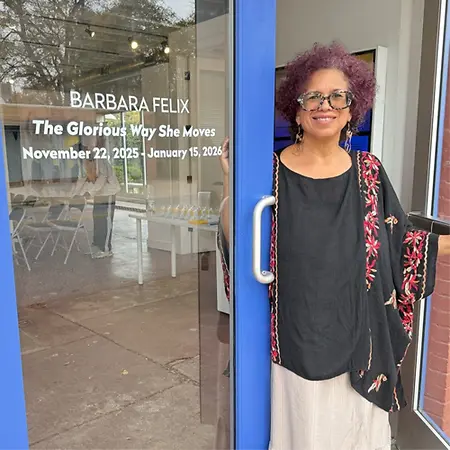
I've been a working artist since 2010, but I didn't become a full-time working artist until 2022 when I early retired from my 20-year career as a corporate in-house graphic designer at Citibank to go full throttle on art and everything creative. My husband and I opened the Beacon at Midtown Gallery and Studios in San Antonio in April of last year, where we have monthly exhibitions, performances with musicians, poetry readings, and artist talks, as well as private events. Our space also has 9 studio artists residents that range from painters, to photographers, to musicians. I primarily handle the marketing for the gallery while my husband manages the calendar. I'm deeply involved in the San Antonio art community -besides serving on the boards of CAM and SAEAS. I'm also a contributing member of The San Antonio Art League & Museum, and a founding member of Gentileschi Aegis Gallery Association (GAGA), a women's art organization. This year I have been a panelist for the city of San Antonio's artist grant, for exhibition proposal, for a juried artist exhibition, a student film competition, and a film festival. My main body of work is a series called The Glorious Way She Moves, where I paint large-scale portraits of women dancing on synthetic paper called "Yupo" and also on layered fabrics, some as large as 5 feet by 10 feet. I interview the women I paint, asking them questions about their life and how they feel about dancing. I've filmed 60 women so far and painted about half of them. I had a major solo exhibition at the prestigious Women and Their Work Gallery in Austin, in December 2025 that closed in January '26. The exhibition included a talk with "the artist andher muses (5 of them), and a dance performance that created a beautiful sense of connection and community for women of all ages. I also work on another series, 'Bailando con Mi Misma' (Dancing with My Self), where I take bodies of professional couple dancers and put my face on both the men and the women. These are much smaller works created as oil and water color monotypes or cut paper collage. I've also created work in the experimental video space that have shown nationally and internationally. I'm very involved in networking across all creative disciplines - with visual artists, dancers, poets, filmmakers - and people often come to me when they need to connect with someone for projects. I've become known in San Antonio for connecting people to make creative things happen in the city.
Her Interview
Ten minutes with Barbara
01What do you attribute your success to?
I would say my success has come from "jumping into the deep end of the pool" challenging my self and my abilities. I get a vision and I figure out how I can make it happen. Also, knowing that I don't have to be able to do everything. There's this wonderful thing called "collaboration". Sometimes my ideas are bigger than me, and collaboration has been a wonderful way to make exciting community experiences come to fruition, working with others towards the same goal, each of us shaping the project with our individual expertise. I have worked with dancers, poets, and filmmakers these have always been very exciting experiences for me. Another thing that has helped me is not being afraid to fail. Failure is the biggest learning opportunity that a person can have. You learn so much by failure. Growing up, my mother was afraid of failure and she often discourage me from trying something I'd never done before because she didn't want to see me hurt emotionally if I wasn't successful. I had to tell her, "Mom,, you have to let me fail. I'm going to be okay." And that has been absolute truth. I think of artists are scientists to a degree. I enjoy the process of experimenting, even if things don't work out as envisioned. Sometimes that leads to happy accidents. Other times, if there is failure, I note what I learned for the experience. I'm not one to get very upset about mistakes unless they results in missing a deadline (which has rarely happened) or an opportunity. I'm humbly grateful to a higher power than me, for the talents passed down from family generations that came before me, and also the support from my loving husband, encouraging mentors, and my wonderfully supportive circle of friends.
02What’s the best career advice you’ve ever received?
The best piece of advice that I ever received was from a woman I met when I was taking computer classes in Hawaii. We collaborated on a project together, and she said, "Barbara, when somebody asks you to do something, don't say 'no,' say 'yes', and figure it out." Before that, when I didn't know how to do something, I would say, "oh, I'm sorry, I don't know how to do that." My friend's advice liberated me to be able to take on challenges that I otherwise would have turned away from because of lack of experience. You know, you present confidence, and then leverage that confidence to figure it out. I've learned so much by doing that and I can do so many different things now. I know that I could teach myself what I need to know, or find where to learn it on Google or YouTube, because someone out there is teaching it. Other's see or recognize my accumulated knowledge and they trust me and my advice because of it.
03What advice would you give to young women entering your industry?
Just follow your authentic voice. Be yourself. If you want to be an artist who’s making money from your work, networking is incredibly important. Get out into the community, attend exhibitions, introduce yourself to curators, gallery owners, and even the artists showing their work. Mingle with people, stay curious, ask questions about the art you’re seeing, and don’t be afraid to share who you are and what you do. Sometimes you can show people your work right then and there, but play that by ear. If they’re busy, respect the moment. Make the face-to-face connection first, then come back during gallery hours when there’s more opportunity for a deeper conversation and a chance for them to really get to know you. Ask about their application process for exhibitions. Not every gallery will be the right fit for your work, and that’s okay—there are so many spaces out there. Restaurants, coffee shops, and community spaces can all be great places to start showing your work.
Most importantly, share your work and give yourself deadlines. That’s one of the biggest motivators for me. If I have a deadline, I’m going to focus and get things done. There are so many open call opportunities out there, even on Instagram. Look for the shows that resonate with you, apply, and see where it leads. Those deadlines will push you to keep creating. When I was still working full-time as a graphic designer, I participated in a lot of group exhibitions. I wasn’t focused on having a solo show yet—I just wanted gallery experience. I applied for exhibitions and joined organizations that gave me opportunities and deadlines to work toward. Over time, I slowly built my CV that way. Today, my CV is about five pages long with all the places I’ve shown my work. Eventually, you reach a point where you feel ready to make your mark with a solo exhibition.
To summarize, start by networking and getting your work out into the world. Give yourself deadlines by applying for exhibitions and open calls, and see what opportunities come your way. Start with smaller galleries and community spaces, then work your way toward larger and more prestigious venues over time. And most importantly, don’t let other people define what you can or cannot do. Define your own path and take ownership of your future. Women have proven time and time again that we can pursue the things our hearts and minds call us to do—including raising families while continuing to build meaningful, creative careers.
04What are the biggest challenges or opportunities in your field right now?
One of the biggest challenges in the arts right now is the economy. The arts are often one of the first things affected when people feel financially stretched. Even though art can bring healing, joy, reflection, and connection, it can start to feel like a luxury purchase during difficult times. For many artists, the challenge isn’t just getting seen anymore—it’s making sales and being able to sustain a living through creative work. Another major challenge is AI technology. I think AI can be a useful tool to support creatives, but there’s also concern about originality, copyright, and artists’ work being imitated without permission. AI is constantly learning, and many artists are asking important questions about how our styles and images are being used. At the same time, there’s still a lot of misunderstanding around copyright in general. Just because an image exists online doesn’t mean it’s free to use. But despite those challenges, I still see a lot of opportunity. There are grants available, galleries and community spaces still looking to show work, and many ways for artists to build visibility and connect with audiences. Even if people aren’t buying art at the same level right now, artists can still use this time to establish themselves, grow their networks, and continue sharing their work so they’re positioned well when the market shifts again. I also think one of the greatest opportunities right now is creating and connecting with community. Here in San Antonio, the arts community has been incredibly supportive and nurturing. Even when artists are applying for the same opportunities, there’s still a spirit of encouragement and celebration for one another. That sense of community is powerful, especially for emerging artists trying to find their place.
05What values are most important to you in your work and personal life?
I work hard to be a person of my word. If I say I’m going to do something, I do it. I rarely back out of commitments, and if I ever need to, I try to do it as early in the process as possible. It would have to be something serious, like a health issue, for me to cancel at the last minute. To me, that’s part of being a professional in any career. I also believe it’s important to present my work professionally and to stay committed to my practice. Galleries want to see that you’re actively creating and dedicated to your craft. A lot of that comes down to reputation—being reliable, consistent, and someone people know they can count on. At the same time, I’ve had to learn not to take on more than I can realistically handle. That’s been a challenge for me because I naturally want to say yes to everything, but I remind myself that I’m only human—I’m not an octopus. I also deeply value community and giving back. I don’t believe life is only about individual success. I believe in helping one another, building connections, supporting our neighbors, and creating spaces where people feel seen and encouraged. That sense of connection is incredibly important to me. I’m proud of what I do, but in a humble way. I try to stay grateful for the gifts I’ve been given while also recognizing and celebrating the gifts in others. I’m also something of a late bloomer as an artist. I didn’t really start drawing seriously until college, and now, being over 50, I feel like I’ve truly blossomed over the last 10 to 15 years. Even now, when I finish a piece that really works, I still have moments where I think, “Wow, I did that.” I still feel amazed and grateful every time I create something meaningful.
Join Influential Women and start making an impact. Register now.