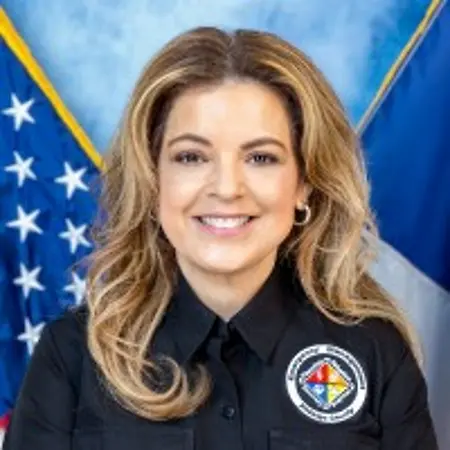
Her Story
About Belinda
Belinda Saenz-Alvarez is an accomplished emergency management professional with 20 years of experience dedicated to protecting and strengthening communities across Texas. She currently serves as Deputy Emergency Management Coordinator for the Hidalgo County Office of Emergency Management, where she leads efforts in preparedness, response, recovery, and mitigation. Her career path is both unique and inspiring she began working in emergency management in 1999 after joining Hidalgo County as a planner in what was then a small, one-person department. Over time, she advanced into her current leadership role, where she has contributed to more than nine federally declared disasters, serving as a vital liaison among local, state, and federal agencies, including during the COVID-19 response.
A Certified Texas Emergency Manager and member of the National Registry of Emergency Medical Technicians, Belinda has built her expertise through extensive training, hands-on experience, and a strong commitment to professional growth. She is actively involved with the Texas Emergency Management Association and has served on the Disaster Recovery Advisory Committee under the Texas Emergency Management Advisory Council. As a member of the Texas Division of Emergency Management Incident Support Task Force, she has deployed across the state in support of large-scale disaster operations and was part of the first out-of-state deployment team to North Carolina following Hurricane Helene. These field experiences have provided her with a powerful, real-world education—where operational demands, collaboration, and leadership intersect in high-pressure environments.
Belinda’s journey has also been shaped by resilience and determination. Coming from a family of educators, she once envisioned a career in teaching, but found her calling in emergency management through unexpected circumstances. Early in her career, she navigated challenges including self-doubt and imposter syndrome, particularly in a field traditionally dominated by men. Through mentorship, continuous learning, and field experience, she developed the confidence and expertise that define her leadership today. In addition to her operational role, she serves on the executive committees for the South Texas All Hazards Conference and the RespondHER Leadership Summit, where she supports professional development and advocates for women in emergency management. She remains deeply committed to mentoring others, strengthening partnerships, and ensuring the next generation of leaders is equipped to serve with confidence and purpose.
Her Interview
Ten minutes with Belinda
01What advice would you give to young women entering your industry?
To ride the wave. Honestly, I think sometimes when we're in the midst of a career, we don't always look at the big picture. One of the things my boss always tells me is that I'm one of those people that likes to listen and look at things from above, while others are just looking straight ahead. And sometimes we meet obstacles in our career, and sometimes I think there is a generation that thinks I can just leave and move on to somewhere else. I think that riding the wave sometimes, and just not jumping to such quick conclusions to things, or reacting to things so quickly, can turn out to be the best for them. I'm a true believer that people come into our lives for a specific reason or a specific time, and whether that's just for a moment or for a lifetime, it changes your path in life. So I sometimes suggest to the younger ones that, you know, things may be difficult right now, but just give it a moment, and let's just see where the wave ends. And if the wave ends in a place where you're still not happy, then you make the decision or the choice that you need to make. But instead of quitting so easily, or wanting to change jobs so easily - sometimes we don't always have the option to do that. We have family, we have bills we have to pay. And it's not easy to just jump from one career to another. For me, I think it's really about telling someone to just be patient about things sometimes, and sometimes it works out in the end. I've had some people come back and say, yeah, you know, if I would have just left when you told me to, I would probably be in a different place, but I'm glad I didn't. And I've realized in the end that sometimes jumping to a decision very quickly isn't always the best option.
02What are the biggest challenges or opportunities in your field right now?
I see a lot of opportunities for women in emergency management. One of the biggest challenges where I live in South Texas is the cultural environment. I'm in Hidalgo County, right on the Texas-Mexico border, and I think that where we live, there's a lot of cultural and heritage and family traditions that kind of limit young women or women in the fields that they choose. When we look at statistics today, we see that a lot of women are teachers, they're in healthcare professions, they're in the food industry, but when you look at anything that has to do with public works, or fire, or law enforcement, or emergency management like my field, the number is very, very low. And I think a lot of that is because of really where our region is, because if I look at other regions going north Texas, I don't see that. I see a lot of women who are in this field who are coordinators or in charge of departments, and we don't have that. We are the seventh largest county in the state of Texas, our population is about 1.2 million, we have 22 cities, and we are only two female emergency managers in my county. I am one, and the other one is another staff member with us. I would like that to change. I would like to make a difference in the future for how some women have that opportunity. For me personally, I never thought when I first started here that I would make it a year, much less a career of 20 years. Had I not had really good mentors - and I'm talking about men, because I did have women, but the men that I did have in my life were good at seeing something in me I didn't see in myself. At some point, I think I had imposter syndrome. I didn't feel like I was confident enough to be able to do the job, technically the job of a male. It wasn't until a couple of years back that someone said something to me, and I realized that I didn't have to follow the expected path that people expected to still have an impact, to still be able to have a career in what I did.
03What values are most important to you in your work and personal life?
Family is most important to me - I have three boys in their early 20s who lost their father about five years ago, and a lot of my goal the last six to seven years has really been on making sure that they're in a good place. My religion is very important as well - staying close to my religion has really anchored me into some of those difficult times, whether on deployment or in the middle of nowhere. A good work ethic is another value that's central to who I am. I come from a family where my father owned a small business for the last 50 years, and he taught me at a young age - we started working for him when we were young - a good work ethic. I never thought my father was going to instill that in me until I realized it years later, about wanting to do my best at my job. I also value building a strong network around me - I had a really good network of family and friends who helped me with my kids when I couldn't make it to certain things, or I was out of town doing something. Part of me wants to give back to that, and just trying to help the younger ones that come into this career. I want to make sure that the job that we do is satisfying for our constituents, because it is their dollar that is paying us to work here. The decisions we make every day when we're in disaster response and recovery don't just affect me, they affect a lot of other people. So I want to make sure that those decisions are sound decisions and good decisions.
Join Influential Women and start making an impact. Register now.