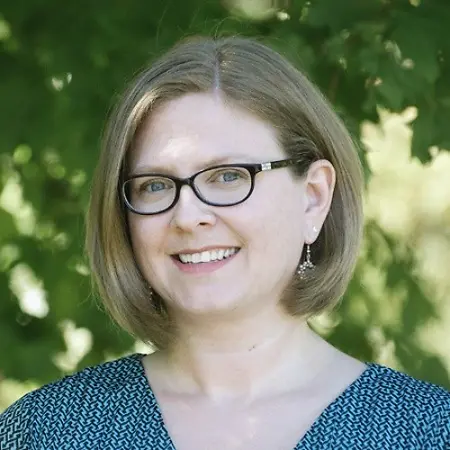
Her Story
About Beth
A seasoned communications leader and higher education strategist, Beth is currently serving as Director of Communications & Creative Services at Middlesex Community College. With more than 25 years of experience in communications and over a decade at Middlesex, she leads a highly creative team. In her role, she partners with more than 90 internal stakeholders across the college, helping faculty and staff translate ideas into strategic, effective communications. Known for her innovative leadership, Beth has spearheaded major institutional initiatives, including the development of a Brand Ambassador Program, the implementation of a campus-wide digital display system, and the creation of award-winning Academic Pathway Maps, earning more than two dozen national and regional marketing awards.
Beth began her career with a bachelor’s degree in graphic design, working at a Massachusetts-based publishing house. Early in her career, she recognized the importance of aligning her creative work with a meaningful mission, which led her to transition into higher education. Drawing on her prior experience in student life, she joined Lesley University in a graphic design role—an opportunity that combined her creative expertise with her passion for student-centered environments.
Her interdisciplinary master’s degree focused on managing creative professionals, equipped her with the ability to apply business and management principles in ways that support and empower designers, artists, and communicators. A recognized advocate for accessibility, inclusion, and human-centered design, Beth has been instrumental in advancing digital accessibility policies and neuro-accessible communication practices in higher education. She has intentionally cultivated one of the most diverse teams on campus, bringing together individuals from varied cultural backgrounds and identities to foster creativity and innovation. Her work is grounded in a deep commitment to equity and belonging, with a focus on crafting messaging that honors the lived experiences of community college students.
As Director-at-Large for the National Council for Marketing & Public Relations (NCMPR), she contributes to national conversations on diversity, equity, and inclusion, continuing to champion accessible communications as a pathway to opportunity and impact.
Her Interview
Ten minutes with Beth
01What do you attribute your success to?
I think a large part of my success is because I chose to do what I love. I have a skill set that enables me to work in a wide variety of industry settings; in fact, my career began in publishing and high-tech. I could earn a higher salary working in the private sector, but I choose to work in community college communications because I believe deeply in the mission. For me, loving what I do and immediately seeing the impact it makes on people's lives motivates and pushes me to keep learning and growing in this field. I believe that if you can find a way for your personal values to align with your work, if you believe in the mission of the industry you are in, and you work hard, success finds you.
02What’s the best career advice you’ve ever received?
The best career advice I’ve received came early in my professional journey: seek mentors and collaborators who not only offer guidance but actively create professional growth opportunities. Career advancement is not solely about individual effort; it is also about building relationships and trust, so others are willing to invest in your potential. This influences my approach to leadership, as I prioritize mentoring others, creating pathways for growth, and fostering an environment where individuals feel supported to develop their skills and pursue new opportunities.
03What advice would you give to young women entering your industry?
When I'm working with younger women entering higher education, I impress upon them the importance of self-advocacy and professional development. Although higher education is more diverse than many other workplaces, misogyny still exists. Even after 25 years in the industry, there are times when I have to ask to be invited to the meeting or I have to remind others about my skill set. Title alone does not guarantee a place for you at the table. My advice is to trust yourself and be brave enough to ask for a seat and to ask to be heard.
Professional development comes in all shapes and sizes and can be both formal and informal. If you are offered the opportunity to attend a conference or networking event, say "yes." If there is a campus committee that you are interested in, ask if you can join. Start a book club with colleagues or set aside time each week to learn about a new topic in your field. Being proactive about your growth is one of the best ways you can build agency at your job.
04What are the biggest challenges or opportunities in your field right now?
Two of the biggest challenges facing higher education and community colleges in particular are a declining traditional-age population to recruit from and the public assault on the value of education. These are issues facing both public and private institutions nationwide. The other large challenge is the federal administration's changing policies, support, and funding for under- and miss-served populations. In my commonwealth, community colleges receive the least amount of state funding. This means we rely on grants and federal funding as part of our revenue stream to ensure that marginalized communities have access to educational opportunities and the supports they need to succeed academically and professionally.
The good news is that community colleges have an advantage in the current landscape: our ability to quickly respond to community and workforce needs faster than private and four-year institutions. From developing micro-credentials and stackable credits, to designing skill-based certificates and career-integrated learning opportunities, we are agile and scrappy enough to find solutions and build learning opportunities that get trained employees into the workplace faster.
To me, marketing and communication is really just problem-solving. If you like a challenge and enjoy taking risks, being at a community college is a great place to be because there are continual opportunities to develop creative and effective solutions to the challenges facing higher education today.
05What values are most important to you in your work and personal life?
The values most important to me are equity, belonging, and accessibility. In the last six years, I've really focused my professional work — and the work of my team — around equity and inclusion. Creating communications that meet students where they are and provide them with the information they need while also fostering belonging. I worked hard to build a team that mirrors the students we serve. Having different cultures on my team, different languages spoken, different identities, and different ways of thinking allows us to be better communicators.
Personally, I am a trained Racial and Community Healing Circle facilitator, using conversation and compassion to reframe our collective humanity, helping people connect in ways that foster welcome and belonging. I am also the chair of the Lowell Cultural Council, with a mission to provide access to and support for education and diversity in the arts, humanities, and interpretive sciences, improving the quality of life for the city's diverse residents.
Join Influential Women and start making an impact. Register now.