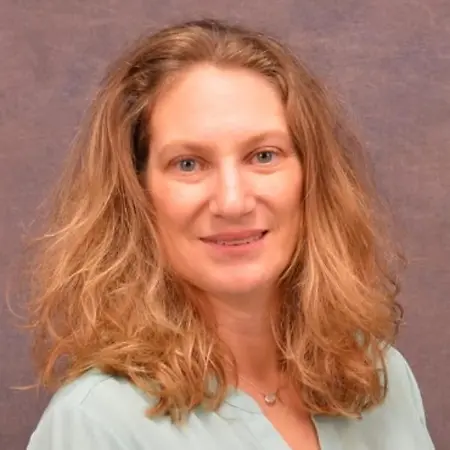
Her Story
About Beth
Beth Phillips is a seasoned educational psychologist and researcher with over 20 years of experience in early childhood literacy and language development. She currently serves as Professor of Educational Psychology and Learning Systems and Associate Director of the Florida Center for Reading Research at Florida State University, where she teaches graduate courses, coordinates master’s programs, and leads research projects aimed at improving literacy outcomes for young children. Her work combines rigorous scientific research with practical applications for educators, particularly focusing on children from lower-SES backgrounds.
Beth’s career began with a PhD in Clinical Psychology from Florida State University in 2003, followed by a pre-doctoral internship at the UCLA Neuropsychiatric Institute and a postdoctoral fellowship from 2003 to 2006. She joined Florida State University as an assistant professor in 2006, was promoted to associate professor in 2013, and became a full professor and Associate Director of FCRR in 2019. Over the years, she has collaborated closely with the state of Florida to shape policies and professional development programs for the state-funded pre-kindergarten program, impacting tens of thousands of teachers and reaching 50,000–100,000 children annually.
Beth’s research has made significant contributions to understanding early language development, including the design of language interventions aimed at improving children’s developmental trajectories. She is committed to translating research into actionable guidance for educators and is recognized for her dedication to both basic and applied science. In addition to her academic accomplishments, Beth is an active member of professional organizations such as the Society for the Scientific Study of Reading and the Society for Research on Educational Effectiveness, where she also mentors emerging women researchers in the field.
Her Interview
Ten minutes with Beth
01What do you attribute your success to?
I attribute my success to collaboration, curiosity, and integrity, paired with a deep commitment to improving outcomes for young learners. I also credit my passion for “paying it forward”—supporting emerging educators and women in leadership—as a key driving force in my work.
02What’s the best career advice you’ve ever received?
The best career advice I’ve ever received is to stay curious and collaborative, recognizing that the most meaningful breakthroughs in education come from shared expertise and sustained inquiry.
03What advice would you give to young women entering your industry?
Go for it. We need more women in leadership positions in higher education and as full professors like me in education, and don't let anybody tell you can't do it. I'm involved in an organization called Providing Opportunities for Women in Educational Research, where I was a founding board member and served as chair of the mentoring committee until last year. It's a relatively small organization, but we've been growing it over the last 10 years, and we're now an official LLC. Our whole mission is to connect and support and provide mentoring and peer support to women and allies, people who identify as women, across the education research landscape, which means people in psychology or sociology who study education research too. We've got members from all over the world. There was a group of about a dozen of us who said we could help each other and we want to pay it forward to a larger group of people. That's been hugely meaningful in the last decade for us to grow this organization. For me, it's all about paying it forward to the younger generation and making sure that I'm reaching my hand down to lift other people up to follow after me.
04What are the biggest challenges or opportunities in your field right now?
The biggest current challenge is the enormous upheaval in terms of federal funding for research due to the current political situation. This has been very discouraging and disruptive. Friends have lost their jobs, and there's uncertainty about whether new federal funding will be available for us to pursue our work. We're competing for federal funding where the chance of getting grants has typically been at the 10 to 15 percent mark, but now it might be at the 3 to 5 percent likelihood mark, and that's a different ballgame. It changes how you have to think about going about your work. Setting that aside, other challenges include trying to figure out the impact of AI on education, what that's going to look like for child development and reading development. Marketing and educational technology companies are getting ahead of the science, and there's a lot we don't know about the impact of all those things on learning and child development. As usual, the scientists will be playing catch-up on commercial products. On the opportunities side, one of the things that COVID did was give a lot of parents a window into their children's classrooms because of all those Zoom classrooms. I feel like it gave parents some newfound respect for how hard teachers work, and that was long overdue. The opportunity for teachers and parents to really see themselves as partners in supporting children's education is important. Parents are understanding that this is a hard job and that teachers often work without the resources they need and need a lot more support, and that it's a professional job and not anybody can just walk into a classroom and do it well. That window into the classroom might move the public's view to recognize that teaching looks hard and deserves respect. The massive childcare crisis that COVID also brought is creating opportunities for people to recognize that childcare is a huge economic issue. People can't go to work without it, and the business community is really waking up to the fact that we need to pay more attention to this. That might encourage state, local, and federal governments to start being willing to spend more money on these things so it doesn't break the bank of so many families who pay more for childcare than to send their kids to college sometimes. That is also an opportunity for creative public-private partnerships to take the burden off of families. You're starting to see some of that materialize in pockets around the country, and the economic arguments can be persuasive.
05What values are most important to you in your work and personal life?
I'd say integrity, having a strong work ethic, and collaboration, and making sure you pull your weight in your collaboration. A lot of what I do is collaborative science, working with large teams. You don't do these multi-million dollar giant projects with 8,000 participants or 4,000 participants or things like that with thousands of people without a large team of people. When you're leading them or collaborating with people in lots of places, you both as one of the leaders of those projects have to model this, but you also want to make sure that the people you choose to work with are following through on the things you say you're going to do. It's very important for me to model that for my graduate students and my project coordinators and things like that. Being known as a good collaborator is really important to me. I also value curiosity. You don't do this for the money, so if you weren't curious about how the world works and how people work, then you're in the wrong business.
Join Influential Women and start making an impact. Register now.