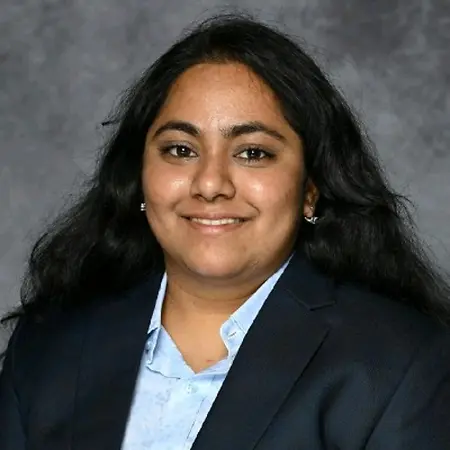
Her Story
About Bhavana
Bhavana Chivukula, MS, is a pharmaceutical scientist specializing in formulation research and development, inhalation drug delivery systems, and clinical manufacturing. She currently serves as an Associate Scientist II at Transpire Bio, where she works on soft mist inhalation products, formulation development, analytical method development, and aseptic manufacturing processes. Her work includes coordinating with analytical and quality assurance teams to support the safe and effective production of clinical batches while contributing to innovative pharmaceutical development initiatives. With expertise spanning inhalation technologies, transdermal systems, hot melt extrusion, and package integrity testing, she is recognized for her strong technical capabilities and hands-on approach to pharmaceutical manufacturing. Bhavana began her academic journey in India, earning her Bachelor of Pharmacy degree from Sri Padmavathi School of Pharmacy before moving to the United States to pursue a Master of Science in Pharmaceutical Sciences at the University of Mississippi. During her graduate studies, she focused on advanced drug delivery technologies including inhalation formulations, 3D printing, and hot melt extrusion, where she developed transdermal patches for asthma treatment. Her early passion for pharmaceutics was shaped by witnessing healthcare and public health challenges firsthand during childhood, inspiring her commitment to improving patient care and advancing pharmaceutical innovation. Throughout her career, she has remained dedicated to continuous learning, scientific excellence, and developing solutions that positively impact patient outcomes. Prior to joining Transpire Bio, Bhavana worked at Tergus Pharma as a Scientist in Formulation Research & Development and In Vitro Sciences, supporting the development of topical and transdermal pharmaceutical products. One of her most notable achievements has been helping establish aseptic clinical manufacturing processes from the ground up, including equipment qualification, packaging operations, and quality testing processes. She credits much of her professional growth to the mentorship of leaders such as Mr. Srikant Mane and Dr. Chad Harrell, who helped shape her scientific, communication, and project management skills. Passionate about empowering women in science, Bhavana advocates for consistency, authenticity, technical mastery, and resilience, encouraging young professionals to remain confident, speak up, and continuously pursue growth within the pharmaceutical industry.
Her Interview
Ten minutes with Bhavana
01What do you attribute your success to?
I attribute my success to the mentors who guided me throughout my professional journey, especially Mr. Srikant Mane, who played a significant role in shaping the way I think, work, and communicate as a scientist. Early in my career, I approached projects from a highly theoretical perspective, but he taught me how to streamline my thinking, structure experiments efficiently, and work effectively under tight timelines. Through his mentorship, I developed professional communication, project management, and organizational skills that became essential to my growth. I also credit my success to hands-on learning, perseverance, and my willingness to continuously take on new technical challenges.
02What’s the best career advice you’ve ever received?
One of the best pieces of career advice I received was to approach projects with practicality and efficiency, especially in fast-paced pharmaceutical environments where deadlines are critical. I learned the importance of structuring experiments thoughtfully, prioritizing execution, and maintaining clear communication. I was also encouraged to continuously develop both technical and professional skills, including project management, leadership, and collaboration, which helped me grow into a more well-rounded scientist.
03What advice would you give to young women entering your industry?
I would encourage young women entering the pharmaceutical industry to stay consistent, remain authentic to themselves, and never feel pressured to master every technique immediately. It is far more valuable to deeply master one area through repetition and experience than to only have surface-level knowledge across many disciplines. I would also encourage them to develop confidence in their own voice, maintain a strong sense of self, and never shrink themselves to fit into someone else’s expectations. This industry can be demanding and requires long hours, persistence, and resilience, but the knowledge and accomplishments gained through hard work are incredibly rewarding. Most importantly, I would tell them to continue speaking up, trust their abilities, and stay committed to their goals.
04What are the biggest challenges or opportunities in your field right now?
One of the biggest challenges in the pharmaceutical and manufacturing field is navigating the complexity of regulated environments, particularly in formulation development, quality assurance, and clinical manufacturing operations. The work can be highly demanding, repetitive, and technically rigorous. Additionally, women in science can still encounter cultural or social barriers, especially in traditionally male-dominated manufacturing settings. At the same time, there are tremendous opportunities emerging through advanced pharmaceutical technologies such as 3D printing, hot melt extrusion, inhalation drug delivery systems, and innovative formulation platforms. Being involved in facility development, process optimization, and next-generation manufacturing technologies creates significant opportunities for innovation and professional growth.
05What values are most important to you in your work and personal life?
Consistency, authenticity, perseverance, and continuous learning are values that are extremely important to me both professionally and personally. I strongly believe in mastering skills through dedication and repetition while remaining honest about where I am in my learning journey. I value hard work, resilience, and maintaining a strong sense of self, regardless of external pressures or expectations. I also believe in speaking openly, standing up for myself and others, and approaching challenges with determination and integrity.
Join Influential Women and start making an impact. Register now.