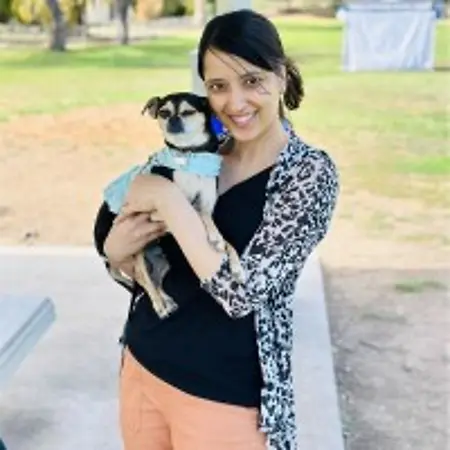
Her Story
About Binita
I am a licensed veterinary doctor from Nepal with a Bachelor's degree in Veterinary Science and Animal Husbandry, and I completed my Master's in Animal and Veterinary Science from Hebrew University of Jerusalem, Israel, where I was awarded a full scholarship and fellowship. Being a foreign student in a foreign country, there are less chances that you will grab this opportunity, but I was the chosen one, and I got full scholarship and fellowship for my studies and to conduct my research. I worked in a microbiology lab in Israel for almost three and a half years before moving to the United States. I then joined the University of California San Diego, one of the top universities in America, where I worked as a Research Associate I in the pathology department in the lab of the head of the department from May 2023 to October 2025. My work focused on research on anti-inflammatory drugs for Alzheimer's disease, specifically testing drugs on tau proteins which are the main proteins responsible for Alzheimer's disease and dementia. I conducted in vivo research using mouse models, testing various peptides and anti-inflammatory drugs while following all animal welfare guidelines and ensuring proper anesthesia and pain management. In my veterinary career, I worked with animals for five and a half years, treating all kinds of species including farm animals and livestock such as goats, sheep, pigs, and cows. I have had my research papers published in different journals. Currently, I am applying for PhD positions in America and am in the process of obtaining my green card to continue my scientific career in the United States.
Her Interview
Ten minutes with Binita
01What do you attribute your success to?
I attribute my success to my hard work, determination, and my not-giving-up attitude. My husband says that I want to be too perfect, and I think that attitude is the thing that has brought me so far - the not-giving-up attitude, my hard work, my determination, and honesty. I feel like I try to find perfection in everything, and that drive has been crucial to my achievements. I've always trusted my instincts, and it has always taken me to the right direction, the right path.
02What’s the best career advice you’ve ever received?
The best career advice I ever received was from my mentor when I was doing my master's degree. He told me that I am a great scientist and that I'm gonna make it a long way. He encouraged me not to give up and to continue my studies, saying I should focus more on my studies and do a PhD because I'm gonna be a great scientist. At the time, I wanted to work and didn't want to continue with my studies, but he motivated me a lot. That advice from my principal investigator really inspired me, and currently I'm actually applying for different PhD positions in America because of his encouragement.
03What advice would you give to young women entering your industry?
I would say that you're gonna face a lot of challenges, and it's not easy - it's gonna come with a lot of challenges. But you should always prepare yourself to face any kind of challenges, and once you are ready, when you're ready to face it, then it's like 50% done. And then the rest 50% is your hard work and your consistency. So don't be afraid, just follow your heart, and trust your instincts. I have always trusted my instincts, and it has always taken me to the right direction, right path. Be ready to compromise, to sacrifice, and then at the end, you will achieve something really hard, really valuable. That would be my advice to aspiring women.
04What are the biggest challenges or opportunities in your field right now?
In this field, I think the biggest challenge would be the lack of funds in the lab. Sometimes there is lack of fund, and you have so many plans and ideas in your head, but you're not able to implement that because of lack of funds. Recently, with the situation in America right now after the new government came in, there was a deduction in the federal funds, so currently we are facing a lot of challenges with the fund. When you don't have enough funds, then you're not able to execute your experimental plans properly. Another challenge is making your PI happy, because your professors don't get happy easily unless they see very good results. Sometimes the results are not promising, and then you have to really multiply your efforts and increase the number of animals for the experiment. Not getting a promising result is also a challenge, but at the end, it's biology, and we get what is there in the animal system. Sometimes balancing the research with your coursework is also very difficult - you have a lot of courses to take, a lot of credit points to complete, and to carry that one forward with your research. But with strong determination and zeal, we can achieve that.
05What values are most important to you in your work and personal life?
I think no matter how successful you are, being humble and down-to-earth is the most important thing that I think everyone should own. No matter how successful you are, you should always think about uplifting others too. If you see that there are people around who need your help, and your small help can uplift them, then you should definitely try to help them and uplift them too. It's not only about my development - I feel like if I get enough resources and I can develop my strengths and my skills, then I can help some other people to do that too. I have different cultural values because I'm an Asian, and I was born like that. In our culture, we treat everyone as brother and sister - that's what our culture teaches us - and no matter what, you should always help others, whatever is in your capacity. I like to help everyone that I see around me, whoever needs my help, and if there is something that's my forte, or something that is within my capacity, then I definitely like to help them and uplift them. It's not only about my upliftment but other people too, especially women.
Join Influential Women and start making an impact. Register now.