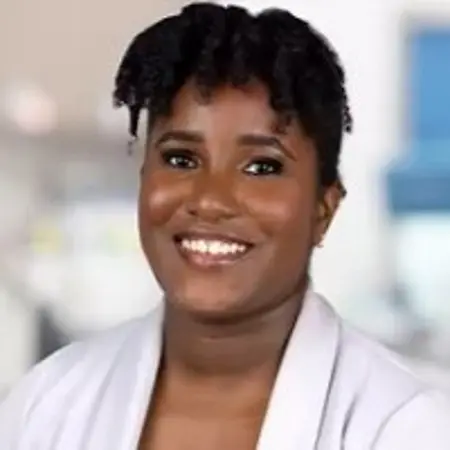
Her Story
About Boahemaa
Boahemaa Adu-Oppong, PhD is a distinguished leader in data science and computational biology, currently serving as Director at Terrana. With a PhD in Ecology and Evolutionary Biology from Washington University in St. Louis and over a decade of experience driving data-driven initiatives in life sciences and biotechnology, she operates at the nexus of deep scientific expertise and enterprise-scale execution. Boahemaa specializes in designing and implementing AI and cloud-based data infrastructures that enable organizations to make faster, more informed decisions while maintaining the highest standards of scientific rigor and regulatory compliance. Her work encompasses enterprise data strategy, governance, and the development of scalable, audit-ready AI/ML workflows that empower scientific research and operational efficiency in highly regulated environments.
On a typical day, Boahemaa’s work bridges science and business strategy. She spends much of her time in meetings with scientists, engineers, and thought leaders, interpreting complex data and translating insights into actionable decisions. Reporting directly to the CTO, she ensures that her teams’ activities align with the company’s strategic objectives, while also advising leadership on data-driven directions for growth and innovation. Her leadership style reflects a servant-leader philosophy: she actively supports her teams, meets each individual where they are, and develops their skills and careers. Known for protecting and advocating for her people, she cultivates high-performing teams that thrive on collaboration, trust, and accountability.
In addition to her corporate leadership, Boahemaa is an adjunct instructor at Washington University in St. Louis, where she teaches advanced data analytics, machine learning, cloud computing, and scientific programming. She has authored peer-reviewed publications on plant-microbe interactions and microbial ecology, demonstrating her commitment to advancing scientific knowledge alongside enterprise application. Recognized for her unique bench-to-boardroom perspective, regulatory fluency, and ability to translate biological complexity into scalable data infrastructure, Boahemaa continues to shape the future of computational biology, AI-driven research, and enterprise decision-making in life sciences.
Her Interview
Ten minutes with Boahemaa
01What do you attribute your success to?
I attribute my success to my mom and her tenacity in life and her ability to just handle anything that's thrown her way with so much grace and humility. I try to channel that when I'm at work by thinking about what would my mother do in this situation, and coming in with a humble heart. That's also grounded in our faith - I'm Christian - and I think about what's the greater thing, greater than me right now. There's always a greater presence around us, and so I don't let those things at work really weigh more on me than they need to, because at the end of the day, we're just all passing by each other and there are so many other things that are way more important in this life. My mom always continually has her group of women around her that she will vent to and talk with, and that will support her no matter what. That's really important to have as you try to climb this corporate ladder in America.
02What’s the best career advice you’ve ever received?
I have a career coach right now to help me through this tough time, and one thing she has told me is that everything is temporary, no matter what you're doing. If you can change your mindset to think that this is a temporary state of being, then it helps you kind of get through that moment of dark times and understand that there is another side to this, there's something on the other side. I've been really focusing on that and meditating on understanding that this moment that I'm in right now isn't gonna last forever. I use that as my framework, and then I understand that if I want this to change, I also have to move. I can't just sit in it and say this is temporary and not actually put effort behind what could make this different. Once I started thinking of things as more of a temporary state and saying that this person is saying this about me but that's temporary, it's been pretty freeing. All I can control is how I respond to that information versus trying to change their mind. I complain less to my partner about my job now, so it's been good.
03What advice would you give to young women entering your industry?
The number one thing that will help them is networking. It really is getting in there and doing the grunt work of meeting people where they are. Right now, there's a ton of applications going into the system, but there's a human on the other side having to filter through all of that. If you learn how to network pretty early in your career, it won't feel like this huge hurdle that you have to jump over. Another contribution to my success was because I was so interested in all these nonprofit organizations and leading programs like the Young Scientist Program, I was meeting people, meeting teachers, meeting corporations every other day, not knowing that the person sitting on our board would one day be the reason why I got a job at Monsanto. When I mentioned I knew Barry Goldman during my interview, my hiring manager called him that weekend to confirm it, and Barry supported me because I had called him two weeks prior just to get advice about the interview. It was a full circle moment of understanding what networking really is - you're talking with people, you're meeting with people, and you don't know if anything will come from it, but that's not why you network. You don't network just to gain things from it. I've seen a lot of people reach out to me asking if I have a job available, and I tell them to slow down. If you're gonna network, do it because you want to meet people and learn from them, not just because you want to get a job. You can tell that instantly when people reach out to you.
04What are the biggest challenges or opportunities in your field right now?
The biggest challenge is funding. Right now I'm in a biotech agricultural startup, and we rely on a lot of investors to fund us through the research and development phase. Now, as we switch over to more of a product-focused company, we have to think about what research and development we pause because we really need to focus on more product development. Because funding is so tough, investors are kind of holding their pocketbooks a little bit closer to the chest. Biotech ag has such a long runway that their returns on investment are gonna take 10 to 15 years, and they don't want that anymore. The ones they're gonna invest in are companies that are heavily baked in AI where they can see those returns next year. That's been a big Debbie Downer for our space - we have fewer and fewer investors in this area. In terms of top-down leadership, it's like how do we scale without scaling people, and that's been difficult. I actually don't have any jobs to offer anyone because my boss is telling me I can't hire more people. We're not allowed to hire, and that's been a little 180 from the days of Monsanto where there were so many jobs available for PhD scientists. All the government grants have gone away because of the new administration, so it's just taken a huge hit to our space.
05What values are most important to you in your work and personal life?
Number one is transparency. I value that to the fullest. I can't read your mind, and I'm a very curious person, so I'm gonna ask you a ton of questions because I want to make sure we are both being as transparent as possible. Another value that I have is being bold. I was reading Brene Brown's book I love her, she's my best friend in my head - and I think about being bold. That's never been a value of mine before, but after thinking about how to do this right, I want to make sure my voice is being heard. So being bold in that room, even if others may disagree with me, that doesn't hurt my feelings. My feelings are hurt if I don't feel like I have space for my voice to be heard. I always tell my coworkers and colleagues that they can disagree with me in front of the whole room - I don't care, I welcome that. But if we have a one-on-one and that's where you decide to share your disagreement, I'm like no, we should be able to have this open dialogue in front of everyone. The last one is humility. That's a huge value of mine. I don't think anyone is better than anyone else. I think we all just have different strengths. I love this book that I read to my son called Be Uniquely Boldly You, and it talks about how everyone has different gifts. You may try to want someone else's gift, but you shouldn't just try to copy someone else's gift - just find yours, and you're gonna shine so brightly with that. It doesn't matter if someone else wants something different. My greatest success would be if my son finds something that he gets as excited about as I get about my work, something he's so jazzed about that he can't stop talking about it with everyone.
Join Influential Women and start making an impact. Register now.