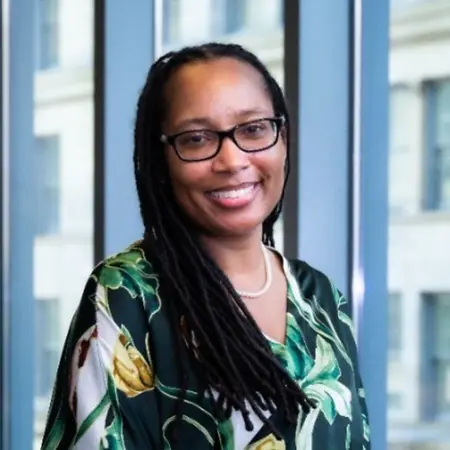
Influential Woman · Data Industry
Brandeis Marshall, PhD, EMBA
Chief Executive Officer, DataedX Group™
Smyrna, GA 30082
Her Story
About Brandeis
Brandeis Marshall, PhD, EMBA, is a Data & AI Governance specialist, executive advisor, and founder of DataedX Group™, a consulting firm focused on helping organizations design and implement responsible, people-first data and AI strategies. A former computer science professor and department chair, she brings a rare combination of academic rigor and industry application to her work, guiding enterprises through complex data ecosystems with a focus on clarity, accountability, and ethical implementation. Her expertise spans data strategy, governance frameworks, and AI orchestration with a strong emphasis on aligning technology decisions with organizational values and long-term sustainability. Her work centers on client engagement, where she partners with cross-functional teams to assess existing data strategies whether mature, fragmented, or entirely absent and build them from the ground up. She helps organizations align policies with operational practices and processes, then guides them through responsible AI adoption by evaluating where and how AI tools are being used, and whether they should be used at all. A key part of her practice involves developing practical roadmaps for integrating data and AI tools in ways that enhance productivity, preserve workflow integrity, and reduce operational risk. Her typical engagements include focused client sessions, usually one to two meetings per day lasting about an hour, extending slightly when deadlines require deeper collaboration. Dr. Marshall’s core expertise lies in databases, data modeling, data analytics, and data ethics, with an advanced focus on responsible AI strategy and enterprise-wide adoption. She supports organizations in not only implementing AI systems, but sustaining them through governance structures that prioritize transparency, accountability, and human impact. In addition to her consulting practice, she is an author and thought leader whose work bridges technical depth with practical application, helping leaders and teams make informed, ethical decisions in rapidly evolving data-driven environments.
Her Interview
Ten minutes with Brandeis
01What do you attribute your success to?
I attribute my success to relationship building. If networking is what women don't do, quote-unquote, I think we really need to relabel it and just say connection and relationship building. I talk to people, and people talk to me. I check in on people, people check in on me. I think that's what's needed in the world - for us to have that personal connection. If we don't do that, then we're toast. Throughout my career, support groups have formed organically at each stage and phase of my evolution. In grad school, 5 or 6 of us were sitting in the cafe lamenting about our advisors or research, and we decided to meet regularly. When I was an assistant professor at Purdue, all the assistant professors in my college got together for dinner and drinks, and we made that a regular thing. It happened again when I got to Spelman. There have been people surrounding me, and I surround them. These support systems that come along unexpectedly have been instrumental. I also credit my parents, who always instilled that education can't be taken away from you - hence why I have a PhD. I started in school and just went till I was done, because if I stopped, I probably wasn't going back.
02What’s the best career advice you’ve ever received?
The best career advice I've received is don't be afraid to pivot. You might have to endure a difficult situation for a minute, but you can exit out. You don't have to stay stuck. I've learned that when I've been gaslit or overlooked, I kind of go, okay, you just don't understand what I bring to the table, so I'm gonna move. I'm gonna move to a different table. I'm not gonna stay stuck in that cycle of oppression and being downslotted. I'm going to unstick myself from the situation that's trying to bring me down. This mindset has served me well throughout my career, reminding me that I always have agency and the power to choose a different path when an environment no longer values my contributions.
03What are the biggest challenges or opportunities in your field right now?
I think the biggest challenge is for people to not be enamored with the hype. As I say in my book and when I speak, data fuels the algorithms that are making the AI and everything is AI right now. We need to stop following the hype cycle and the doom cycle. Consistently good data is going to help you get to good results, good insights, and good impact. But you gotta have good data. The AI era that we are in produces a lot of content, but that doesn't mean that content is going to give insights or has context. Because I've been in this discipline way too long to be pulled in all those directions at once, I know tech is going to message things a certain way, then people are going to find out that messaging has a lot of falsehoods, and then we're going to get to a more balanced conversation. I just pause, and I wait till we get to the balanced conversation. A lot of the AI conversations - I just wait 30 days. If it's still a thing, then I start paying attention. Our industry needs to stop the hype stuff. People in tech and in data and in AI that are following the hype cycles - I kind of go, you guys really haven't seen the pattern. The pattern has been the same from the telecom era, through the internet era, through the iPhone and iPod era, and now we're in this next iteration, which is the AI era.
04What values are most important to you in your work and personal life?
My values have evolved over time, and right now they're definitely centered on what rest looks like and what pausing looks like - because those are two separate things that I don't conflate anymore. I'm focused on how to have a softer life. Being busy isn't the flex. It's not being busy and making impact still. It's being targeted in your activities that provide you joy, and working with people that you want to work with. I spent too many years working with people that didn't necessarily value me, or my ideas, or my presence. Now I'm at a spot in my life where it's like, oh, okay, you don't value me? Okay, cool, I'm out. And I just kind of move on. That, to me, is the flex. I've redefined what success in my work life and my home life looks like. It's peace, it's calm. I can get up and not have to rush to a meeting, get in the car and commute. I don't have to get up and dread the meeting happening. That to me is part of my core of where I'm at in this phase of my life.
Join Influential Women and start making an impact. Register now.