A nurse's powerful 20+ year journey with endometriosis reveals the critical importance of patient advocacy and listening to your body when medical tests come back normal.
Verified Member
Influential Woman · Healthcare Technology & Clinical Registries
Brandy Sue Greif
Registry Experience & Training Lead, Layer Health
Middleburg, PA 17842
25Years experience
1Article published
Her Story
About Brandy
Brandy Sue Greif is a healthcare technology and clinical quality leader whose career has been shaped by a passion for helping people, solving complex problems, and making healthcare data more meaningful. With more than 20 years of healthcare experience—including over 12 years in nursing and nearly a decade specializing in clinical registry abstraction, quality measurement, and medical record auditing—she brings a distinctly human perspective to the rapidly evolving world of healthcare artificial intelligence.
As Registry Experience & Training Lead at Layer Health, Brandy works at the intersection of clinical expertise, technology, and education. She partners across product, engineering, machine learning, customer success, and clinical operations to help develop AI-supported clinical data abstraction workflows that are accurate, transparent, and grounded in real-world clinical practice. She also leads client and hospital-system onboarding, trains new hires and clinical professionals, and oversees a team of approximately 20 people. Known for translating complicated registry guidelines into practical, understandable processes, Brandy has supported more than 30 hospitals and health systems and trained over 30 professionals throughout her career.
Before joining Layer Health, Brandy developed extensive expertise in stroke, heart failure, psychiatric core measures, clinical quality improvement, and medical record auditing. Her clinical background gives her the ability to bridge the gap between the people building healthcare technology and the professionals who use it—ensuring that innovation supports, rather than replaces, human expertise.
Brandy is also the co-founder of the Quality Data Abstractor Association (QDAA), a professional community created by abstractors, for abstractors. Through QDAA, she is helping give an often-overlooked profession greater visibility while creating a place where abstractors can connect, share knowledge, find trusted resources, and grow together. Her belief that better-supported abstractors produce better data—and that better data ultimately contributes to better patient care—is at the heart of the organization’s mission.
She holds an associate degree in Pre-Professional Studies–Health & Biomedical Sciences from Adventist University of Health Sciences and has continued expanding her knowledge through training in Lean Six Sigma, lean management, software validation, and healthcare technology. She also volunteered with Give Kids The World Village and One Brick while living in Orlando, FL, and now that she resides in Pennsylvania, she volunteers at Buttinhead Farms wrangling goats, during goat yoga events.
Brandy credits supportive mentors, adaptability, and a willingness to keep learning as important foundations of her success. Her leadership philosophy is simple: build trust before authority, develop people before processes, and solve problems collaboratively. Whether she is teaching a new abstractor, improving an AI workflow, or building a professional community, her goal remains the same—to make people feel supported, capable, and confident in the work they do.
Her Interview
Ten minutes with Brandy
01What do you attribute your success to?
I attribute my success to the people who believed in me, my willingness to keep learning, and my genuine passion for helping others grow. While I was in nursing school, I was fortunate to work alongside an extraordinary group of mentors and team members at Florida Hospital Apopka, now AdventHealth Apopka—including Jamie, Lawanna, Charlene, Joe, Craig, Shannon, Candi, Donald, Dr. Tran, Dr. Garcia, Dr. Wetmore, and Dr. Bennett. Their hands-on teaching, guidance, and willingness to invest in me helped build the strong clinical and professional foundation that I still rely on today. I have tried to honor that investment by doing the same for others. Whether I am mentoring a new hire, training hospital staff, or helping someone build confidence in their abilities, teaching and supporting others remain at the heart of my work. I also credit my success to being adaptable, asking questions, embracing unfamiliar opportunities, and never believing that I have reached a point where there is nothing left to learn.
02What’s the best career advice you’ve ever received?
The best career advice I have ever received was to never stop learning, always ask questions, and never be afraid to be wrong. Admitting that you do not know something is not a weakness—it is an opportunity to learn and become better. Some of my greatest professional growth has come from asking questions, listening to other perspectives, and being willing to reconsider what I thought I knew. In healthcare and technology, where guidelines, evidence, and processes continually evolve, curiosity and humility are just as important as experience.
03What advice would you give to young women entering your industry?
My advice to young women entering healthcare technology and clinical quality is to stay curious, remain adaptable, and never be afraid to ask questions. These fields change constantly, and no one enters the room already knowing everything. Do not allow unfamiliar technology—or the fear of saying the wrong thing—to convince you that your perspective does not belong there. Clinical experience and human insight are incredibly valuable, especially when technology is being designed to support healthcare professionals and patients. Speak up, share what you know, and be willing to learn what you do not. Build relationships with people who will teach you, challenge you, and advocate for you—and then do the same for the women coming behind you. Most importantly, do not wait until you feel completely ready to pursue an opportunity. Sometimes growth begins by saying yes and trusting yourself to learn along the way.
04What are the biggest challenges or opportunities in your field right now?
One of the greatest challenges, and opportunities, in clinical data abstraction today is the growing use of artificial intelligence. Many abstractors understandably fear that AI will replace their jobs, but I believe their expertise is more important than ever. AI can locate information, reduce repetitive work, and offer suggested answers, but the abstractor remains the human in the loop—the person who applies clinical judgment, understands nuance, and ultimately makes the final decision. I view AI not as my replacement, but as my favorite coworker or personal assistant: it helps me work more efficiently while allowing me to focus on the critical thinking that only a human can provide.
05What values are most important to you in your work and personal life?
The values most important to me are honesty, compassion, loyalty, trust, and treating people with kindness. In both my work and personal life, I believe in showing up for people, being honest even when a conversation is difficult, and creating relationships where others feel safe asking questions or admitting they do not know something. I never want my title or experience to make someone feel as though they cannot approach me. Helping people feel seen, supported, and capable is more important to me than being the most impressive person in the room.
I also deeply value family, community, collaboration, and continuous learning. I believe knowledge should be shared, not guarded, and that success means more when you help others grow alongside you. That belief shapes how I lead and teach, and it is one of the reasons I co-founded the Quality Data Abstractor Association. Whether in my career or my personal life, I try to build trust before authority, put people before processes, and leave others feeling more confident than they did before they came to me.
Her Content Hub
Articles by Brandy
“The Tests Were Normal. I Was Not.”
What more than two decades with endometriosis taught one nurse about listening to patients—and trusting ourselves.
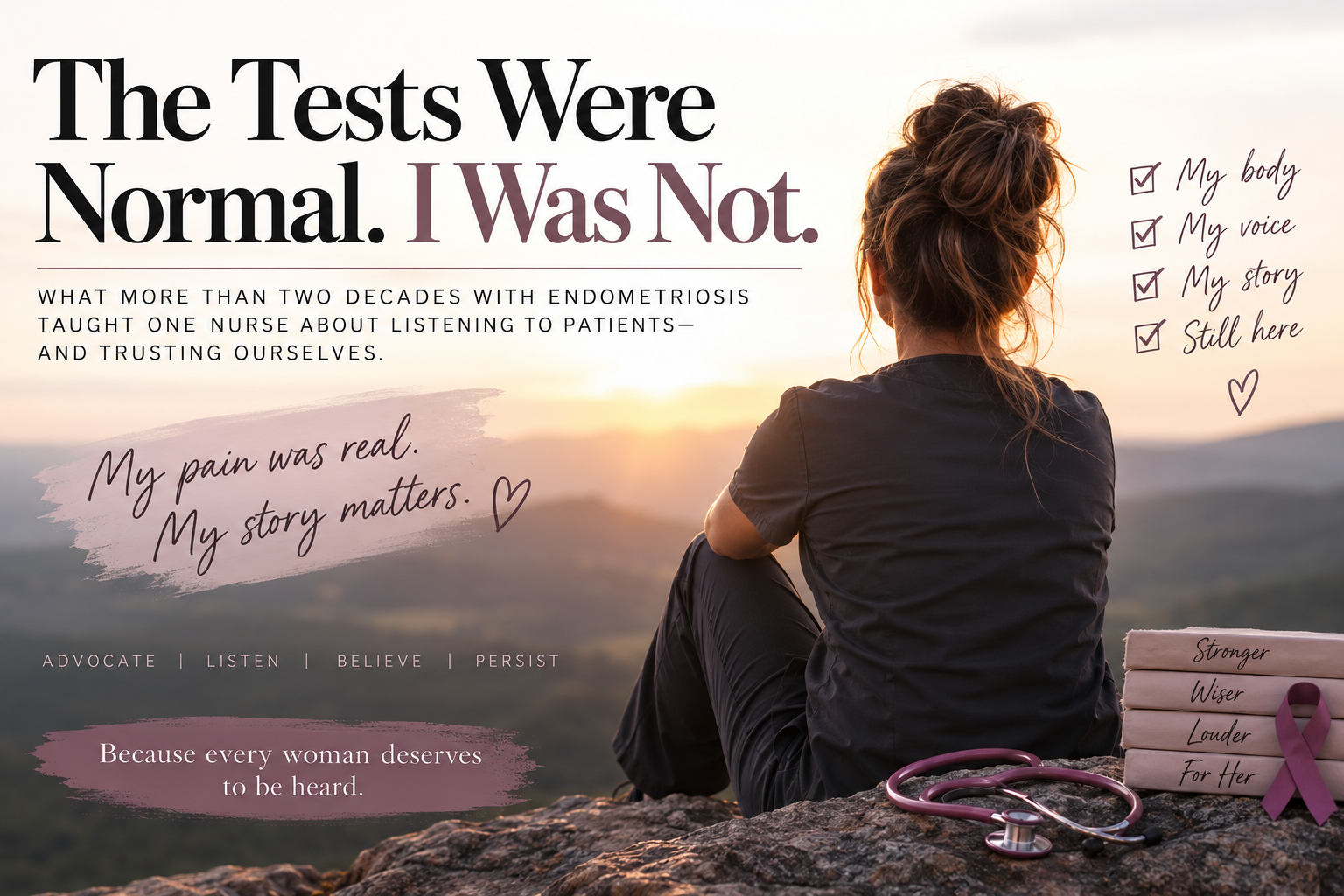
"The Tests Were Normal. I Was Not."
What more than two decades with endometriosis taught one nurse about listening to patients-and trusting ourselves.
For 68 days, I was in pain.
I couldn't sit comfortably. I had constant cramping. Something in my body was telling me that something was wrong.
I had already been diagnosed with endometriosis twice-once in 2012, when it was found on my bladder and colon, and again during my hysterectomy in 2019.
So when the pain returned this summer, I asked the emergency-room provider a very reasonable question: Could my endometriosis have come back?
I was told that because I no longer had a uterus, that was unlikely.
Yesterday, September 3, 2026, a surgeon operated on me.
She found endometriosis.
Again.
And she found something else: extensive pelvic adhesive disease involving my colon, pelvic sidewalls, bladder peritoneum, and vaginal cuff.
Today, for the first time in 68 days, the cramping is gone.
I'm sore from surgery. But the pain that brought me here is gone.
And that is why I'm telling this story.
Let me take you back to 1999.
I had my son Jacob just a month and a half after turning 21. Postpartum depression hit, along with increased menstrual flow and horrible menstrual cramps. Nothing was too bad for me to handle, but it was definitely worse than before Jacob was born.
In 2003, I had Kylee, and all hell broke loose. I would bleed through a super-plus tampon and a thick, diaper-like menstrual pad in an hour. I was miserable. The cramps were excruciating. I would pass blood clots the size of a clementine just walking from the toilet to the shower.
Then, as time went on, the migraines started, along with vomiting and a diagnosis of anemia. I had never experienced migraines before. When they hit, I had to remove myself from everything-a pitch-black room, complete quiet, and hours of sleep. Not exactly something you can do when you're a stay-at-home mom.
I started talking to my OB-GYN more and asking for help. We tried different birth controls, and while they helped with the cramping, the bleeding and migraines were still there. I started to think maybe I was the problem. Maybe I was overreacting. Maybe this was just how it was after you had children. I didn't know.
My mom did say she went through the same things I was going through, and it was just something we had to deal with as women. The one thing that stuck out to me was that my friends were not experiencing the same things I was every month, and they, too, had children.
As my kids grew older, I returned to the workforce and started working at their elementary school as a teacher's aide.
There is nothing more embarrassing than hearing, "Mrs. Greif, you sat in something."
No, I didn't sit in something. I was bleeding through my menstrual protection-and yes, I said protection, because I was using both a tampon and an overnight heavy-flow pad.
Teachers and teacher's aides can't simply use the restroom whenever they need to. Some don't even have bathrooms in their classrooms. Imagine knowing you need to change your tampon every hour and not being able to leave to do it.
I ruined clothes. I missed work. For seven days every month, my quality of life disappeared.
I was 25 years old when my symptoms became unbearable. For the next three years, my request never changed. I wanted a hysterectomy. Due to my age, they refused. Their reasoning? My age. What if I wanted more children? What if I divorced and my new partner wanted children? I was also told they didn't want to put me on hormone replacement therapy (HRT) at such a young age, so they finally offered to do a NovaSure endometrial ablation procedure instead.
In September 2006, I had the NovaSure ablation, and waiting for my period that October seemed like years. October, November, and December all came and went with no period. In September 2007, I had been period-free for a year. The best year ever. No missed days of work, no ruined clothes, no cleaning blood clots off the floor.
Occasionally, here and there, I would have a migraine, but it was not every month. I was able to once again enjoy life. Life was good.
Fast forward to December 2012.
I was finishing my first semester of nursing school and prepping for finals. I had menstrual like cramps. Ah hell. I am getting a period again flashed in my brain. Run to the bathroom. No blood. Buy pads on the way to work. Getting hot and sweating doubled over in pain. Thankfully, by this time I was working in the emergency room and my charge nurse sent me to a room to be seen. She thought maybe I had appendicitis. Labs were drawn, a CT was ordered and everything came back unremarkable. She sent me home and told me to rest up for my final the next day.
Getting hot and sweating, doubled over in pain. Thankfully, by this time, I was working in the emergency room, and my charge nurse sent me to a room to be seen. She thought maybe I had appendicitis. Labs were drawn, a CT was ordered, and everything came back unremarkable. She sent me home and told me to rest up for my final the next day.
The next morning, I was still in pain. When I got into the car, I could have cried.
But I had nursing school finals.
I took my finals standing up.
Afterward, I walked across campus to the main hospital.
They drew labs, did a CT, and again, everything was unremarkable. They sent me home. I went back to work that night, and the charge nurse sent me back to a room and ordered an ultrasound. She knew me well enough to know something was off.
The provider I saw suggested I be admitted, and since we did not have an OB-GYN at our campus, he had me transferred to another hospital.
I spent seven days lying in a hospital bed. I could not sit; it hurt too badly. I had X-rays, CTs, MRIs, and several ultrasounds. On the sixth day, the OB-GYN said something like, "I cannot find anything wrong with you. The only thing I can do is exploratory laparoscopic surgery, but I do not really want to do that. There are risks with surgery."
Well, I want you to.
There is something wrong with me, and I am not going home to two children and not be able to sit or drive them anywhere. She scheduled the procedure for the next morning.
Post-op, I went to the restroom, and while I was sore, I did not have any cramping. I was not sure what she did in there at this point.
I walked back from the restroom and sat on the edge of the bed. I looked at my mom.
"I don't have cramps. I'm sore, but I can sit."
Not long after, the OB-GYN came in, and she apologized to both me and my mom.
"You have endometriosis."
She handed me photos and explained that she found it on my bladder and my colon.
I went home later that day. Oh, and I still did not get a period, so far, the NovaSure procedure was working.
And then I lived happily ever after right…. nope. In March 2019, I noticed spotting. By then I had moved from Florida to Pennsylvania, and I worried that a new OB-GYN wouldn't understand everything I had already been through. I immediately requested my records and found a new provider.
She was surprised the NovaSure ablation had lasted nearly 13 years and suggested trying Depo-Provera. Within days of the injection, I developed headaches and abdominal pain, so we decided not to continue it.
All was well until September.
My boyfriend and I were going to hike the Pennsylvania Grand Canyon for my birthday. On the way there, I was nauseous and cramping. I felt a migraine coming on, and we cancelled the trip. We ended up in the ER. They did all the tests and came back to tell me I had uterine fibroids and needed to follow up with an OB-GYN.
I brought my records from Florida, and as soon as this woman looked at my records and my most recent ER visit, she said, "I think the best thing we can do for you is a hysterectomy." I could have cried. Finally!
She suggested we leave my ovaries to avoid early menopause, and I agreed. I was scheduled for a hysterectomy in October 2019. After the procedure, she told me she found endometriosis on my colon and bladder and removed it, which could have been part of my pain, as well as the fibroids.
I felt like a new woman. No pain. No cramping. No spotting. No headaches or migraines. Everything was great. Until June of this year. I woke up on a Sunday with horrible pain in my lower right quadrant, and as the day progressed, so did the pain. I waited on the couch for hours, and when I got up to use the bathroom, I could feel the pain radiating up my back. Ugh.
"Pyelonephritis-a kidney infection-was the first thing that came to mind because I'd had one before."
Off to the ER I went. The provider thought I had kidney stones and ordered morphine. It did not touch the pain. He ordered Dilaudid. It did not touch the pain.
The labs and CT came back unremarkable. He told me that I probably had a bad UTI and was ordering antibiotics and steroids. I questioned him about a recurrence of my endometriosis, and he told me I did not have a uterus, so it was not likely. I mentioned I still had my ovaries, and again, he told me that was far-fetched and maybe I had pulled a muscle.
I left feeling like a nutcase.
My body was telling me something was wrong. I was in so much pain I could not sleep. I made an appointment at 3:45 a.m. through my health portal with my PCP for the next morning.
She knows I do not schedule an appointment to see her just to say hi! She took one look at me and was like, "Girl! What is going on? You look miserable."
I told her I was miserable and felt like I was losing my mind. She ordered stat labs and another CT, thinking maybe I had appendicitis and it had not presented the day before.
Everything came back unremarkable, again. I asked her about endometriosis recurring and told her what I'd been told in the ER. She disagreed. She explained that endometriosis could still be possible after a hysterectomy and recommended that I see a gynecologist for further evaluation.
The provider who did my hysterectomy moved out of state, so I reached out to the PA at that office. The response I got back from the PA echoed the ER provider, so I started looking for a new provider.
The dates I started looking for a new provider were June 29 and 30, 2026. The first opening I found with a Minimally Invasive Gynecologic Surgery (MIGS) specialist was August 12. I took it. Then the next place I called was August 18. I took that one, too. I did not want the first one to cancel or reschedule and then have to wait another one to two months. I was desperate for answers.
I saw the provider on August 12 and cancelled the one for the 18th that same day. I told her what had been going on and that I was miserable.
She gave me lots of options: pelvic floor therapy, a women's midlife health group, surgery, and suggested that if we went in to look for endometriosis, we should consider removing my ovaries, too, as a preventative way to hopefully keep this from happening again.
She explained that even after a hysterectomy, endometriosis can persist or recur and that there is no guaranteed cure. She pointed out that I had made it seven years from my first diagnosis to my second, and nearly another seven years before symptoms led me back to her office.
After discussing my options with her, including the risks and benefits, I decided to move forward with surgery and removal of both ovaries. I opted for the surgery to remove my ovaries.
On September 3, 2026, surgery finally gave me an answer. My surgeon documented pelvic adhesive disease, with adhesions involving my colon, pelvic sidewalls, bladder peritoneum, and vaginal cuff. She also found nodular endometriosis on both uterosacral ligaments and superficial endometriosis in the posterior cul-de-sac and on the colonic epiploica. The lesions were excised, the adhesions were freed, and both ovaries were removed.
I did not have a uterus. I did have endometriosis.
I have spent more than two decades learning this lesson, first as a woman and then as a nurse: tests are important. Physicians are important. Medical expertise is important.
But so is the person living inside the body being evaluated.
You are allowed to keep looking for someone who will listen.
I did.
On September 3, a surgeon found the endometriosis I had been told was "far-fetched."
On September 4, for the first time in 68 days, I woke up without the cramping that had consumed my summer.
Sometimes advocating for yourself isn't about proving that you're right. It's about refusing to stop looking for the answer.
Join Influential Women and start making an impact. Register now.