Her Story
About Brooke
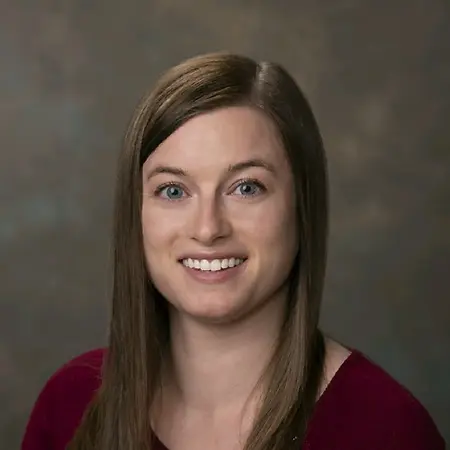
Brooke Ellen Delgoffe, M.Sc. (She/Her) is a Senior Research Programmer/Analyst at Sanford Health (Marshfield Clinic region), where she applies her expertise in data transformation, analytics, programming, and clinical research to advance healthcare outcomes. Her work spans trauma and emergency medicine, genetics and precision medicine, clinician/resident-led research, clinical trials, and nationwide enrollment studies. Brooke prepares electronic health record, registry, dental, survey-based, and insurance claim data for both resident-led quality improvement initiatives and large-scale research, integrating data from sources such as REDCap databases and state and national registries. She also develops SAS macros, manages documentation, and provides training to ensure high-quality, reproducible research. Brooke’s path into biostatistics began with a left turn from her original plan in occupational therapy. While completing her undergraduate studies, she discovered a passion and aptitude for statistics. Graduating with a Master’s in Biostatistics from Grand Valley State University in 2017, Brooke began her career at Marshfield Clinic Health System just days later, on her birthday. She embraced the opportunity to learn about healthcare data firsthand, combining her analytical skills with her passion for healthcare; a combination that continues to drive her fulfillment and professional growth. Outside of her professional work, Brooke is dedicated to community engagement and wellness. She is a certified therapy dog handler with Bright and Beautiful Therapy Dogs Inc., spreading joy alongside her poodle, Miss Remy Bell, and volunteers as a Co-Leader with the Girl Scouts of the USA, fostering compassion and leadership in young learners. Brooke also mentors colleagues, interns, and students, striving to be the same kind of guide and encourager that Paul Stephenson was for her. By blending technical expertise, curiosity, and compassion, she continues to make an impact in healthcare, research, and her community near and far.
Her Interview
Ten minutes with Brooke
01What do you attribute your success to?
I attribute my success to my strong support system: my parents (Steve and Kerry Delgoffe), family members, friends, my workplace, and Paul Stephenson. My parents have always challenged me to be the best version of myself and supported me unconditionally. My mom is a "super mom" (active in our community and our lives) and my parents had me involved in everything possible to help me find my spark. Girl Scouts, 4-H international exchange, dance, gymnastics, horseback riding, you name it. For a day or a life time, I was shown every opportunity they could muster and taught how to work hard to reach goals instead of waiting/looking for hand outs. Paul was my statistics professor who saw something in me that I didn't see in myself. When I was dedicated to occupational therapy, he told me 'Brooke, you're pretty good at this. Not a lot of people are good at statistics.' When I didn't get into OT school, he said he thought I had a really strong career as a statistician and suggested a spot in the master's program with a partial scholarship. He encouraged me not to be afraid to take a left turn in life. Now I try to be a "Paul Stephenson" for others, to open doors they may not have seen. As I turned left, it was equally important to be received by a workplace ready to cultivate excellence. Marshfield Clinic Research Institute has been my first and only "professional" workplace because they have kept my interest, provided excellent mentorship, and placed me under leadership that allows me to be my best self no matter how "creative" my ideas have been. I would not be where I am now without the many leaders that surround me (titled or untitled).
02What’s the best career advice you’ve ever received?
The best career advice I ever received came from my first manager, Laurel Verhagen. I had so many thought-provoking conversations with her about transitioning from being a student to being a professional. She told me that my work is as good as I make it. She said 'if you set the bar high, and you reach that bar, excellent. We love that for you. If you set your bar low, we don't have a problem until somebody complains and its evaluation time or you get passed over. So, create the work that you're proud of.' This was really challenging for me at first because I was used to grades and right answers. She taught me that not everything has a right answer in the professional world, and it was up to me to come up with what is my best work, what represents me, and what people expect when they work with me. That advice really changed the way I interacted with my work and taught me how to be authentic and create something that was recognizable as mine. While Laurel gets the "best advice" credit my current director, Lynda Kubacki-Meyer, has been a huge reason those things that were recognizable as mine have reach through our team into the larger programming world and beyond.
03What advice would you give to young women entering your industry?
I would say add me on LinkedIn and connect with people. One of my favorite things about remaining vibrant in the SAS programming community is my ability to connect with students and women of all ages who need a career change and want to do something different. When they come to me and say 'you love your job, I want to love my job too, how do I do that?' I tell them: Faith, Trust, and Pixie Dust. I really own that statement. For me it means having faith in God, faith in others, faith in myself, that things happen for a reason, and if you can be the reason that somebody does something great, then you should be. I stand behind people who are trying to make a difference for themselves by giving them a voice and a pedestal. A lot of people just aren't as confident, so I focus on teaching people how to be resourceful. Trust means trusting that if you put the work in, you should be able to get there. There are resources out there and people you can trust to help you. You don't have to do everything yourself. Real smart people know how to connect and be resourceful more than just productive. And Pixie Dust is just fun. If you have a job that you think is fun, or that you can add some fun to, it doesn't feel like work anymore. If you can find something that you can make your own and add fun elements to, like how I lead our team social committee, it makes it something I look forward to. I also make sure to maintain a work-life-love balance, and I don't think those things need to be separate. They need to work together for the best you.
04What are the biggest challenges or opportunities in your field right now?
It's a very tumultuous time in the IT and programming industry right now. AI seems like the elephant in the room that you either train to be your pet or you risk being ran over by. But just like the calculator, AI is a tool that allows us to do more of what matters and less of what is mundane, copy-and-paste, and time consuming. No one misses doing math by hand. AI completely underlines a motto I have playing constantly in my head, "Good data in, Good research out. Bad data in, Bad research out." So the greatest opportunity in our industry is to be part of the data management and development of tools that use it better than before. Which is honestly not new at all, just more visible to a wider audience. You're not just working for your employer, your working for the world of users.
05What values are most important to you in your work and personal life?
The most important values to me are community involvement, helping others succeed, and maintaining what I call a work-life-love balance. I don't try hard to be visible; I try hard to be that invisible reason why other people succeed. I believe in women supporting women, and I think it always has taken a community. If I can put my hand out to help somebody else up on their horse, that's what I want to be. I'm involved in the operations committee and SAS users groups where I review and present papers at regional conferences. I do volunteer work including bringing my therapy dog Remy to libraries for Reading with Remy, to the Children's Hospital every Tuesday to sit with patients, and to the Discovery Education Station STEM after-school program. I also participate in the Nutrition on Weekends program where we pack lunches for children who don't have enough food at home. As a Girl Scout leader for a 3K through 2nd grade troop, I get to teach little women who are just learning how to exist and develop their own personalities, teaching them about science, art, entrepreneurship, and life skills. As STAR Scholarship chair in P.E.O., last fall I interviewed 22 young women graduating from high school this spring and was able to identify someone to recommend for our $2,500 scholarship nomination. I love getting to meet these exemplary young women in our community and connect them to opportunity. My approach of Faith, Trust, and Pixie Dust guides how I help others find fulfilling careers. It emphasizes faith in God and others, building confidence and trust, and adding fun elements to work so it doesn't feel like work anymore. I don't think work and life need to be separate; they need to work together for the best you.
Join Influential Women and start making an impact. Register now.