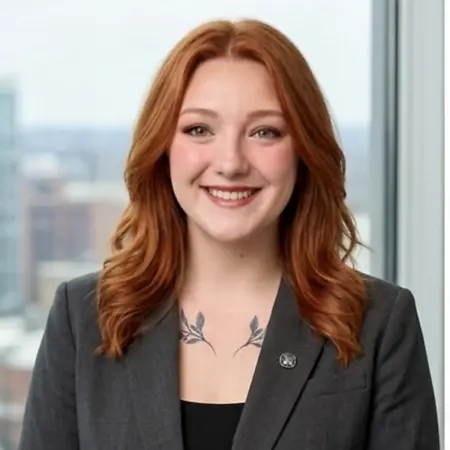
Her Story
About Brooke
I'm a director of nursing at Thrive Behavioral Health, a certified community behavioral health center in Rhode Island. I lead a team of about two dozen nurses across 5 clinical sites, group homes, and therapeutic schools, serving underserved populations, mostly Medicare and Medicaid folks. I grew up in a pretty rural community of cranberry farmers, and a lot of our help on the cranberry bogs were migrant workers who were a largely underserved community, so I really grew my heart for serving that population from a really young age through the interactions I had with the workers in my community. I started in healthcare when I was in high school as a certified nursing assistant and just kind of grew from there - it's been about 13 years now. My day-to-day involves going between all of our clinical sites, therapeutic schools, and group homes to retain, train, and coach nurses and medical assistants. I check in with our teams and staffing, and I still maintain a small caseload of clients myself because it's really important for me to be visible and in the trenches with them. I don't think it's fair to put out fires you haven't felt the warmth of yourself. From a high-level perspective, I follow up on all of our incident reports, build community relationships with our care partners whether that's inpatient hospitals or substance community members, and I track down new resources and grants to expand our current pool of resources. I'm currently back in school for my master's degree.
Her Interview
Ten minutes with Brooke
01What do you attribute your success to?
I attribute my success to building a strong team that can function independently. My proudest moment was when I had a car accident in December and had a concussion, was out of work for like a month, and they locked me out of my email. I had this pulling anxiety about wanting to give back to my team, and I was super pissed about it. But that forced break allowed me to just rely on my team, and seeing the nurses that I've launched as either new nurses or new nurses in psych nursing be able to run that ship without me was a really important and profoundly validating moment for me as a leader. I think it's the same thing when you raise children - they come to you with some level of experience, and then you get to launch them into a career in psychiatric or mental health nursing. I have nurses that I'm close with and have mentored up from being a CNA like I was, and one nurse was a CNA when I was a nurse, then grew into an LPN, and now she's an RN, and that's been really exciting to see her journey as well. I think that nurse education and growing our young instead of eating them is something that nursing has lost, and it's really important for me that my teams don't become spectators of medicine. Nursing has tended to lean in that direction over the years, and it's really important for me that nurses get to job craft and get to become participants in the system. We have so many great clinicians and substance counselors, and nursing in community health never happens in isolation. We are great because our teams are great, and because we're able to learn from each other and cover each other's blind spots.
02What advice would you give to young women entering your industry?
None of us end up in this type of work by accident. I think it's really important to remember that nurses have been framed historically as healers, but in all actuality, we're just handymen with different tools. It's really important that as nurses, we take our cape off and hand it to the person we're serving, and we give them all of the tools and all of the options and all of the choice. What I find drives nurses out of nursing is the moral injury of when they don't succeed in moving someone forward in treatment, whether that looks like progressive chronic illness - it really becomes a moral injury issue. When we give that choice and all of the options and all of the knowledge that we have to our patients, it no longer becomes 'I failed.' I think it's really important that nurses learn to do that, that we don't tie our worth and our value as nurses to the individual successes of our clients. When you tie it to the community at large, it becomes not a bigger thing, it actually becomes a much easier thing when that data gets bigger. Mental illness and addiction are relapsing diseases, and we know that. We've done so well with it, and the reason we've done so well is because we've stopped tying addiction and psychiatric illness to morality and value. When we've started to create that separation, we've seen clients come more accepting, but we've also become better listeners.
03What are the biggest challenges or opportunities in your field right now?
The biggest challenge I see is reliable funding sources. I really think that with all of the changes to our federal and state government, and also all of the requirements changing to access that funding so frequently, that we are very much building the ship as we're flying it, and then we're flying it in a different direction. As far as the biggest opportunity, I think that mental health and addiction in particular are less stigmatized now than they were prior to COVID. I've seen a lot more community acceptance, and that's when we can have conversations. I really think that the shame and stigma has improved, and we still have a lot of work to do. But even the overdose deaths reducing over the last several years - they're in a spike right now because of some contaminants in our drug supply - but the reduction we saw was because of the utilization of harm reduction, and because people were able to access care differently. I think that the biggest opportunity for us is access and reducing stigma.
04What values are most important to you in your work and personal life?
For me, it's really important to stay close to the community that I work in. I want to do that good work in the community that I live in, in particular, being able to see the impact of giving one person these wellness behaviors that they give to their children or their kind of nuclear family that turn into these generational wellness habits that create healthier communities over time. That work is what's important to me as a legacy for whatever I do. It's really important for me to be really visible and in the trenches with my team. I don't think it's fair to put out fires you haven't felt the warmth of yourself. Nursing in community health never happens in isolation - we are great because our teams are great, and because we're able to learn from each other and cover each other's blind spots. That's something that I really love about this setting, that you don't always get in maybe like one-to-one nursing, where everyone has their hands in your case too. Instead of becoming territorial, it's really this shared responsibility of moving that individual forward, and that's really unique about this level of care.
Join Influential Women and start making an impact. Register now.