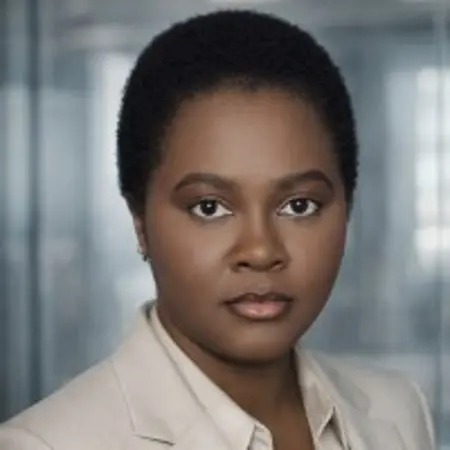
Her Story
About Bwayisak
Bwayisak Tanko is the Founder of Muna-Tare, where she specializes in helping multicultural organizations reduce cultural friction and improve team performance through intentional intercultural communication strategy. Based in Norman, Oklahoma, she works with HR and organizational leaders to diagnose communication breakdowns that often go unrecognized but significantly impact productivity, trust, and retention. Her work challenges the common assumption that diverse teams underperform because of diversity itself, instead addressing the underlying issue of unclear and misaligned communication norms across cultures.
Through Muna-Tare, Bwayisak developed the Cultural Clarity System, a practical framework designed to help organizations identify communication gaps, interpret cultural differences more accurately, and establish shared norms that strengthen collaboration. Her approach goes beyond surface-level training, focusing on building sustainable communication systems that support long-term organizational success. She partners with organizations through cultural risk assessments, global alignment programs, and strategic advisory, equipping teams to turn cultural diversity into a measurable strength rather than a source of friction.
Bwayisak’s expertise is grounded in both academic research and lived experience. She holds a Master’s degree in Communication and Media Studies from the University of Illinois Springfield, where her award-winning research and documentary, Accents and Acceptance, explored the communication experiences of international students in the United States. Combining research, storytelling, and strategic insight, she brings a nuanced and human-centered perspective to her work, helping organizations build environments where communication is intentional, inclusive, and performance-driven.
Her Interview
Ten minutes with Bwayisak
01What do you attribute your success to?
I am a person of faith, and I mostly attribute my success to God. Me being able to come from Nigeria and to experience this, and to get the meaning out of my experiences, and to choose this career path, I strongly believe that this is the path God has laid for me. My family has been vital in my story, especially my mother. She's a resilient and tenacious woman, a farmer. I watched her in seasons where she doesn't make yields and it feels like the whole world is going to crumble, and then the next year, you see her back in her boots, going to the farm. I thought you were going to quit, and she would say last year is different. As a child, I never understood that, but now as an adult, I feel like she's influenced me so much. She's never afraid to speak out, she's never afraid to go after what she wants. My husband has been very supportive too. When I started this, I mostly didn't have a direction of where I am going, and there was a time I was very broke and I needed to have this business training, and he used his money. Having a supportive partner has been a very big blessing. And my professor, especially Dr. Novak from the University of Illinois at Springfield, she has been such a tremendous blessing to me too. She saw me, she supported me all the way, and she's been the greatest mentor that I have made. These people and God are vital in my story.
02What’s the best career advice you’ve ever received?
You have not yet gotten your best idea, keep going!
03What advice would you give to young women entering your industry?
First, I'd like to let the woman understand that she is enough and her voice matters, because culture isn't just about nationality, it could also be about gender. In some places, like in some places in Nigeria where I come from, they might downplay the voice of a woman in big meetings, like board meetings, and when she's making suggestions they might say it's just a woman talking, emotions talking. But first of all, being aware of who you are, that is one. Then having humility, which is cultural humility, the ability to know that you don't understand everything and there is this gap that you would need to fill from learning across different cultures. The truth is, we don't know what we don't know until we know, and when we know it, we would never know it all. The second thing is curiosity. Curiosity is actually what helps us to bridge that gap when we are having conversations across cultures. For example, when context matters and you don't understand the meaning, curiosity would be like, okay, me being patient enough to ask, what do you mean by that? Not because I want to be defensive, but because I truly want to understand and get clarity. And the third thing is for the woman to speak when she needs to and to listen more. Not just the woman, everybody that works across cultures, because when we listen more, it tends to kind of help us fill in those gaps.
04What are the biggest challenges or opportunities in your field right now?
One of the biggest challenges in cross-cultural communication right now is that many multicultural workplaces assume they are communicating well simply because they are diverse.
They may have people from different cultures, countries, languages, and backgrounds in the same room, but they often lack a clear system for how meaning is created, shared, questioned, and understood across those differences. So the issue is not always an open conflict, It is often a silent misunderstanding.
Many organizations believe, “We’ve got this under control,” because nothing has visibly gone wrong yet. But cross-cultural communication problems often remain hidden until a crisis: a conflict between teams, high turnover, poor collaboration, exclusion, mistrust, or a major breakdown in leadership communication.
That is also the biggest opportunity in the field. Organizations can move from reacting to cultural miscommunication after damage has already happened to building systems that prevent it.
05What values are most important to you in your work and personal life?
The ability to take a break when you need one is important to me, because there's only so much we can handle, and when we allow ourselves to burn out by trying to do different things at the same time, we might not actually do as much as we need to. I believe in creating schedules for the different things I do, scheduling my time based on the different tasks so that things wouldn't crash. And of course, sometimes things come up that are urgent and you need to do them because of the timing, so the ability to also be flexible with my schedule is important. I don't believe in being rigid and saying this is how I need to do it, because then I might miss out on great things. I value not burning out, being organized with my time, and staying flexible and adaptable.
Join Influential Women and start making an impact. Register now.